The best random orbit sander can remove material quickly while leaving a smoother finish than a conventional orbital sander. The right choice depends on whether you prioritize cordless convenience, variable-speed control, low vibration, dust collection, or heavy-duty performance.
We compared 10 popular 5-inch models, including corded and battery-powered options, to help you choose a sander that matches your projects, work area, and budget.
Best 10 Random Orbit Orbital Sanders Picks for 2026
Best Cordless Pick

- Brushless motor supports runtime and efficiency
- 8,000–12,000 OPM variable-speed control
- Low-profile design with hook-and-loop pad
Best For: Cordless sanding and mobile jobsite use
Best Ergonomic Corded Pick

- 3.0-amp motor for smooth sanding
- 4,000–12,000 OPM variable-speed dial
- Rubberized palm grip and handle
Best For: Corded workshop sanding with comfort-focused handling
Best Dust-Control Kit

- Pad dampening helps reduce swirl marks
- 7,500–12,000 OPM variable-speed motor
- Microfilter and accessories included
Best For: Fine finishing and dust-conscious workshop use
Best Value

- 2.8-amp motor reaches 13,000 OPM
- Variable-speed control for different materials
- Cyclonic dust box and compact ergonomic design
Best For: DIY sanding and tight spaces
Best for Comfort

- 3-amp variable-speed motor, 8,000–12,000 OPM
- Counterweight design helps reduce vibration
- Shorter height and rubber overmold improve control
Best For: Comfortable workshop sanding
Best for Heavy Removal

- Dual-mode sanding for finishing or aggressive removal
- 6.5-amp variable-speed motor
- Multi-hole 5-inch pad and vacuum adapters included
Best For: Heavy stock removal and workshop projects
Best All-Rounder
HYCHIKA 5-Inch Variable-Speed Sander
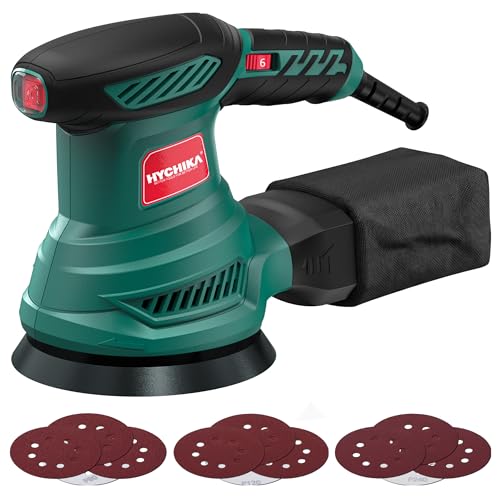
- 300W motor with six speeds and up to 13,000 RPM
- 12 included discs in three grits
- Ergonomic grip and dust bag for controlled sanding
Best For: DIYers handling varied woodworking and finishing tasks
Best Grit Variety
DEKOPRO 5-Inch Six-Speed Sander

- 2.5A motor reaches up to 14,000 RPM
- 16 discs span 60 through 1000 grit
- Balanced design and detachable dust box
Best For: Mixed wood and metal sanding from coarse to fine
Best Low-Vibration Pick
DCA ASA125 5-Inch Orbital Sander

- 3.0A motor with six speeds from 4,000 to 12,000 OPM
- Low-vibration design and 2.87-pound weight
- Dust bag and 10 included discs
Best For: Comfort-focused furniture, finishing, and paint-removal work
Best Cordless Pick – DEWALT 20V MAX Orbital Sander
DEWALT 20V MAX Orbital Sander, Tool Only (DCW210B) | Brushless motor, dust collection
Check Price On AmazonFor projects where cord-free movement matters, the DEWALT DCW210B is a practical choice among random orbit orbital sanders. Its brushless motor, variable-speed control, and low-profile design support efficient, controlled sanding, though the battery and charger are not included.
Best For: Cordless workshop and jobsite sanding where mobility is important.
Pros:
- Brushless motor is designed for runtime and efficiency.
- Variable speed from 8,000 to 12,000 OPM suits different applications.
- Low-profile body and rubber overmold grip support close, comfortable sanding.
- Hook-and-loop pad allows quick paper changes, with dust-collection options available.
Cons:
- Tool-only kit does not include a battery or charger.
- Dust collectors and the universal hose connector may require separate purchases.
The DEWALT stands out when portability and compatibility with the 20V MAX battery platform outweigh the convenience of a complete corded kit.
Best Ergonomic Corded Pick – Makita BO5041K 5-Inch Sander
The Makita BO5041K is a straightforward corded option for shoppers comparing random orbit orbital sanders. Its 3.0-amp motor, broad 4,000–12,000 OPM speed range, and rubberized palm grip make it adaptable for routine sanding tasks.
Best For: Home workshops and users who prefer consistent corded power with adjustable speed.
Pros:
- 3.0-amp motor provides smooth, fast sanding.
- Variable-speed dial covers 4,000 to 12,000 OPM.
- Rubberized palm grip and handle are designed for operator comfort.
- Includes a carrying case.
Cons:
- Corded design limits mobility compared with a battery-powered sander.
- The supplied notes do not specify included dust-collection accessories.
Choose this Makita when you want adjustable speed and an ergonomic grip in a conventional 120-volt tool, without managing batteries.
Best Dust-Control Kit – Bosch ROS20VSC Palm Sander
The Bosch ROS20VSC is a well-equipped choice among random orbit orbital sanders, especially for users focused on finish quality and dust management. Its pad-dampening system is designed to reduce swirl marks, while the variable-speed motor handles 7,500–12,000 OPM.
Best For: Fine finishing work where included dust collection and accessory coverage are priorities.
Pros:
- Pad-dampening system is designed to help eliminate swirl marks on flat and contoured surfaces.
- Variable-speed 2.5-amp motor matches speed to the task.
- Microfilter system traps particles as small as 1/2 micron, according to the supplied notes.
- Includes sanding accessories, vacuum adapter, dust canister, and carrying bag.
Cons:
- Corded 120-volt operation limits movement.
- Its 2.5-amp motor is rated below the 3.0-amp Makita models in this roundup.
The Bosch is a strong fit for finish-oriented users who want a complete accessory package and an integrated approach to collecting fine sanding dust.
Best Simple High-Speed Option – Makita BO5030K 5-Inch Sander
The Makita BO5030K keeps the random orbit orbital sanders formula simple: a 3.0-amp motor, fixed 12,000 OPM operation, and a 1/8-inch random-orbit action for fast, smooth sanding. It also includes a dust bag, abrasive disc, and plastic tool case.
Best For: Users who want fast corded sanding without a variable-speed control.
Pros:
- 3.0-amp motor delivers smooth, fast sanding.
- 1/8-inch random-orbit action is designed for fast, smooth results.
- Through-the-pad dust collection supports a cleaner work area.
- Includes a dust bag, #120 abrasive disc, and plastic case.
Cons:
- Fixed 12,000 OPM provides less speed adjustment than the BO5041K.
- Corded operation is less mobile than the DEWALT cordless model.
This Makita makes sense for repeat sanding tasks where a consistent top speed, included case, and basic dust collection are more useful than variable-speed flexibility.
Best Value – SKIL SR211601
SKIL 5” Random Orbital Sander with Cyclonic Dust Box & 3pc Sanding Sheet - SR211601, Multicolor
Check Price On AmazonThe SKIL SR211601 is a practical choice for shoppers comparing random orbit orbital sanders for general home projects. Its 2.8-amp motor, variable-speed control, compact design, and cyclonic dust box balance useful performance with everyday handling.
Best For: DIYers sanding furniture, trim, and other projects where compact handling and straightforward dust collection matter.
Pros:
- 13,000 OPM motor supports smooth sanding across a range of applications.
- Variable-speed control helps match power to different materials.
- Cyclonic, transparent dust box is easy to empty and clean.
- Counterweight balance, soft rubber grip, and compact size improve comfort and control.
Cons:
- Corded design requires access to a 120V outlet.
- Includes only three sanding sheets.
With its compact footprint and useful comfort features, this SKIL is a well-rounded option for routine sanding. It is especially appealing if you want variable speed and built-in dust collection without stepping up to a heavier professional-oriented tool.
Best for Comfort – DEWALT DWE6423
DEWALT Random Orbit Sander, Variable Speed, 5-Inch (DWE6423), Power Source Corded Electric
Check Price On AmazonThe DEWALT DWE6423 is a solid contender among random orbit orbital sanders for users who prioritize controlled handling and reduced vibration. Its 3-amp motor offers variable speeds from 8,000 to 12,000 OPM, while the counterweight and rubber overmold support more comfortable operation.
Best For: DIY and workshop users who want variable speed, close workpiece access, and flexible dust-collection options.
Pros:
- Variable-speed 3-amp motor covers 8,000 to 12,000 OPM.
- Separate counterweight design helps reduce vibration.
- Shorter height lets the user get closer to the workpiece.
- Dust port works with select DEWALT dust collectors, and a locking dust bag is included.
Cons:
- Some vacuum hose setups require the DWV9000 universal quick connector.
- Corded operation limits mobility away from an outlet.
The DWE6423 focuses on balanced control rather than maximum motor size. Its dust-sealed switch, comfortable grip, and compatibility with specific dust systems make it a sensible pick for repeated sanding sessions.
Best for Heavy Removal – BOSCH GET65-5N
The BOSCH GET65-5N stands apart from other random orbit orbital sanders with dual-mode operation. Its standard random-orbit setting handles normal removal and finishing, while the turbo-driven eccentric mode is designed for more aggressive stock removal.
Best For: Woodworkers tackling heavier removal, wood floors, furniture finishing, and projects that benefit from variable speed and two sanding modes.
Pros:
- Dual-mode design switches between standard sanding and aggressive turbo removal.
- 6.5-amp variable-speed motor provides a broad 3,300–7,300 OPM range.
- Multi-hole pad accepts a wide variety of 5-inch abrasive discs.
- Includes a front handle, sanding disc, pad wrench, and vacuum hose adapters.
Cons:
- At 5.3 pounds, it is heavier than the other listed models.
- Passive dust collection requires a vacuum cleaner and hoses.
- Compatible Bosch hoses are sold separately, aside from the included adapter.
This Bosch is the most capability-focused option in the group. The dual-mode system can reduce the need for a separate aggressive-removal tool, but its greater weight and vacuum-dependent dust collection make it better suited to workshop use than quick touch-ups.
Best All-Rounder – HYCHIKA 5-Inch Variable-Speed Sander
For shoppers comparing random orbit orbital sanders, the HYCHIKA is a versatile corded option with a 300W motor, six speed settings, and a top speed of 13,000 RPM. Its 5-inch hook-and-loop pad, included abrasives, and dust bag make it ready for general woodworking, finishing, polishing, and paint preparation.
Best For: DIYers who want broad speed control, a comfortable one-hand design, and a useful starter kit.
Pros:
- Six speeds and up to 13,000 RPM support varied sanding and polishing tasks.
- Includes 12 discs in 80, 120, and 240 grits.
- Ergonomic rubber grip and upgraded dust bag help with control and cleanup.
Cons:
- Corded design requires access to a 120V outlet.
- Included grit selection is less extensive than some competing kits.
The HYCHIKA stands out as a balanced choice for routine workshop and home projects, especially when adjustable speed and a comfortable grip matter more than cordless convenience.
Best Grit Variety – DEKOPRO 5-Inch Six-Speed Sander
The DEKOPRO is a practical pick among random orbit orbital sanders when you want one tool for coarse removal through fine finishing. Its 2.5A motor reaches up to 14,000 RPM, while six speeds and 16 included sanding discs cover wood and metal work across a wide range of grits.
Best For: Users who value a broad selection of included abrasives and adjustable speed for mixed projects.
Pros:
- Six variable speeds and a maximum speed of up to 14,000 RPM.
- Includes 16 discs ranging from 60 to 1000 grit.
- Balanced counterweight, rubber grip, and detachable dust box support longer work sessions.
Cons:
- Corded operation limits mobility away from an outlet.
- The supplied specifications list 220 volts, so users should verify electrical compatibility before purchase.
With the widest stated grit range in this group, the DEKOPRO is well suited to buyers who want to start with fewer additional sanding-disc purchases.
Best Low-Vibration Pick – DCA ASA125 5-Inch Orbital Sander
For buyers prioritizing comfortable handling, the DCA ASA125 is one of the more appealing random orbit orbital sanders in this lineup. Its 3.0A motor offers six speeds from 4,000 to 12,000 OPM, while the low-vibration design, rubberized grip, and 2.87-pound weight support steady one-handed sanding.
Best For: Woodworkers and beginners who want controlled, lower-vibration sanding for furniture, paint removal, and finishing.
Pros:
- 3.0A, 300W motor with six speeds from 4,000 to 12,000 OPM.
- Low-vibration design and ergonomic grip help reduce hand fatigue.
- Includes a sealed dust bag and 10 discs from 80 to 320 grit.
Cons:
- Walls and ceilings are not recommended applications.
- Its 12,000 OPM maximum is lower than the rated maximums of the other two options.
The DCA focuses on smooth, manageable operation rather than the highest speed, making it a sensible choice for users who expect longer sanding sessions and want reduced vibration.
How We Picked These Random Orbit Orbital Sanders
We focused on practical features that affect sanding performance and user comfort: power source, motor output, variable-speed control, dust management, grip design, vibration control, included accessories, and overall versatility. The list includes compact palm sanders for occasional DIY work, dependable corded tools for longer sessions, and cordless options for portability.
Because performance can vary with the abrasive disc, material, and technique, we treated specifications as a starting point rather than the only measure of quality. A well-designed sander should run smoothly, maintain consistent pad motion, connect reasonably well to dust extraction, and make it easy to change discs.
Quick Comparison
| Best For | What to Look For |
|---|---|
| Maximum portability | 20V cordless design and a compatible battery system |
| Long sanding sessions | Reliable corded power, low vibration, and comfortable grip |
| Controlled finish work | Variable-speed settings and a smooth-running motor |
| Fast material removal | Higher power, efficient dust collection, and dual-mode capability |
| Occasional DIY projects | Affordable price, included abrasives, and simple controls |
Key Buying Factors for Random Orbit Orbital Sanders
Power Source
Corded sanders provide continuous power and are often the better value for workshops or lengthy refinishing jobs. Cordless models eliminate the power cord and are easier to use outdoors or in unfinished spaces, but battery runtime, charging time, and the cost of batteries should be part of the calculation.
Speed and Sanding Action
Variable speed helps you work more carefully on delicate finishes and increase aggression when leveling wood. A 5-inch pad is the most common size for general woodworking. Dual-mode models can offer a more aggressive setting for stock removal alongside a standard random-orbit action for finishing.
Dust Collection and Comfort
Dust ports, collection boxes, and bags can reduce airborne debris, although no onboard system captures everything. Check whether the port fits your shop vacuum or requires an adapter. Low vibration, a balanced body, and a comfortable palm or top grip matter just as much as speed during extended use.
Included Accessories
Sandpaper, storage cases, dust containers, and batteries can change the real value of a tool. Confirm the abrasive size and hook-and-loop compatibility before buying, especially if you already have preferred discs or a dust-extraction setup.
Who Should Buy Which Random Orbit Orbital Sanders?
Choose the DEWALT 20V MAX model if you already use DEWALT batteries and want cordless mobility. For a dependable workshop tool, the Makita and corded DEWALT models are sensible choices. The BOSCH ROS20VSC and similar variable-speed sanders suit finish work and general home projects, while the BOSCH GET65-5N is better for users who need more aggressive removal.
Budget-focused DIY users may prefer the SKIL, HYCHIKA, DEKOPRO, or DCA options when included accessories and a lower upfront cost matter most. Whichever model you choose, use the correct grit sequence, keep the pad moving, wear eye and respiratory protection, and connect dust extraction whenever practical.