Hot RV interiors can become uncomfortable quickly, especially when you are parked without reliable shore power. Evaporative coolers offer a lower-energy way to improve comfort by combining airflow with water-based cooling.
Our 2026 roundup compares 10 portable models across tank capacity, airflow, controls, portability, and practical RV usability. Use the guide below to choose the right balance of cooling performance, size, and operating convenience for your camper.
Best 10 Evaporative Coolers for Rvs Picks for 2026
Best Battery-Ready Pick
Hessaire DC18 Mobile Evaporative Cooler

- 900 CFM airflow for areas up to 300 sq. ft.
- Runs on compatible 18V/20V batteries or AC power.
- 2.8-gallon reservoir; battery sold separately.
Best For: RV users with compatible tool batteries
Best Mid-Size Convenience Pick
SereneLife 1800 CFM Evaporative Cooler

- 1800 CFM airflow with four included ice packs.
- Detachable 4-liter tank with shortage protection.
- Remote control, touch panel, and 1–7 hour timer.
Best For: RV owners wanting convenient room cooling
Best Personal-Space Pick
Evapolar EvaChill Portable Cooler

- Low 7.5W power draw with USB operation.
- Quiet 25 dB design with four fan speeds.
- Cools a personal 3–5-foot area, not a whole room.
Best For: Solo travelers and desk or tent cooling
Best High-Capacity Pick
SereneLife 2500 CFM Wi-Fi Cooler

- 2500 CFM airflow with 360-degree oscillation.
- Large 30-liter tank and two included ice packs.
- Wi-Fi, remote, and touch controls with caster wheels.
Best For: Larger RV interiors and covered outdoor areas
Best for Easy Setup
VEVOR 12.7-Gallon Evaporative Cooler

- 4,129 CFM airflow with wide-angle oscillation
- 12.7-gallon tank supports extended operation
- Includes ice boxes, remote, timer, and hose-fill option
Best For: RV patios, campsites, and larger dry spaces
Compact RV Pick

- Lightweight design with 360-degree casters
- Four modes and three fan speeds
- 2-gallon tank rated for up to 10–12 hours
Best For: Personal cooling in small RV rooms and spaces
Balanced Cooling Pick
35-Inch 3-in-1 Evaporative Cooler
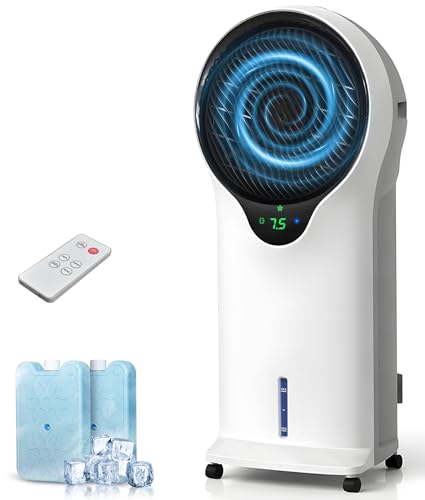
- 29 ft/s airflow with 360-degree direction adjustment
- 5.5-liter tank and 7.5-hour timer
- Low-water protection and removable cooling components
Best For: Medium-size RV living areas and dry indoor spaces
Best Compact Pick

- Three speeds and two mist outlets
- 900ml tank runs about 6–8 hours
- Low 8-watt power use with timer
Best For: Personal cooling in a small RV area or at a desk
Best Long-Run Pick
3-Gallon Remote-Controlled Swamp Cooler

- 3-gallon tank supports up to 10–12 hours
- Six speeds and three operating modes
- Remote control and 360-degree casters
Best For: Extended cooling in an RV living area or room
Best Coverage Pick
5L High-Airflow Evaporative Cooler

- 5L tank and ice boxes support up to 10 hours
- 12 speeds with four cooling modes
- Wide oscillation and remote control
Best For: Larger RV rooms or spaces needing stronger airflow
Best Battery-Ready Pick – Hessaire DC18 Mobile Evaporative Cooler
For shoppers comparing evaporative coolers for RVs, the Hessaire DC18 is a practical option when battery flexibility matters. It delivers up to 900 CFM of airflow, uses either an 18V or 20V tool battery platform or the included 115V AC adapter, and has a 2.8-gallon reservoir. Note that it is not an air conditioner.
Best For: RV users who already own compatible 18V or 20V tool batteries and want a freestanding cooler for spaces up to 300 square feet.
Pros:
- Works with major 18V and 20V tool battery platforms.
- Includes a 115V AC adapter for wired operation.
- Provides adjustable speed and up to 900 CFM airflow.
- 2.8-gallon reservoir supports extended use between refills.
Cons:
- Battery is not included.
- It reduces heat stress but is not an air conditioner.
- At 42 pounds, it is heavier than the personal-sized options here.
The DC18 stands out for RVers who value off-grid power compatibility. Its substantial reservoir and 900 CFM output are useful for larger areas, while the AC adapter keeps it practical at a powered campsite.
Best Mid-Size Convenience Pick – SereneLife 1800 CFM Evaporative Cooler
Among evaporative coolers for RVs, this SereneLife model balances strong airflow with easy controls and a compact, mobile design. It produces up to 1800 CFM, includes four ice packs, and has a detachable 4-liter tank with water-shortage protection.
Best For: RV owners who want remote control, timer settings, and ice-assisted cooling for indoor rooms or covered outdoor areas.
Pros:
- Up to 1800 CFM airflow for spaces listed up to 700 square feet.
- Four included ice packs can boost cooling performance.
- Remote and touch-panel controls include a 1–7 hour timer.
- Detachable tank includes a water-shortage alarm and pump protection.
Cons:
- Quiet operation is rated at up to 65 dB.
- Its 4-liter tank is smaller than the larger SereneLife model.
- Evaporative cooling is most suitable where added humidity is acceptable.
This is a versatile choice for RV use when portability and straightforward operation are priorities. The detachable tank and included ice packs simplify setup, while the remote adds convenience when the cooler is positioned across the room.
Best Personal-Space Pick – Evapolar EvaChill Portable Cooler
The Evapolar EvaChill is a compact choice for shoppers seeking evaporative coolers for RVs, tents, cars, or desks. Rather than cooling an entire room, it directs a personal breeze over a range of about 3–5 feet and can run from USB power sources such as a power bank, laptop, or suitable car outlet.
Best For: Solo RV travelers who need quiet, low-power personal cooling at a desk, bed, tent, or seat.
Pros:
- Uses only 7.5W and supports 5V USB power.
- Compact 800 ml reservoir and 750 g weight make it easy to move.
- Four fan speeds and one-button control keep operation simple.
- Rated at 25 dB for quiet personal use.
Cons:
- Designed to cool a person, not an entire room.
- Most effective at relative humidity of 70% or less.
- Small reservoir requires more frequent refilling than larger units.
EvaChill makes the most sense when conserving power and space is more important than whole-RV coverage. Its USB operation and low noise suit boondocking, nighttime use, and focused cooling in dry climates.
Best High-Capacity Pick – SereneLife 2500 CFM Wi-Fi Cooler
For larger RV interiors or covered outdoor areas, this SereneLife unit offers the strongest airflow and largest reservoir in this group. It provides 2500 CFM, a 30-liter tank, 360-degree oscillation, Wi-Fi control, and fan, cooler, and humidifier modes without requiring window venting.
Best For: RV owners who need high airflow, long tank capacity, and app or remote control for larger spaces.
Pros:
- 2500 CFM airflow with 360-degree oscillation.
- Large 30-liter tank supports longer operation between refills.
- Wi-Fi, touch, and remote controls provide flexible operation.
- Includes two ice packs, caster wheels, and built-in handles.
Cons:
- Its 34.24-inch height and 20.7-pound weight require more storage space.
- Listed noise varies by the supplied specifications, with operation noted up to 65 dB.
- Like other evaporative coolers, it is not a conventional compressor air conditioner.
This model is the most capable pick when tank size and airflow take priority. The wheels, oscillation, and multiple controls make it easier to position and manage, although its larger footprint may be less suitable for tightly packed RV interiors.
Best for Easy Setup – VEVOR 12.7-Gallon Evaporative Cooler
The VEVOR evaporative cooler is a high-capacity option for RV owners who need extended cooling in dry outdoor or open indoor spaces. Its 4,129 CFM airflow, wide-angle oscillation, four ice boxes, and hose-compatible water tank make it suited to larger areas, though its 35.7-pound size is better for semi-permanent placement than frequent repositioning.
Best For: RV patios, campsites, workshops, and other dry environments where long runtime and strong airflow matter.
Pros:
- Large 12.7-gallon tank supports extended cooling and can be refilled from the top or through a compatible 0.98-inch garden hose.
- High 4,129 CFM airflow combines with 60-degree horizontal and 120-degree vertical oscillation for broad coverage.
- Includes four ice boxes, a remote, 12-hour timer, visible water level, casters, and a silver ion filtration system.
- Pure copper motor operates within a stated 65 dB noise range.
Cons:
- Its 46.46-inch height and 35.7-pound weight may be cumbersome in a compact RV.
- Evaporative cooling is intended for environments below 60% humidity, so performance can vary in humid weather.
- The 175-watt unit is more substantial than a personal-size cooler.
Choose this model when tank capacity and airflow are more important than compact storage. For smaller RV interiors, its footprint may be excessive, but it offers useful flexibility for outdoor living areas and larger open spaces.
Compact RV Pick – 2-Gallon 4-in-1 Swamp Cooler
This compact 4-in-1 evaporative cooler is a practical choice for RV owners who want personal cooling without installation, an exhaust hose, or a large footprint. It offers three fan speeds, four operating modes, remote control, and a 2-gallon tank rated for up to 10–12 hours of operation.
Best For: Personal cooling in RV bedrooms, small living areas, offices, and other spaces up to the stated 150 square feet.
Pros:
- Compact 12.6-pound design with 360-degree casters is easy to move between rooms.
- Combines fan, humidifying, air circulation, and cooling functions with Normal, Natural, Sleep, and Cool modes.
- 2-gallon bottom tank includes a water-level window and supports up to 10–12 hours of continuous operation.
- Uses 65 watts and has a stated 45 dB noise level for quieter everyday use.
Cons:
- The stated coverage is limited to 150 square feet, so it is aimed at personal rather than whole-RV cooling.
- Its 15–20 ft/s airflow specification is less substantial than larger high-capacity models.
- The supplied warranty description is six months.
For small RV interiors, this model balances portability, low power use, and simple controls. Its modest coverage makes it less suitable for cooling a large open floor plan, but it should be easier to store and position than taller units.
Balanced Cooling Pick – 35-Inch 3-in-1 Evaporative Cooler
The 35-inch 3-in-1 evaporative cooler offers a middle ground for RV owners who want more airflow than a personal unit without moving up to a large commercial-style cooler. It provides 29 ft/s airflow, three modes, a 5.5-liter tank, remote control, and a timer adjustable in half-hour increments.
Best For: RV living rooms, home offices, and open indoor areas up to the stated 300 square feet in hot, dry conditions.
Pros:
- 29 ft/s airflow and 360-degree adjustable direction help distribute air across a wider area.
- Three speeds and Normal, Natural, and Sleep modes allow flexible comfort settings.
- Low-water protection alerts when the tank is low and switches to fan-only mode.
- Removable tank and cooling pad simplify cleaning, while casters and a built-in handle improve portability.
Cons:
- The 5.5-liter tank is considerably smaller than the high-capacity model, so refills may be more frequent.
- At 35 inches tall and 15.7 pounds, it may require dedicated storage in a compact RV.
- Evaporative cooling is most appropriate for hot, dry conditions rather than humid environments.
This unit is a sensible compromise when you need broader airflow and useful safety features but still want a portable form factor. Its 110-watt power draw and 7.5-hour timer add convenience for routine RV use.
Best Compact Pick – Personal 3-in-1 Mist Cooler
For shoppers comparing evaporative coolers for RVs, this compact USB-powered model is suited to close-range cooling at a desk, bedside, or in a small RV area. It combines fan airflow, misting, and humidifying in a lightweight personal unit.
Best For: Personal cooling in an RV, bedroom, office, or other small space.
Pros:
- Three fan speeds and two spray outlets provide adjustable airflow and mist.
- The 900ml visible tank supports approximately 6–8 hours of cooling with water and ice.
- Uses just 8 watts and operates at a stated 50dB.
- Includes a seven-color light and two- or four-hour timer.
Cons:
- The compact reservoir and personal form factor are not intended for cooling a large RV interior.
- It uses a 5-volt connection, so users should plan for a compatible power source.
This is a practical choice when portability and low power use matter more than whole-room coverage. Its small tank and personal airflow make it especially convenient for a bunk, desk, or seating area.
Best Long-Run Pick – 3-Gallon Remote-Controlled Swamp Cooler
If you need evaporative coolers for RVs with longer operation between refills, this freestanding model offers a 3-gallon tank, six speeds, and three operating modes. Its casters also make it easier to reposition around a larger indoor space.
Best For: RV users who want extended runtime and flexible cooling for a room or larger living area.
Pros:
- The 3-gallon bottom tank supports up to 10–12 hours of continuous use.
- Six speeds and Normal, Sleep, and Cool modes allow flexible adjustment.
- Remote and touch controls simplify operation from across the room.
- 360-degree casters enable movement without window installation or an exhaust hose.
Cons:
- At 26.8 inches tall and 45 watts, it requires more floor space and power than a personal cooler.
- Its stated coverage is up to 150 square feet, so it may not cool an entire large RV evenly.
The large reservoir is the main advantage for RV use, reducing refill frequency during extended daytime operation. Confirm that the available floor space and 110-volt power supply fit your setup.
Best Coverage Pick – 5L High-Airflow Evaporative Cooler
For RV shoppers prioritizing airflow and broad directional coverage, this evaporative cooler combines a 5L tank, 12 fan speeds, oscillation, and multiple cooling modes. It can operate as a fan, mist cooler, or ice-assisted cooler without requiring an exhaust hose.
Best For: Larger RV rooms, garages, bedrooms, or work areas where stronger airflow and longer runtime are useful.
Pros:
- The 5L dual tank and included ice boxes support up to 10 hours of cooling.
- Twelve speeds, four modes, and remote or top-touch controls offer extensive adjustment.
- Provides manually adjustable 120-degree vertical airflow and automatic 70-degree horizontal rotation.
- Operates at a stated 36dB and includes Sleep Mode plus a one- to nine-hour timer.
Cons:
- The 110-volt design requires a suitable RV power connection.
- Its larger airflow and rolling form factor may be more than needed for a single sleeping or seating spot.
- Evaporative cooling performance depends on using water or ice and appropriate ambient conditions.
This model stands out when you want more directional control and capacity than a personal cooler. The washable filter cover, top-fill tank, and casters also support regular RV use and maintenance.
How We Picked the Best Evaporative Coolers for Rvs
We evaluated these Evaporative Coolers for Rvs based on the features that matter most in a compact mobile living space: airflow, water-tank capacity, portability, controls, timer functions, noise considerations, and expected power demands. We also considered whether a unit is better suited to personal cooling, a small sleeping area, or a larger RV interior.
Because evaporative cooling adds moisture to the air, we favored products that make sense for dry climates and well-ventilated spaces. None should be treated as a direct replacement for a compressor-based air conditioner in humid weather.
Quick Comparison
- Best for higher airflow: Larger Hessaire and SereneLife models are better suited to moving air through more spacious RV interiors.
- Best for compact spaces: Evapolar and smaller personal coolers take up less room on a nightstand, counter, or desk.
- Best for extended operation: Models with larger tanks reduce refilling, though they are usually heavier and less convenient to move.
- Best for flexible control: Units with remotes, timers, multiple speeds, and operating modes are easier to adjust from a bed or dinette.
Key Buying Factors for Evaporative Coolers for Rvs
Airflow and Coverage
Check the advertised airflow, often listed in CFM, but treat coverage claims as approximate. A high-CFM model can circulate air more effectively, while a compact cooler may be better for directing a gentle stream at one person.
Tank Size and Ice Compatibility
Small tanks save space but require more frequent refills. Larger tanks are useful overnight or during long stops. Ice packs or ice compartments may provide a temporary cooling boost, but they do not turn an evaporative cooler into a true air conditioner.
Size, Weight, and Power
Measure the available floor or countertop space before buying. Look for a handle, manageable weight, and controls that are easy to reach. Confirm the required voltage and wattage if you plan to run the cooler from an inverter, battery station, or campground hookup.
Humidity and Ventilation
Evaporative coolers perform best in dry climates. Keep a window, roof vent, or door cracked when practical so humid air can escape. In damp regions, a fan or portable compressor air conditioner may deliver better results.
Who Should Buy Which Evaporative Coolers for Rvs?
Choose a compact personal model if you mainly need cooling beside the bed or at a workstation. Pick a mid-size unit with a remote and timer for a sleeping area or small RV lounge. Choose a larger, high-airflow cooler when you want broader circulation and have enough room for its larger footprint and water tank.
For dry-climate campers seeking lower energy use and simple setup, an evaporative cooler can be a practical supplement to roof ventilation and shade. For humid climates, sealed RVs, or whole-cabin cooling, prioritize a properly sized air conditioner instead.