The right power inverter for camping can keep phones, lights, laptops, coolers, and essential appliances running when outlets are out of reach. The best choice depends on your load, battery setup, and whether you need clean power for sensitive electronics.
This roundup covers compact vehicle inverters, portable battery-powered options, and higher-capacity models for RVs and off-grid setups. Use the buying guide below to match output, waveform, safety features, and installation requirements to your trip.
Best 10 Power Inverter for Camping Picks for 2026
Quiet Generator Pick

- 2,200W inverter generator for camping, RVs, and backup
- Quiet 48–57 dB(A) operation with CO-MINDER
- Up to 8.1 hours of runtime; Bluetooth monitoring
Best For: Quiet, appliance-capable campsite and RV power
Smart Battery Inverter

- 2,000W pure sine wave output; 4,000W surge
- UPS transfer switch for grid and battery power
- Bluetooth app monitoring plus wired remote control
Best For: 12V RV and camping battery systems
Heavy-Duty RV Choice

- 3,000W pure sine wave output with 6,000W peak
- Three AC outlets, terminal, USB, and 30W PD charging
- 15-ft remote display, cables, and multiple protections
Best For: High-demand RV and off-grid battery power
Compact Vehicle Pick
BESTEK 300W Car Power Inverter

- 300W continuous, 700W peak output
- Two AC outlets and two fast USB ports
- Compact design with multi-protection
Best For: Vehicle-based camping and road-trip charging
Clean-Power Pick
EGO POWER+ 400W Portable Inverter

- 400W continuous, 800W peak output
- Pure sine wave power for sensitive electronics
- Works with EGO 56V batteries
Best For: EGO users needing quiet portable campsite power
High-Output Pick
Cantonape 3000W 12V Power Inverter

- 3000W continuous, 6000W surge power
- Four AC outlets and four USB ports
- LCD monitoring and remote control included
Best For: RV and battery-based high-demand outdoor setups
Compact Camping Power

- 500W continuous, 1,000W peak output
- Two AC outlets plus USB charging
- Lighter adapter and battery-clamp connection
Best For: Small electronics, campsite lights, laptops, and road trips
Heavy-Duty RV Power
3000W Modified Sine Wave Inverter
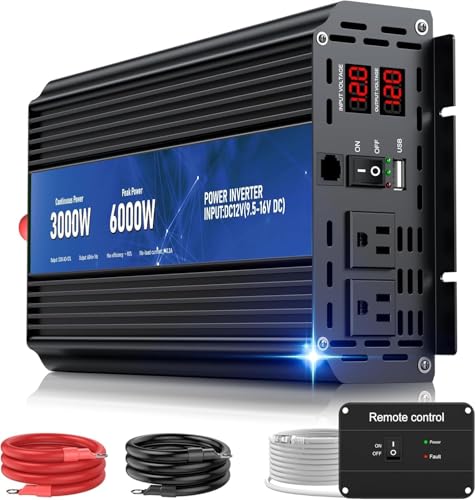
- 3,000W continuous, 6,000W peak output
- LCD monitoring and 14.8-foot remote
- Cooling fans and low-battery protection
Best For: RVs, trucks, off-grid setups, and higher-demand camping loads
Fast-Charging Travel Power

- 400W continuous, 800W peak output
- Dual 3.1A USB ports and two AC sockets
- Compact 14.08-ounce vehicle design
Best For: Road trips and camping with phones, tablets, cameras, and laptops
Quiet Generator Pick – Honda EU2200i
The Honda EU2200i is a strong alternative to a conventional power inverter for camping when you need generator-level output for appliances, RV equipment, or home backup. Its inverter technology, quiet operation, and portable design make it practical for campsites where noise matters.
Best For: Campers and RV users who need reliable 120V power for appliances, electronics, or supplemental backup.
Pros:
- Produces 2,200 watts and can handle items such as microwaves, refrigerators, hair dryers, and small AC units.
- Operates at approximately 48–57 dB(A), helping limit campsite noise.
- Offers Bluetooth monitoring through Honda’s My Generator app and includes CO-MINDER automatic shutdown.
- Runs up to 8.1 hours on a 0.95-gallon tank and includes a three-year residential warranty.
Cons:
- Uses gasoline rather than a battery-based power source.
- At just over 47 pounds, it is portable but not especially lightweight for carrying long distances.
- Not available in California according to the supplied product notes.
Choose this model when quiet, dependable generator power is more important than the simplicity of a small 12V inverter. It is particularly well suited to longer camping trips, RV use, and emergency backup.
Smart Battery Inverter – Renogy 2000W PUH
The Renogy PUH is a practical power inverter for camping when your setup uses a 12V battery bank rather than gasoline. It delivers pure sine wave AC power, includes an UPS transfer switch, and adds Bluetooth monitoring for easier off-grid and RV power management.
Best For: RVs, trucks, vans, and campers using 12V batteries who want clean AC power and remote monitoring.
Pros:
- Provides 2,000 watts of pure sine wave output with 4,000 watts of surge capacity.
- UPS transfer switching helps move between grid AC and off-grid DC power.
- Built-in Bluetooth, Renogy App support, and a wired remote switch simplify monitoring and control.
- Includes low/high voltage, low/high current, and short-circuit protection.
Cons:
- Requires a suitable 12V battery source; it is not a standalone generator.
- The one-year manufacturer warranty is shorter than some competing options.
- Its 11.9-pound inverter still requires battery cables and a properly sized battery system.
This is a good fit for a permanent or semi-permanent camping power system. Its pure sine wave output and UPS functionality are useful when you need smooth power and minimal interruption between sources.
Compact Travel Power Pick – POWERFUEL 1200W
The POWERFUEL 1200W is a convenient power inverter for camping, road trips, and outdoor work when you want several charging ports from a vehicle or 12V battery. Its three AC outlets, USB connections, LCD display, and automatic cooling make it suited to everyday travel power needs.
Best For: Car, truck, RV, and boat users charging several small devices or running lights, routers, and fans.
Pros:
- Offers three AC outlets, three USB ports, and one Type-C port.
- LCD screen shows input voltage, output voltage, and battery level.
- Temperature-controlled cooling fan is designed to stay quiet during normal use.
- Includes protection against overvoltage, undervoltage, overload, overheating, short circuits, and reverse polarity.
Cons:
- The supplied notes specify 1,200 watts of peak output but do not provide a continuous wattage rating.
- It is intended for 12V systems and cannot replace a higher-capacity inverter for demanding appliances.
- Vehicle or deep-cycle battery runtime will vary with the connected load.
For light-duty camping and travel, this model emphasizes connectivity and simple status monitoring. Verify the continuous power requirement of each appliance before relying on it for heavier loads.
Heavy-Duty RV Choice – LANDERPOW 3000W
The LANDERPOW 3000W is a heavy-duty power inverter for camping and RV use when a 12V battery system needs substantial AC capacity. Its pure sine wave output, 6,000-watt peak rating, multiple outlets, remote display, and included battery cables support demanding campsite, job-site, and emergency loads.
Best For: RV owners and off-grid users powering high-draw appliances, tools, medical equipment, or several electronics from a 12V battery bank.
Pros:
- Delivers 3,000 watts continuously and up to 6,000 watts of peak power.
- Pure sine wave output is designed for sensitive electronics and inductive loads.
- Provides three AC outlets, a hardwired terminal, USB charging, and a 30W PD port.
- Includes 1 AWG battery cables, a 15-foot wired remote, multiple protections, and three years of total coverage.
Cons:
- Requires a capable 12V battery system and substantial installation wiring.
- Its high output can place significant demands on battery capacity and runtime.
- More power and hardware make it less convenient for lightweight, casual camping.
This inverter is best considered for an installed RV or serious off-grid setup rather than a small portable kit. The pure sine wave design and remote monitoring add useful control when powering larger or more sensitive loads.
Compact Vehicle Pick – BESTEK 300W Car Power Inverter
If you need a practical power inverter for camping, road trips, or vehicle-based charging, the BESTEK 300W model offers a compact setup with two AC outlets and two USB ports. Its 11–17V compatibility also suits a range of vehicles, including compatible Tesla models.
Best For: Campers who want lightweight, vehicle-powered charging for laptops, tablets, phones, cameras, and other modest loads.
Pros:
- Provides 300W continuous power and 700W peak power.
- Includes two AC outlets and two 4.8A USB ports.
- Compact, iPhone-sized aluminum housing with a 32-inch vehicle plug cable.
- Built-in protection against overheating, voltage issues, short circuits, and overloads.
Cons:
- Uses a modified sine wave output, which may not suit every sensitive device.
- Designed for vehicle outlets rather than high-demand off-grid battery systems.
- The listed notes contain differing warranty durations, so verify coverage before purchase.
With its small footprint, multiple charging ports, and vehicle-friendly design, this BESTEK inverter is a convenient choice for low-to-moderate camping power needs. It is less appropriate for running high-wattage appliances.
Clean-Power Pick – EGO POWER+ 400W Portable Inverter
The EGO POWER+ PAD5000 is a portable power inverter for camping that pairs with EGO 56V ARC Lithium batteries. It delivers pure sine wave power, making it a useful option for sensitive electronics when portability and quiet operation matter.
Best For: EGO battery owners who want clean, portable power for electronics, USB devices, lighting, and short-duration campsite use.
Pros:
- Produces 400W continuous power and 800W peak power.
- Pure sine wave output is suitable for sensitive electronics.
- Offers a 120V outlet, USB-C, USB-C PD, and USB-A charging.
- Includes pass-through charging and built-in LED lights.
Cons:
- Battery and charger are not included.
- Compatible only with EGO 56V ARC Lithium batteries.
- Provides one conventional AC outlet.
This inverter is especially appealing if you already use the EGO battery platform. Its pure sine wave output and USB-C PD port add versatility, while the separate battery requirement increases the initial setup cost.
High-Output Pick – Cantonape 3000W 12V Power Inverter
For demanding campsite, RV, truck, or emergency setups, this 3000W power inverter for camping converts 12V battery power to 110V/120V AC. It includes multiple outlets, an LCD display, and a remote control for monitoring and convenient operation.
Best For: RV and outdoor users with a suitable 12V battery system who need to power several devices or higher-wattage loads.
Pros:
- Delivers 3000W continuous power and 6000W surge power.
- Includes four AC outlets and four USB ports.
- LCD shows input/output voltage, battery, load, and frequency information.
- Provides remote on/off control and six protection functions.
Cons:
- Modified sine wave output may be unsuitable for some sensitive electronics.
- Requires a 12V battery system and appropriate battery cables; the remote needs a 12V 23A battery.
- Larger and heavier than compact vehicle-plug inverters.
This Cantonape model offers substantially more capacity than entry-level camping inverters and is better suited to a properly sized battery installation. Its LCD and protection features help with monitoring, but its modified sine wave output warrants checking appliance compatibility.
Compact Camping Power – 500W Vehicle Inverter
This 500W power inverter for camping offers a practical balance of output and portability. It provides 500W continuously, with 1,000W peak power, two AC outlets, and a USB port for phones, laptops, lights, tablets, and similar gear. Use the cigarette-lighter adapter for loads under 150W, or connect the included battery clamps directly to a 12V battery for the full rated output.
Best For: Campers and road trippers who need compact power for small electronics, lighting, laptops, and charging devices.
Pros:
- 500W continuous and 1,000W peak output supports a range of camping electronics.
- Includes two AC outlets, a 5V USB port, a lighter adapter, and battery clamps.
- Compact 6.7-by-3.5-by-2-inch design fits easily in a glove box or travel bag.
- Built-in protection helps guard against overloads, short circuits, voltage problems, overheating, and reverse connection.
Cons:
- The cigarette-lighter connection is intended for loads under 150W.
- Reaching the full 500W output requires a direct connection to a 12V battery.
Choose this model when portability and flexible connection options matter more than high-wattage appliance support. Its compact format makes it a convenient companion for basic campsite and vehicle power needs.
Heavy-Duty RV Power – 3000W Modified Sine Wave Inverter
For demanding off-grid setups, this 3000W power inverter for camping converts 12V battery power into 110/120V AC and reaches 6,000W peak output. It is designed for RVs, trucks, trailers, emergency backup, and camping, with two AC outlets, a USB port, an LCD display, and a wired remote control.
Best For: RV owners, truck users, and campers running multiple devices or higher-demand equipment from a 12V battery system.
Pros:
- 3,000W continuous and 6,000W peak capacity can support TVs, fans, small appliances, laptops, and power tools.
- LCD display shows input and output voltage, battery level, and protection status.
- Includes a 14.8-foot wired remote for convenient operation in RVs, trailers, and trucks.
- UL/CSA certification, low-battery protection, aluminum housing, and automatic cooling fans add practical safeguards.
Cons:
- At 6.9 pounds, it is less portable than compact vehicle inverters.
- Its modified sine wave output may not suit every sensitive electronic device.
- It requires direct connection to a compatible 12V battery system rather than a typical lighter socket.
This is the capacity-focused option in the group. Its monitoring features and remote operation are especially useful for permanent or semi-permanent RV and off-grid installations, while the large output rating demands appropriate battery cables and system planning.
Fast-Charging Travel Power – Pro Chaser 400W Inverter
This 400W power inverter for camping is a lightweight vehicle option for charging and powering everyday travel electronics. It converts 12V DC to 110V AC, delivers 400W continuously with 800W peak power, and combines two AC sockets with dual 3.1A USB ports in a cellphone-sized housing.
Best For: Road trips, family travel, and campers who mainly need compact power for phones, tablets, cameras, laptops, and similar devices.
Pros:
- Dual USB ports provide a combined 4.8A charging output for compatible devices.
- Two AC sockets support devices such as laptops, DVD players, bottle warmers, and breast pumps.
- Compact 4.8-by-3.07-by-1.81-inch design weighs only 14.08 ounces.
- Includes a 30-inch cord, overheating protection, and a cooling fan that activates at 113°F.
Cons:
- The 400W continuous rating is intended for lighter-duty electronics rather than large appliances.
- It uses modified sine wave output.
- It should be used in a cool, dry environment.
The Pro Chaser is a strong fit when low weight and convenient USB charging are priorities. It is easy to carry between vehicles and campsites, but users should keep connected equipment within its 400W continuous limit.
How We Picked the Best Power Inverter for Camping
We compared these models by usable AC output, peak or surge capacity, waveform, connection method, portability, and intended camping application. We also considered practical features such as USB charging, AC outlet count, display information, Bluetooth monitoring, transfer switches, cooling, and built-in protection.
Because a compact car inverter and a permanently installed RV inverter serve different purposes, the list includes several power classes. Always verify the manufacturer’s continuous-wattage rating, cable requirements, and battery recommendations before connecting a load.
Quick Comparison
| Power class | Best for | Typical connection | Main advantage |
|---|---|---|---|
| 300–500W | Phones, tablets, small electronics | 12V vehicle socket or clamps | Portable and affordable |
| 1,200W | Several small devices and light-duty tools | Vehicle battery or heavy-duty outlet | More headroom than compact adapters |
| 2,000–2,200W | Camping appliances and RV electronics | Battery bank or generator | Strong all-around capacity |
| 3,000W | RV systems and demanding loads | Dedicated 12V battery bank | High continuous and surge capability |
Key Buying Factors for a Power Inverter for Camping
Continuous and Surge Wattage
Choose continuous output based on the devices you will run simultaneously. Motors, compressors, pumps, and heating appliances can require substantially more power when starting, so check surge capacity as well. A 3,000W inverter is not automatically suitable for every 3,000W appliance; battery, wiring, and ventilation must also support the load.
Pure Sine Wave or Modified Sine Wave
Pure sine wave output is the safer choice for laptops, medical equipment, audio gear, variable-speed motors, and other sensitive electronics. Basic modified-sine models can work well for simple chargers, lights, and some resistive loads, but compatibility varies.
Battery, Wiring, and Runtime
An inverter does not create energy; it converts DC power from a battery or vehicle electrical system. Higher wattage quickly increases battery drain. Use appropriately sized cables, short connections, proper fusing, and a battery bank with enough amp-hour capacity. Do not expect a 12V vehicle accessory socket to safely deliver the full rating of a large inverter.
Convenience and Safety Features
USB-C, multiple AC outlets, an LCD, Bluetooth monitoring, low-voltage shutdown, overload protection, thermal protection, and a transfer switch can make field use easier and safer. For quiet campsites, compare fan behavior and consider a battery-powered inverter rather than a fuel generator.
Who Should Buy Which Power Inverter for Camping?
- Day campers and travelers: Choose a 300W–500W vehicle inverter for phones, cameras, tablets, and small electronics.
- Users with several moderate loads: A 1,200W model provides useful extra capacity, provided the battery and cabling can handle it.
- RV owners and serious campers: Consider a 2,000W pure sine wave inverter or inverter generator for appliances, tools, and sensitive equipment.
- High-demand off-grid setups: A 3,000W inverter is best only with a properly sized battery bank, heavy-gauge wiring, ventilation, and suitable protection.