Choosing among solar charge controllers for beginners can feel complicated when specifications, battery types, and wiring limits vary so widely. The right controller helps protect your battery while making better use of the power your panel can produce.
We selected 10 options spanning efficient MPPT designs, affordable PWM controllers, portable setups, and higher-current systems. Use the guide below to match controller type, voltage, amperage, and features to your battery bank and solar array.
Best 10 Solar Charge Controllers for Beginners Picks for 2026
Smart MPPT Pick
Victron Energy SmartSolar 75/15

- MPPT charging for 12V or 24V systems
- Bluetooth monitoring through VictronConnect
- Configurable low-voltage load disconnect
Best For: Smaller systems needing efficient charging and app control
Easy LCD Starter
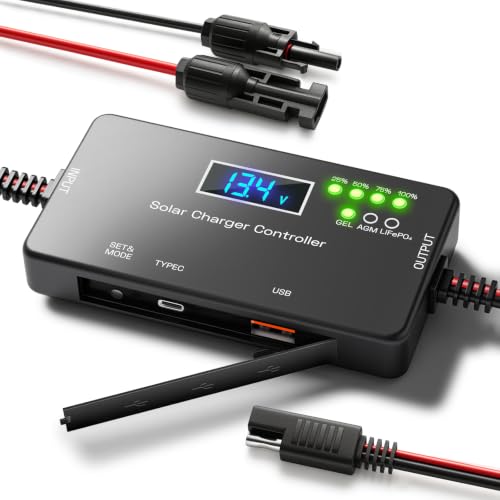
- 12V support for LiFePO4, AGM, and Gel batteries
- LCD displays voltage and charge level
- Built-in USB-C PD and USB fast charging
Best For: Simple 12V RV, boat, shed, and outdoor systems
Higher-Capacity MPPT
Victron Energy SmartSolar 100/50

- 50A MPPT controller for 12V or 24V systems
- Bluetooth app monitoring and configuration
- Supports synchronized multi-controller charging
Best For: Growing systems that need more charging capacity
Budget LCD Controller

- Automatic 12V/24V system adaptation
- LCD with adjustable load-time settings
- Designed for lead-acid batteries only
Best For: Budget-conscious lead-acid systems with USB charging
Best Compact MPPT Pick
SunRock 10 10A 12V MPPT Controller

- Compact 12V MPPT design with LCD monitoring
- Works with lead-acid and LiFePO4 batteries
- Includes SAE cables and multiple protections
Best For: Portable 12V battery systems
Best Beginner-Friendly PWM Option
ECO-WORTHY 30A Bluetooth Controller

- Supports both 12V and 24V systems
- Bluetooth and LCD monitoring
- Dual USB outputs for device charging
Best For: Simple monitored home or off-grid setups
Versatile MPPT Pick
Auto-Switch 30A Solar Charge Controller

- Automatic 12V/24V detection
- Supports lead-acid and lithium battery modes
- LCD monitoring with dual USB ports
Best For: Beginners wanting flexible battery compatibility and detailed monitoring
Outdoor Simplicity Pick
SOLPERK 10A Waterproof PWM Controller

- IP67 waterproof housing
- Automatic 12V/24V identification
- Simple LED status indicators and SAE connection
Best For: Compact outdoor lead-acid systems in RVs, boats, and cars
Adjustable Lead-Acid Pick

- LCD with adjustable charging parameters
- Automatic 12V/24V operation
- Dual 5V/3A USB outputs
Best For: Lead-acid systems needing adjustable settings and clear readouts
Smart MPPT Pick – Victron Energy SmartSolar 75/15
For beginners choosing solar charge controllers for beginners, the Victron SmartSolar 75/15 offers a compact way to add efficient MPPT charging and app-based monitoring to a 12V or 24V system. Its Bluetooth connectivity makes setup and performance tracking more approachable.
Best For: Beginners who want a compact, connected MPPT controller for smaller 12V or 24V systems.
Pros:
- MPPT tracking is designed to maximize available solar power, including during partial shading.
- Bluetooth access through the VictronConnect app provides real-time data, history, settings, firmware updates, and alarms.
- Supports synchronized operation with multiple SmartSolar MPPT controllers.
- Configurable load output can disconnect loads when battery voltage is too low.
Cons:
- The 15A rating is intended for smaller systems rather than higher-current installations.
- It has only a minimal LED-style display, so detailed monitoring requires the app.
This is a strong beginner-friendly choice when efficiency and smartphone monitoring matter more than a built-in screen. Confirm your panel current and system voltage before purchasing.
Easy LCD Starter – 12V 20A PWM Controller
Among solar charge controllers for beginners, this 12V 20A PWM model stands out for its quick-connect wiring, readable LCD, and straightforward battery compatibility. It is designed for LiFePO4, AGM, and Gel batteries in 12V systems.
Best For: First-time users building a simple 12V RV, boat, shed, or outdoor charging setup.
Pros:
- Supports LiFePO4, AGM, and Gel batteries in 12V systems.
- LCD shows battery voltage and charge level indicators at a glance.
- Quick-connect ports are intended to simplify installation and keep connections secure.
- Includes 22W USB-C PD and 18W USB QC3.0 charging ports.
Cons:
- It is limited to 12V systems and is not for 24V or 36V batteries.
- PWM charging is less power-optimizing than an MPPT design.
- Its stated solar-panel capacity is up to 300W, so larger arrays may require another controller.
The clear display and device-charging ports make this a practical introduction to solar power. Follow the specified connection order—battery first, then solar panel—and verify the system voltage.
Higher-Capacity MPPT – Victron Energy SmartSolar 100/50
For beginners planning beyond a small starter array, the Victron SmartSolar 100/50 combines MPPT efficiency with a 50A rating for 12V or 24V systems. Bluetooth access through VictronConnect helps make configuration and performance checks easier.
Best For: Users who want a higher-current, expandable MPPT controller with app-based monitoring.
Pros:
- 50A charging capacity suits more substantial 12V or 24V solar systems than a small 15A controller.
- MPPT tracking is designed to capture more available power, including in partial shade.
- VictronConnect provides real-time information, 30-day history, configuration, firmware updates, and alarms.
- Multiple units can synchronize charging stages for system-wide optimization.
Cons:
- The controller has no built-in display, so detailed status information requires the app.
- Its larger size and higher capacity may be unnecessary for a basic beginner setup.
This is the more capable choice for a beginner who expects the system to grow. Check array voltage, charging current, wiring, and battery requirements carefully before installation.
Budget LCD Controller – Upgraded 30A PWM
This 30A PWM model is a straightforward option for beginners comparing solar charge controllers for beginners on a budget. It automatically adapts to 12V or 24V systems, includes an LCD and USB outputs, and is designed specifically for lead-acid battery types.
Best For: Home, commercial, or hobby systems using compatible open, sealed, or gel lead-acid batteries.
Pros:
- Automatically adapts to 12V or 24V systems.
- LCD shows operating status and supports load-time and manual settings.
- Includes dual 5V/2.5A USB outputs for compatible devices.
- Lists protections for overcurrent, short circuit, reverse connection, low voltage, and overcharge.
Cons:
- It is not suitable for lithium or nickel-metal hydride batteries.
- PWM charging does not provide the same power optimization associated with MPPT controllers.
- The battery should be connected before the solar panel, and incorrect wiring may damage the system.
Its automatic voltage recognition and LCD make the controller approachable, but battery chemistry is a critical limitation. Choose it only for a compatible lead-acid setup and install it on a flat, well-ventilated surface.
Best Compact MPPT Pick – SunRock 10 10A 12V MPPT Controller
For beginners comparing solar charge controllers for beginners, the SunRock 10 is a compact choice for a straightforward 12V battery setup. Its LCD, indicator light, SAE connections, and built-in protections make basic monitoring and installation easier, but its voltage limits require careful matching.
Best For: Portable 12V systems using AGM, gel, lead-acid, or LiFePO4 batteries.
Pros:
- MPPT charging is designed to maximize energy harvest from compatible panels.
- Compact housing, LCD display, LED indicator, and included SAE extension cables simplify portable use.
- Supports several common 12V battery types and includes multiple protective functions.
- Water-resistant construction is suited to outdoor use when not submerged.
Cons:
- Designed for 12V batteries only; it should not be connected to higher-voltage batteries.
- PV open-circuit voltage must be above 15V and no higher than 30V.
- The battery must be connected before the solar panel.
This is an approachable option when your system is specifically 12V and within its 10A and 150W panel limits. Verify battery and panel specifications before wiring.
Best Beginner-Friendly PWM Option – ECO-WORTHY 30A Bluetooth Controller
The ECO-WORTHY 30A is a practical starting point for beginners who want a solar charge controller with a readable display and Bluetooth monitoring. It supports both 12V and 24V systems, adds dual USB outputs, and uses automatic three-stage PWM charging.
Best For: Home, commercial, or small off-grid systems using compatible 12V or 24V batteries.
Pros:
- Automatically supports 12V and 24V systems.
- Bluetooth connectivity and an LCD display provide convenient status monitoring and configuration.
- Supports lead-acid, gel, and LiFePO4 batteries.
- Dual USB outputs provide 5V/2.5A maximum charging for mobile devices.
Cons:
- It is a PWM controller rather than an MPPT model.
- The controller can heat during operation and needs a flat, well-ventilated installation location.
- Installation requires the battery first, then the panel, and finally the load.
Its clear controls, wireless monitoring, and flexible system-voltage support make it accessible for a first installation. Keep the 30A charging and 10A discharge ratings in mind when sizing the rest of the system.
Best High-Capacity Versatility Pick – SA100A 100A Multi-Voltage Controller
For beginners planning a larger or expandable installation, the SA100A offers automatic 12V, 24V, 36V, and 48V recognition with a large LCD display. Its high current rating, adjustable controls, and support for multiple battery chemistries provide flexibility, although the advanced feature set is more than a small starter system needs.
Best For: Larger off-grid, backup, street-lighting, or remote systems requiring broad voltage compatibility.
Pros:
- Automatically recognizes 12V, 24V, 36V, and 48V battery systems.
- 100A rating and MPPT-based charging algorithm are aimed at high-capacity applications.
- Large LCD shows battery voltage, PV input, charging/discharging current, temperature, and error codes.
- Supports sealed, gel, flooded, and LiFePO4 batteries, with timing and light-control functions.
Cons:
- The high-capacity design may be excessive for a small beginner system.
- Its many adjustable functions require more careful setup than a basic controller.
- Operation is specified up to 65°C, so installation should allow appropriate heat management.
This controller is most compelling when you need system-voltage flexibility and substantial current capacity. For a first project, confirm the panel, battery, wiring, and load ratings can safely accommodate its capabilities.
Versatile MPPT Pick – Auto-Switch 30A Solar Charge Controller
For beginners comparing solar charge controllers for beginners, this 30A MPPT model is a flexible choice for small 12V or 24V systems. Its automatic voltage detection, LCD monitoring, adjustable settings, and support for several battery types make it easier to configure as your setup grows.
Best For: Beginners who want broad battery compatibility, clear system information, and USB charging in one controller.
Pros:
- Automatically detects 12V or 24V systems.
- Supports OPEN, AGM, GEL, 3S lithium-ion, and 4S LiFePO4 modes.
- LCD provides five-way monitoring, while power-off memory preserves settings.
- Includes dual 5V/2A USB ports and seven protection functions.
Cons:
- The plastic housing may be less rugged than a metal controller.
- Its feature-rich settings may take beginners some time to learn.
This is the most adaptable option of the three, particularly if you may switch battery chemistries later. The three-stage charging design and multiple protections add useful safeguards, while the display helps new users understand what the system is doing.
Outdoor Simplicity Pick – SOLPERK 10A Waterproof PWM Controller
If you are choosing solar charge controllers for beginners for an RV, boat, car, or other outdoor project, the SOLPERK 10A controller keeps the setup straightforward. Its IP67 waterproof construction, SAE connection, automatic voltage identification, and simple LED indicators focus on easy installation and basic status checks.
Best For: Beginners building compact outdoor 12V or 24V lead-acid battery systems.
Pros:
- IP67 waterproof design suits outdoor use.
- Automatically identifies 12V or 24V systems, up to 10A.
- SAE port and included manual support plug-and-play installation.
- Offers three-stage PWM charging and several protection functions.
Cons:
- Its 10A rating limits the supported solar-panel size.
- LED indicators provide less detailed information than an LCD.
- Listed battery compatibility is limited to deep-cycle lead-acid types such as AGM, GEL, and Flooded.
The SOLPERK is a practical entry-level choice when weather resistance and uncomplicated operation matter more than detailed readings. Its 150W maximum at 12V and 300W at 24V should be checked against your panel and battery specifications before installation.
Adjustable Lead-Acid Pick – 30A PWM Controller with LCD
For beginners comparing solar charge controllers for beginners, this 30A PWM model offers a readable LCD and adjustable battery parameters without being limited to preset operation. It automatically supports 12V or 24V systems and adds dual USB outputs for everyday device charging.
Best For: Beginners using OPEN, AGM, or GEL lead-acid batteries who want adjustable settings and load-control options.
Pros:
- Automatically supports 12V and 24V systems.
- LCD shows operating data and allows parameter adjustments.
- Power-off memory retains configured settings.
- Includes dual 5V/3A USB ports and multiple automatic protections.
Cons:
- Not suitable for lithium batteries.
- Uses PWM charging rather than MPPT technology.
- Correct wiring order is important: battery first, then panel, then load.
This controller is a sensible match for a fixed lead-acid setup where adjustable float, reconnect, and stop-discharge settings are useful. Beginners should follow the stated wiring sequence and confirm that their battery chemistry is supported before connecting the unit.
How We Picked These Solar Charge Controllers for Beginners
We focused on the specifications that matter most during a first installation: battery-voltage compatibility, charging technology, rated current, solar-input limits, battery chemistry support, display or monitoring features, and practical protections. The selection includes both MPPT and PWM models because each can make sense in the right system.
MPPT controllers generally extract more energy from a panel, particularly in cooler conditions or when panel and battery voltages differ. PWM controllers are usually simpler and less expensive, making them reasonable for small, budget-conscious 12V systems when the panel voltage is closely matched to the battery.
Quick Comparison
| What to Compare | Best Fit |
|---|---|
| Charging technology | MPPT for efficiency; PWM for simplicity and lower cost |
| System voltage | 12V for small setups; 24V or higher for larger battery banks |
| Rated current | Choose above the solar array’s expected charging current |
| Battery support | Match the controller to lithium, LiFePO4, AGM, gel, or flooded lead-acid requirements |
| Monitoring | LCD or Bluetooth helps with setup and troubleshooting |
Key Buying Factors for Solar Charge Controllers for Beginners
Match Battery Voltage and Chemistry
Confirm that the controller supports your battery’s nominal voltage, such as 12V or 24V. Lithium and LiFePO4 batteries require an appropriate charging profile; do not assume a generic lead-acid setting is safe or effective. AGM, gel, and flooded batteries can also have different voltage requirements.
Size the Current and Solar Input Correctly
A controller’s amp rating describes the maximum charging current it can manage, not necessarily the panel wattage it will always deliver. Check the manufacturer’s maximum PV voltage and recommended solar wattage, then leave reasonable headroom. Exceeding the voltage limit can damage the controller.
Consider MPPT Versus PWM
MPPT is usually the better long-term choice when efficiency, colder weather performance, or a higher-voltage panel matters. PWM may be sufficient for a compact 12V panel-and-battery setup, especially when keeping the purchase price low is the priority.
Look for Useful Protection and Controls
Overcharge, over-discharge, reverse-polarity, short-circuit, and over-temperature protection add valuable safety. A display can simplify setup, while Bluetooth is useful when the controller is installed somewhere difficult to access. Waterproof construction is especially helpful for RV, boat, and outdoor installations, but still follow the mounting and wiring instructions.
Who Should Buy Which Solar Charge Controllers for Beginners?
Choose a small MPPT model for a portable panel, modest battery, or efficiency-focused beginner setup. Pick a PWM controller for a straightforward, low-cost 12V system with a well-matched panel. A 20A- or 30A-rated unit suits many small RV, boat, shed, and backup-power projects, while higher-current models are better reserved for larger battery banks and arrays.
Before buying, calculate panel wattage, expected charging current, battery capacity, and cable requirements together. If your system may expand, select a controller with extra current and voltage capacity rather than operating at its limits. Finally, verify the product’s current manual for lithium settings, terminal limits, fuse requirements, and installation clearances.