The right deep cycle battery can keep an RV, boat, trolling motor, mobility device, or off-grid system running reliably between charges. This roundup compares lithium, AGM, and sealed lead-acid options across several useful capacities and applications.
Use the buying guide below to match battery chemistry, capacity, size, charging requirements, and budget to your setup before choosing a replacement or upgrading your current system.
Best 10 Deep Cycle Batteries Picks for 2026
Best Lithium Upgrade
12V 100Ah LiFePO4 Group 24 Battery

- Lightweight 21.6-pound Group 24 design
- 100A BMS with temperature protection
- Expandable up to 4S4P
Best For: RV, marine, solar, and off-grid energy storage
Best Dual-Purpose AGM
OPTIMA D34M BLUETOP AGM Battery

- 750 CCA starting power
- Sealed, maintenance-free AGM design
- Vibration-resistant SpiralCell construction
Best For: Boats and RVs needing starting plus auxiliary power
Best Long-Life Lithium
12V 100Ah Group 31 LiFePO4 Battery

- 24-pound Group 31 drop-in design
- Smart 100A BMS with cold-charge cutoff
- Supports up to 4S4P expansion
Best For: Daily-use RV, marine, solar, and backup systems
Best High-Capacity AGM
Renogy 12V 200Ah Deep Cycle AGM Battery

- 200Ah C20 reference capacity
- Maintenance-free valve-regulated AGM design
- Below 3% monthly self-discharge at 77°F
Best For: Larger RV, solar, and backup power banks
Best Long-Life Upgrade
12V 100Ah LiFePO4 Group 31 Battery

- 15,000+ claimed cycles at 60% depth of discharge
- 100A Smart BMS with low-temperature cutoff
- 24-pound Group 31-compatible design
Best For: RV, marine, solar, and off-grid users prioritizing long life and low weight
Best AGM Value
Renogy 12V 100Ah Deep Cycle AGM Battery

- Sealed, spill-resistant AGM construction
- 100Ah capacity for RV, solar, and cabin use
- Low stated monthly self-discharge under 3%
Best For: Buyers wanting a maintenance-free 100Ah AGM battery for stationary or mobile power
Best Mobility Battery
Interstate 12V 35Ah SLA AGM Battery

- Compact 35Ah insert-terminal design
- Sealed, maintenance-free AGM/VRLA construction
- Designed for wheelchairs and mobility scooters
Best For: Compatible mobility equipment needing a compact U1 or GT9L replacement
Marine Power Pick

- 50Ah 12V capacity for trolling motors
- Sealed AGM design with low maintenance
- Compact marine battery with one-year warranty
Best For: Small boats, kayaks, and 12V trolling motors
Multi-Pack Value
Daakmax 12V 35Ah AGM Batteries
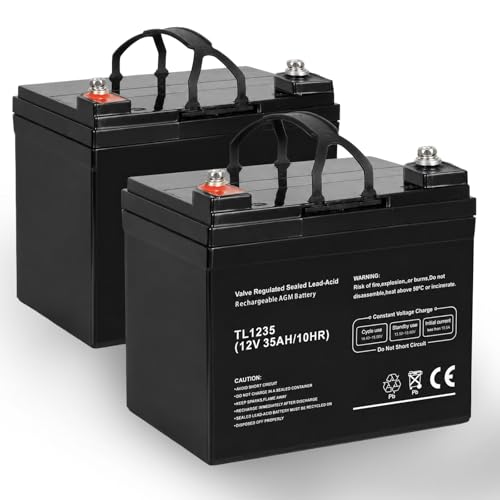
- Two rechargeable 35Ah batteries included
- Sealed, maintenance-free AGM construction
- Suitable for RV, solar, camping, and UPS use
Best For: Backup power, off-grid systems, and multi-battery setups
High-Discharge Choice

- 40Ah capacity for light electric devices
- Up to 400A discharge for five seconds
- Compact maintenance-free AGM design
Best For: Mobility scooters, wheelchairs, go-karts, and e-bikes
Best Lithium Upgrade – 12V 100Ah LiFePO4 Group 24 Battery
For buyers comparing deep cycle batteries for RVs, boats, trolling motors, or off-grid storage, this 12.8V LiFePO4 model combines a compact Group 24 format with a built-in 100A BMS. It is designed for energy storage rather than engine starting and supports several charging and expansion options.
Best For: RV house power, marine electronics, trolling motors, solar storage, and off-grid systems needing a lightweight Group 24 replacement.
Pros:
- Grade A LiFePO4 cells provide stable deep-cycle performance.
- Integrated 100A BMS protects against overcharge, over-discharge, overcurrent, short circuits, and temperature issues.
- Supports solar, lithium charger, generator, and DC-DC charging setups.
- Can be expanded up to 4S4P and includes a five-year warranty.
Cons:
- Not suitable for engine starting or cranking.
- Requires a compatible LiFePO4 charging profile; charging pauses below 32°F.
- Its Group 24 capacity may be insufficient for larger power demands without adding batteries.
This is a practical lithium upgrade for smaller mobile and off-grid systems, especially when weight, protection features, and expandable storage matter. Confirm your battery-box dimensions and charging equipment before switching from lead-acid.
Best Dual-Purpose AGM – OPTIMA D34M BLUETOP AGM Battery
Among deep cycle batteries for boats and RVs, the OPTIMA D34M BLUETOP stands out as a dual-purpose AGM option for both starting and auxiliary power. Its sealed, maintenance-free design and marine terminals make it a convenient choice where vibration resistance and reliable starting performance are priorities.
Best For: Boat and RV owners who need one sealed AGM battery for starting duties and moderate deep-cycle use.
Pros:
- Provides 750 CCA and a 120-minute reserve capacity.
- Dual-purpose design supports starting and deep-cycle applications.
- Sealed, maintenance-free AGM construction avoids routine fluid maintenance.
- SpiralCell technology and vibration resistance support durable operation.
Cons:
- Its stated C20 capacity is 55Ah, lower than many dedicated 100Ah or 200Ah deep-cycle batteries.
- At 43.5 pounds, it is heavier than the listed lithium alternatives.
- It offers a 24-month manufacturer guarantee, shorter than some lithium warranties.
The D34M is a sensible compromise when starting power and auxiliary cycling are both needed. Buyers seeking maximum energy storage for solar or extended off-grid use may prefer a higher-capacity dedicated deep-cycle battery.
Best Long-Life Lithium – 12V 100Ah Group 31 LiFePO4 Battery
This Group 31 LiFePO4 model is one of the more ambitious deep cycle batteries for RVs, trolling motors, solar systems, and backup power. It pairs a 100A smart BMS with low-temperature charging protection, a lightweight form factor, and substantial cycle-life claims for frequent-use applications.
Best For: Group 31 battery-box upgrades, daily solar storage, RV house banks, marine trolling motors, and portable high-draw equipment.
Pros:
- Weighs 24 pounds and is designed as a Group 31 drop-in replacement.
- Smart 100A BMS includes low-temperature charge cutoff and electrical protection.
- Supports charging in about five hours with a 14.6V 20A LiFePO4 charger.
- Designed for up to 4S4P expansion and rated for thousands of cycles.
Cons:
- Requires lithium-compatible charging equipment.
- Charging is disabled below 32°F, so cold-weather setups need appropriate planning.
- The advertised cycle life varies by depth of discharge and operating conditions.
Choose this battery when low weight, long service life, and scalable storage are more important than conventional lead-acid compatibility. Its Group 31 dimensions should be checked against the existing compartment before purchase.
Best High-Capacity AGM – Renogy 12V 200Ah Deep Cycle AGM Battery
For buyers who want substantial capacity without moving to lithium, this Renogy AGM is a conventional option among deep cycle batteries for solar, RV, and backup applications. Its 200Ah rating, sealed construction, and low self-discharge make it suited to larger stationary or mobile energy banks.
Best For: Solar storage, RV power banks, and backup systems where high capacity and maintenance-free AGM construction are priorities.
Pros:
- Offers a 200Ah reference capacity at the C20 rate.
- AGM and valve-regulated construction avoids routine acid maintenance.
- Low stated monthly self-discharge rate of below 3% at 77°F.
- Designed for strong discharge performance and operation across a wide temperature range.
Cons:
- At 127.9 pounds, it is substantially heavier than the lithium options.
- Large 20.5 x 9.4 x 8.8-inch dimensions require careful installation planning.
- The manufacturer recommends upright installation and provides a two-year prorated warranty.
This Renogy battery makes sense when capacity and familiar AGM technology outweigh portability. It is best suited to installations with adequate structural support and ventilation-free, upright mounting space.
Best Long-Life Upgrade – 12V 100Ah LiFePO4 Group 31 Battery
For shoppers comparing deep cycle batteries for RVs, boats, solar systems, or backup power, this 12V 100Ah LiFePO4 model emphasizes low weight, long service life, and built-in protection. Its Group 31 dimensions make it a practical drop-in option for compatible battery compartments.
Best For: RV house banks, marine trolling motors, off-grid solar, and applications where low weight and extensive cycle life matter.
Pros:
- LiFePO4 construction with claimed 15,000+ cycles at 60% depth of discharge.
- Built-in 100A Smart BMS with overcharge, over-discharge, over-current, short-circuit, and low-temperature charging protection.
- About 24 pounds and designed to fit Group 31 battery boxes.
- Supports series and parallel expansion up to 4S4P.
Cons:
- Requires a compatible LiFePO4 charging setup.
- Its higher upfront cost may not suit buyers seeking a basic lead-acid replacement.
- The low-temperature cutoff prevents charging below 32°F, so cold-weather systems need planning.
This is the strongest choice here for frequent cycling and weight-sensitive installations. Confirm the charging equipment, compartment dimensions, and system compatibility before upgrading.
Best AGM Value – Renogy 12V 100Ah Deep Cycle AGM Battery
This Renogy AGM is a conventional option among deep cycle batteries, offering sealed, maintenance-free lead-acid construction for solar, RV, cabin, and backup applications. It provides 100Ah of capacity and stable discharge performance without the charging considerations associated with lithium chemistry.
Best For: RVs, cabins, solar setups, and buyers who prefer a sealed AGM battery with broad appliance compatibility.
Pros:
- Sealed AGM design is rechargeable, maintenance-free, and spill-resistant.
- 100Ah capacity with a claimed 1100A maximum discharge for five seconds.
- Rated for discharge performance from -4°F to 140°F.
- Monthly self-discharge is listed below 3% at 77°F.
Cons:
- At 63.9 pounds, it is substantially heavier than the featured lithium option.
- Lead-acid chemistry generally offers fewer cycles than LiFePO4.
- The supplied warranty is a two-year prorated material and workmanship warranty.
Choose this model when sealed AGM simplicity and established lead-acid compatibility are more important than minimizing weight. Its dimensions and connection requirements should still be checked against the intended installation.
Best Mobility Battery – Interstate 12V 35Ah SLA AGM Battery
For compact equipment, this Interstate 35Ah SLA AGM model is one of the more specialized deep cycle batteries in the group. Its insert terminals, U1 or GT9L form factor, and mobility-focused design make it better suited to wheelchairs and scooters than large RV or golf-cart systems.
Best For: Compatible electric wheelchairs, mobility scooters, and other compact devices requiring a 12V 35Ah insert-terminal battery.
Pros:
- Sealed AGM/VRLA construction is maintenance-free and spill-proof.
- Compact 7.68 x 5.16 x 6.42-inch design with insert terminals and hardware.
- Designed for heavy-demand deep-cycle mobility use.
- Covered by a 12-month performance warranty.
Cons:
- 35Ah capacity is much lower than the 100Ah alternatives.
- It is not intended as a replacement for golf-cart batteries.
- Compatibility depends on the device, terminal style, and U1/GT9L size.
This is a focused replacement battery rather than a general-purpose house-bank solution. Verify the equipment model and terminal configuration before ordering, especially for mobility devices.
Marine Power Pick – Newport 12V 50Ah AGM Battery
If you need dependable deep cycle batteries for a small boat or trolling motor, the Newport 12V 50Ah AGM battery provides steady, rechargeable power in a sealed, low-maintenance design. Its compact format is practical for kayaks, inflatable boats, jon boats, and other small watercraft.
Best For: Anglers and boat owners running 12V trolling motors and compatible marine electronics.
Pros:
- 50Ah capacity is suited to extended trolling-motor use.
- Sealed AGM construction requires minimal maintenance.
- Compact, portable design weighs 32 pounds.
- Includes a one-year limited warranty and USA-based support.
Cons:
- Designed for 12V systems, so it is not a fit for other voltages.
- Its 50Ah capacity and marine-terminal configuration may be more than needed for smaller electronics-only setups.
This is a straightforward marine deep-cycle option when quiet, consistent 12V power and easy handling matter most. It is particularly well matched with Newport trolling motors and small-watercraft setups.
Multi-Pack Value – Daakmax 12V 35Ah AGM Batteries
For buyers comparing deep cycle batteries for backup power, camping, or off-grid equipment, this Daakmax set supplies two rechargeable 12V 35Ah AGM batteries. The sealed construction and low self-discharge design make the pair convenient for a range of stationary and mobile applications.
Best For: RVs, camping systems, solar setups, UPS backup, and users who need a two-battery package.
Pros:
- Pack of two supports replacement or multi-battery configurations.
- 35Ah rechargeable capacity suits backup and off-grid applications.
- AGM construction is sealed, maintenance-free, and leak-resistant.
- Heavy-duty ABS casing is designed for vibration resistance.
Cons:
- Each battery provides 35Ah, less capacity per unit than the 50Ah marine option.
- The supplied notes do not specify individual battery dimensions or weight.
This pair is a practical choice when flexibility and quantity are more important than maximum capacity from a single battery. Its broad application range makes it useful for backup, recreation, and solar-oriented systems.
High-Discharge Choice – VEVOR 12V 40Ah AGM Battery
Among deep cycle batteries for light electric vehicles, the VEVOR 12V 40Ah AGM battery stands out for its stated high-discharge capability. It can deliver up to 400A for five seconds, making it suitable for startup support while its sealed design keeps routine maintenance simple.
Best For: Mobility scooters, electric wheelchairs, go-karts, e-bikes, and similar 12V devices.
Pros:
- 40Ah capacity provides extended runtime for light-duty electric devices.
- Up to 400A discharge current for five seconds supports device startup.
- AGM construction is maintenance-free with minimal electrolyte consumption.
- Compact 24.7-pound design measures 7.8 by 6.5 by 6.7 inches.
Cons:
- Professional charging equipment is required during use.
- It is a single-battery package, rather than a multi-pack.
- The supplied notes identify lead-acid chemistry but do not provide a warranty duration.
This VEVOR battery is a focused fit for compact electric mobility and recreational vehicles that need both usable capacity and strong short-duration discharge performance. Confirm the device’s size, voltage, terminals, and charging requirements before buying.
How We Picked These Deep Cycle Batteries
We selected batteries covering the most common 12V use cases, including RV power, marine electronics, trolling motors, solar storage, camping, mobility equipment, and backup applications. The lineup includes lithium iron phosphate (LiFePO4), AGM, and sealed lead-acid designs in capacities from 35Ah to 200Ah.
Our comparison emphasizes usable capacity, expected cycle life, maintenance requirements, charging compatibility, physical format, portability, and suitability for starting, house-power, or accessory loads. Always confirm the manufacturer’s specifications and your equipment’s requirements before purchase.
Quick Comparison
| Battery type | Typical strengths | Best suited to |
|---|---|---|
| LiFePO4 lithium | Low weight, long cycle life, efficient discharge | RVs, solar systems, frequent-use trolling motors |
| AGM | Sealed, maintenance-free, dependable, broadly compatible | Boats, RVs, backup power, moderate-use systems |
| Sealed lead-acid | Lower upfront cost and simple replacement | Small loads, mobility devices, camping, basic backup |
Key Buying Factors for Deep Cycle Batteries
Capacity and Usable Energy
Amp-hours indicate how much energy a battery can store, but usable capacity depends on chemistry, discharge limits, temperature, and the connected load. A 100Ah battery is not automatically the right choice: estimate your daily watt-hours and allow reserve capacity for cloudy weather, longer outings, or inverter losses.
Battery Chemistry
LiFePO4 batteries usually cost more initially but offer lighter weight, higher usable capacity, faster charging, and substantially longer cycle life. AGM batteries are sealed, spill-resistant, and often easier to integrate with existing chargers. Conventional sealed lead-acid models can be economical for smaller or occasional-use applications but are generally heavier and less tolerant of deep, repeated discharge.
Size, Terminals, and Compatibility
Check the group size, terminal style, mounting space, cable reach, and total weight. Confirm that your charger, solar controller, converter, and battery monitor support the selected chemistry. Lithium models may require low-temperature charging protection and a compatible charging profile.
Discharge and Environmental Needs
Compare continuous and peak discharge ratings with your inverter, trolling motor, or other equipment. For marine or outdoor use, sealed construction, vibration resistance, temperature range, and secure installation matter as much as capacity.
Who Should Buy Which Deep Cycle Batteries?
- Choose LiFePO4 if you want low weight, frequent cycling, long service life, or maximum usable energy in an RV, solar setup, or trolling motor system.
- Choose AGM if you prefer a sealed, maintenance-free battery with broad compatibility for boats, RVs, and moderate-duty backup power.
- Choose a smaller sealed lead-acid battery for compact electronics, mobility equipment, camping accessories, or low-demand backup systems where price and simple replacement are priorities.
- Choose a higher-capacity 200Ah model when your system has substantial daily loads or you want more reserve between charging opportunities.
Before ordering, verify the battery’s dimensions, polarity, terminal hardware, charger settings, and return policy. Proper sizing and charging are essential for safe operation and the longest possible service life.