Articulating inspection borescopes make it easier to see around bends, inside engines, behind walls, and through other hard-to-reach spaces. The right model can reduce disassembly while giving you better control over the camera’s viewing angle.
We selected 10 options with different probe diameters, articulation ranges, camera layouts, displays, lighting systems, and durability features so you can match the tool to your inspection work and budget.
Best 10 Articulating Inspection Borescopes Picks for 2026
Best Overall Control
DXZtoz Two-Way Articulating Borescope

- 220° two-way steering
- 1080p display and recording
- Includes helpful inspection accessories
Best For: Mechanics and technicians needing controlled navigation in tight spaces
Best Dual-Lens Design
Teslong Articulating Borescope

- Front- and side-view cameras
- Large 4.5-inch IPS screen
- Semi-rigid 5-foot gooseneck
Best For: Inspections where viewing from multiple angles saves repositioning
Best Slim Probe
Elitech 6mm Articulating Borescope

- 6mm probe for restricted openings
- 180° articulation and roller control
- Temperature alert and automatic shutdown
Best For: HVAC, plumbing, and machinery inspections requiring a narrow probe
Best Compact Reach
Anykit 210° Articulating Borescope

- 0.22-inch slim probe
- 210° two-way articulation
- 1080p camera with image flip
Best For: Portable engine, HVAC, plumbing, and wall-cavity inspections
Premium Dual-Lens Precision
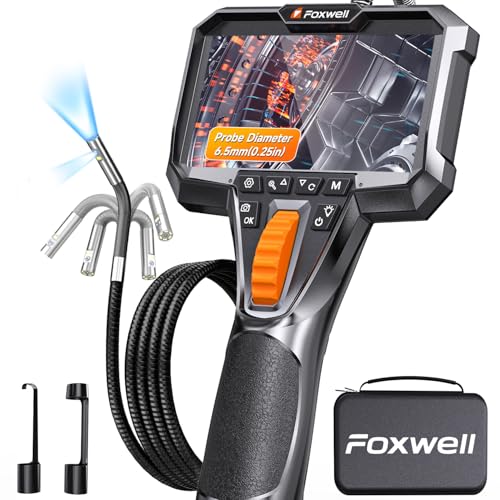
- 220° articulation with dual front and side cameras
- Slim 6.5mm probe for tight access points
- HD IPS display, IP67 protection, and 32GB storage
Best For: Professionals needing broad, documented visibility in tight spaces
Automotive Diagnostic Workhorse

- 5.5mm probe and 180° joystick articulation
- 5-inch 1280x720 IPS display with magnification
- 3000mAh battery and organized carrying case
Best For: Automotive diagnostics and full-day tight-space inspections
Ultra-Slim Steering Specialist

- 6.2mm probe reaches narrow inspection points
- 220° thumb-wheel steering with direct manual control
- 4x zoom, IP67 protection, and 5–7 hour battery
Best For: Field technicians needing slim access and long runtime
Best 4-Way Pick
Ralcam 360° Articulating Borescope

- Four-way joystick articulation
- 5-inch 1080p display
- 6.2mm probe and 5-foot cable
Best For: Mechanics and HVAC inspections requiring broad probe control
Best for Automotive Access
2-Way 210° Articulating Borescope

- Lockable 210° articulation
- 1080p view with 4.3-inch IPS screen
- 32GB card and carrying case included
Best For: Automotive engine inspections in curved or confined spaces
Best Slim 5-Inch Option
TGJOR 210° Articulating Borescope

- 6mm slim articulating probe
- 5-inch 1080p IPS display
- IP67 lens with adjustable LEDs
Best For: Technicians documenting tight-space automotive and industrial inspections
Best Overall Control – DXZtoz Two-Way Articulating Borescope
For buyers comparing articulating inspection borescopes, the DXZtoz stands out for its 220° two-way steering, 1080p video, and built-in display. Its compact probe and flexible gooseneck are suited to automotive, HVAC, electrical, and machinery checks where repositioning the scope is difficult.
Best For: Mechanics and technicians who want strong articulation, a bright display, and useful inspection accessories.
Pros:
- 220° two-way articulation helps steer around obstacles.
- 1080p capture, 8x digital zoom, and eight adjustable LED lights.
- IP67 waterproof, oil-resistant probe with a 4.3-inch IPS screen.
- Includes a hook, magnet, side mirror, case, and 32GB memory card.
Cons:
- The 8.5mm probe is not the slimmest option in this group.
- The stated focal range is relatively close, at 1–15cm.
Choose this model when steering range and included accessories matter more than having the narrowest possible probe. Its no-app design also makes it practical for quick field inspections.
Best Dual-Lens Design – Teslong Articulating Borescope
The Teslong combines two-way articulation with front- and side-view cameras, giving these articulating inspection borescopes a broader perspective without repeatedly repositioning the probe. Its 4.5-inch IPS screen, semi-rigid cable, and one-handed controls support automotive and household inspection work.
Best For: Users who value dual-camera viewing and convenient controls during longer inspections.
Pros:
- Front and side lenses provide two viewing perspectives.
- 4.5-inch IPS color screen requires no app or phone.
- 5-foot semi-rigid gooseneck retains its shape for steadier positioning.
- Adjustable built-in lighting and IP67 waterproof construction.
Cons:
- Listed video resolution is 720p, lower than several alternatives here.
- The product details list a 1MP still resolution.
- At 1.44kg, it may feel less lightweight for extended handheld use.
This is a sensible pick when side-view access can save time. Consider another model if maximum image resolution or a lighter unit is your primary concern.
Best Slim Probe – Elitech 6mm Articulating Borescope
The Elitech is one of the more compact articulating inspection borescopes, using a 6mm probe with 180° two-way articulation. Its temperature monitoring, adjustable LEDs, and IP67-rated probe make it a practical option for pipes, HVAC systems, machinery, and other demanding inspection locations.
Best For: Professionals needing a slim probe with temperature protection for wet or challenging environments.
Pros:
- 6mm probe reaches tighter openings than larger designs.
- 180° articulation with a roller-style control wheel supports one-handed operation.
- Six adjustable LEDs, 4x digital zoom, and image rotation/flip functions.
- Temperature sensor alerts and shuts down above 194°F (90°C).
Cons:
- Listed video and still resolution are 1MP, despite the 1080p display claim.
- Fixed focus and a 15–100mm focal range offer less close-focus flexibility.
Its narrow probe and built-in temperature safeguard make the Elitech especially appealing for access-limited work. Verify that its fixed-focus behavior suits the distances you expect to inspect.
Best Compact Reach – Anykit 210° Articulating Borescope
The Anykit offers a slim 0.22-inch probe, 210° two-way articulation, and a 4.3-inch IPS display in a no-app inspection package. For articulating inspection borescopes used around engines, walls, plumbing, and HVAC equipment, its semi-rigid cable, image flip, and temperature alert add practical versatility.
Best For: DIY users and technicians wanting a slim, portable scope with broad steering and straightforward controls.
Pros:
- 0.22-inch probe accesses narrow spaces.
- 210° two-way articulation and thumb-slider control aid positioning.
- 1920×1080 camera, adjustable LEDs, three zoom levels, and 180° image flip.
- IP67 design, overheat alarm, 3000mAh battery, and included 8GB card.
Cons:
- The included memory card is 8GB, smaller than some competing kits.
- The supplied details do not specify a stated probe temperature cutoff.
- The 4-foot cable is shorter than some 5-foot alternatives.
This model balances a narrow probe with a generous articulation range and useful image controls. It is a strong fit for users who want portability without giving up steering flexibility.
Premium Dual-Lens Precision – FOXWELL Y406D-Elite
For technicians who need broad visibility in confined spaces, this articulating inspection borescope combines a slim 6.5mm probe with 220° steering and dual front-and-side cameras. It is designed to inspect automotive, HVAC, plumbing, and other hard-to-reach areas without extensive disassembly.
Best For: Automotive, HVAC, and plumbing professionals who want dual-camera coverage, a slim probe, and onboard photo and video storage.
Pros:
- 220° articulation and dual lenses provide front and side views in complex spaces.
- 6.5mm probe fits spark plug holes, HVAC vents, and narrow pipes.
- HD IPS display, adjustable lighting, IP67 probe protection, and 32GB storage.
Cons:
- At 2.41 pounds, it may be less convenient than a lighter handheld scope.
- The listed heat protection shuts the device down above 70°C, so hot-engine inspections require care.
The Y406D-Elite is a strong choice when inspection coverage matters as much as access. Its dual-lens design and onboard storage make it particularly useful for documenting findings during professional service work.
Automotive Diagnostic Workhorse – Teslong TD300P 5.5mm
This Teslong is a practical articulating inspection borescope for engine and transmission diagnostics. Its 5.5mm probe, 180° joystick-controlled movement, and 5-inch IPS display help technicians inspect spark plug holes, injector ports, valve seats, and other restricted areas.
Best For: Automotive technicians and mechanics who need a slim probe, precise joystick control, magnification, and a full-day battery for repeated inspections.
Pros:
- 5.5mm probe reaches tighter spaces than many standard 8mm scopes.
- 180° articulation, six adjustable LEDs, and 1.3x/1.5x digital magnification support detailed viewing.
- 3000mAh battery, 5-foot probe cable, carrying case, and included microSD card suit mobile work.
Cons:
- Its 180° articulation provides less steering range than the 220° FOXWELL models in this roundup.
- Video capture is listed at 720p, with 1MP effective still resolution.
The TD300P focuses on straightforward automotive diagnosis rather than extra complexity. The slim probe, responsive joystick, and full-shift battery make it a sensible choice for mechanics who value control and portability.
Ultra-Slim Steering Specialist – FOXWELL Y400 220° Borescope
The FOXWELL Y400 is built for users who need precise access in narrow passages. This articulating inspection borescope pairs a 6.2mm probe with 220° two-way steering, a thumb-wheel controller, adjustable LEDs, and 4x zoom for automotive, HVAC, plumbing, and industrial inspections.
Best For: Technicians who prioritize slim access, responsive manual steering, long battery life, and simple photo or video capture without Wi-Fi or an app.
Pros:
- 6.2mm probe reaches spark plug holes, vents, pipes, valves, and industrial equipment.
- 220° thumb-wheel articulation offers direct control around bends and hidden surfaces.
- HD IPS display, 4x zoom, IP67 probe protection, 5–7 hour battery, and 32GB storage.
Cons:
- The supplied notes do not specify the display resolution or video resolution.
- It uses two-way steering, so it may offer less directional flexibility than multi-way scopes.
The Y400 is a focused, easy-to-operate option for demanding access work. Its combination of a narrow probe, strong articulation range, long runtime, and onboard storage makes it well suited to field diagnostics.
Best 4-Way Pick – Ralcam 360° Articulating Borescope
Among articulating inspection borescopes, the Ralcam stands out for its four-way joystick control and large 5-inch display. Its 6.2mm probe and semi-rigid 5-foot cable are suited to automotive, HVAC, plumbing, machinery, and other inspections where maneuverability and a stable viewing position matter.
Best For: Mechanics, HVAC technicians, and users who want broad probe control with a large built-in screen.
Pros:
- Four-way 180° articulation with joystick control helps navigate complex spaces.
- 5-inch screen displays 1080p images and video without requiring a phone or app.
- 6.2mm waterproof probe and 5-foot semi-rigid cable support tight-space inspections.
- 4400mAh rechargeable, replaceable battery is rated for about five hours of use.
Cons:
- The probe’s stated articulation is 180°, rather than a full 360° directional range.
- Fixed focus and a maximum focal length of 10cm may limit close-up flexibility.
The Ralcam is a strong choice when four-way control, cable stability, and long battery life are more important than a particularly compact display or two-way-only design.
Best for Automotive Access – 2-Way 210° Articulating Borescope
This 2-way model is one of the more practical articulating inspection borescopes for automotive work. Its 210° articulating head, 5.3-foot flexible cable, and angle-locking design help users reach curved or confined areas while the built-in screen keeps operation independent of a phone or app.
Best For: Automotive engine inspections and users who need a portable, angle-locking probe.
Pros:
- 210° two-way articulation can be locked at a selected angle for detailed viewing.
- 1080p camera and 4.3-inch IPS screen provide a clear real-time image.
- Three-level LED lighting helps illuminate dark inspection areas.
- Includes a 32GB TF card, carrying case, and battery rated for about four hours.
Cons:
- Two-way articulation offers less directional control than four-way alternatives.
- The display is smaller than the 5-inch screens on the other listed models.
- The supplied notes do not specify the probe’s exact minimum bend radius.
Choose this borescope if angle locking and automotive maneuverability are priorities. Its IP67 camera and high-temperature warning feature add useful protection for demanding wet, oily, or hot inspection areas.
Best Slim 5-Inch Option – TGJOR 210° Articulating Borescope
For users comparing articulating inspection borescopes, this TGJOR model combines a slim 6mm probe with joystick-controlled 210° two-way movement. The built-in 5-inch IPS screen, adjustable LED lighting, and app-free operation make it a straightforward option for automotive, HVAC, plumbing, and industrial troubleshooting.
Best For: Technicians and DIY users who need a slim probe, built-in display, and basic photo or video documentation.
Pros:
- Joystick-controlled 210° articulation helps reach hidden areas with less disassembly.
- 6mm probe fits narrow spaces such as engines, pipes, walls, and machinery.
- 5-inch 1080p IPS display works without Wi-Fi, a smartphone, or an app.
- IP67 lens, adjustable LEDs, and included 4GB TF card support practical field inspections.
Cons:
- Two-way articulation provides less directional coverage than four-way designs.
- Battery life is listed at approximately three to four hours.
- The included storage card is smaller than the 32GB card supplied with one competing model.
This is a well-balanced choice for tight-access inspections where a slim probe and large screen matter. Its recording capability is useful for documenting findings, though the shorter stated battery life may favor shorter inspection sessions or access to USB-C charging.
How We Picked the Best Articulating Inspection Borescopes
We compared these models by focusing on the features that most affect real-world inspections: articulation range and control, probe diameter, image quality, lighting, camera configuration, display usability, water and dust resistance, and suitability for automotive, HVAC, industrial, and household tasks.
We also considered practical differences between slim two-way probes, wider-range four-way designs, dual-lens cameras, and units with built-in screens. A strong specification is useful only when it supports easier positioning, clearer viewing, and dependable operation in confined spaces.
Quick Comparison
| Feature | What to look for | Best suited to |
|---|---|---|
| Probe diameter | About 5.5–6mm for general access; slimmer probes for tighter openings | Engines, pipes, walls, and machinery |
| Articulation | Two-way for basic directional control; four-way or 360-degree designs for complex paths | Simple versus highly angled inspections |
| Camera layout | Front-facing or dual-lens viewing | Direct inspection versus broader situational awareness |
| Lighting | Adjustable LEDs with enough brightness for dark cavities | Metal parts, ducts, engines, and enclosed spaces |
| Protection | IP-rated waterproof and dust-resistant probe | Automotive, plumbing, HVAC, and industrial work |
Key Buying Factors for Articulating Inspection Borescopes
Probe Size and Access
Measure the smallest opening you expect to use. A 5.5mm or 6mm probe works for many automotive and maintenance jobs, while a 0.22- or 0.24-inch probe may reach tighter passages. A thinner probe can sacrifice some rigidity, so balance access with control.
Articulation Range
Two-way articulation is usually sufficient when you need to direct the camera forward or backward along one axis. Choose a 220-degree or four-way design when the inspection path includes multiple bends or when repositioning the probe is difficult.
Image, Lighting, and Viewing Options
1080P output can make cracks, corrosion, leaks, and deposits easier to identify, but lighting is equally important. Adjustable LEDs help prevent glare and shadows. Dual-lens models can provide forward and side views, reducing the need to withdraw and reinsert the probe.
Screen and Recording Features
A built-in IPS display is convenient for field work and avoids relying on a phone connection. Check whether the unit supports photos, video, image playback, and removable storage if you need inspection records or customer documentation.
Durability and Handling
Look for an IP67-rated probe when the camera may encounter moisture, oil, dust, or debris. Also consider cable stiffness, handle ergonomics, battery life, control placement, and the length of the probe for your typical work area.
Who Should Buy Which Articulating Inspection Borescopes?
For automotive technicians: Choose a slim probe with strong articulation, bright adjustable lighting, and preferably a dual-lens camera for engines, cylinders, and narrow access points.
For HVAC and plumbing work: Prioritize a small waterproof probe, flexible steering, and a screen that remains easy to read in dim mechanical spaces.
For industrial maintenance: Select a durable model with high-resolution imaging, reliable articulation controls, recording capability, and enough probe length for machinery and ducts.
For occasional home inspections: A straightforward two-way model with a built-in display and adjustable LEDs should provide the best balance of usability and cost.