A dependable bench vise gives you a stable third hand for cutting, drilling, filing, shaping, and assembly. The right model can make demanding work safer and more precise without taking over your entire workbench.
We compared 10 bench vises across jaw size, opening capacity, swivel range, construction, and versatility to help you find the best fit for your workshop and budget.
Best 10 Bench Vises Picks for 2026
Heavy-Duty Versatility
Forward DT08125A 5-Inch Bench Vise
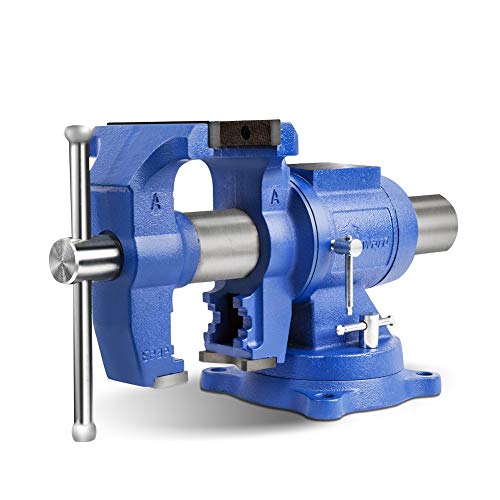
- 5,500-pound clamping force
- 360-degree rotating head and swivel base
- Three jaw configurations plus reinforced anvil
Best For: Demanding DIY and industrial work
Trusted Shop Utility
Wilton 674U 4-1/2-Inch Bench Vise

- Replaceable hardened-steel serrated jaws
- 360-degree swivel base with dual lock-downs
- Pipe jaws, large anvil, and lifetime warranty
Best For: General-purpose home workshop use
High-Clamp Precision
Forward CR40A 4.5-Inch Bench Vise

- 6,600-pound clamping force
- 210-degree swivel base for positioning control
- Flat slot jaws and built-in pipe jaws
Best For: Professional-style demanding shop tasks
Compact Home Workshop Choice

- Multi-jaw design for flat materials and pipes
- 240-degree swivel locking base
- 2,204-pound clamping force and large anvil
Best For: Home projects and small workshops
Heavy-Duty Swivel Pick

- 5-inch jaws with a 5-inch opening
- 360-degree base and front-jaw adjustment
- Up to 5,512 pounds of clamping force
Best For: Heavy-duty metalwork, pipe work, and general workshop projects
Most Versatile Angle Control

- 360-degree articulating ball-and-socket design
- Eight locking positions rated to 130 ft-lbs
- Swap-in jaws and integrated accessory ports
Best For: Multi-angle repair, woodworking, and hobby work
Value Multipurpose Pick
VEVOR 4.5-Inch Swivel Bench Vise

- 4.5-inch jaws with a 3.3-inch opening
- 240-degree swivel locking base
- Handles flat stock, pipe, and tubing
Best For: General workshop drilling, cutting, grinding, and sharpening
Heavy-Duty 6.5-Inch Vise
VEVOR 6.5-Inch Swivel Bench Vise

- 60,000 PSI ductile-iron construction
- 360-degree swivel base and pipe jaws
- Up to 9.3-inch reverse jaw opening
Best For: Large, demanding workshop projects
Compact 5-Inch Workhorse
VEVOR 5-Inch Swivel Bench Vise

- 5-inch jaw width and maximum opening
- Four-bolt mounting for added stability
- Pipe jaws and 360-degree swivel base
Best For: Versatile home workshop use
Balanced 6-Inch Shop Vise
VEVOR 6-Inch Swivel Bench Vise

- 6-inch jaws with a 5.9-inch opening
- 360-degree swivel base and 4,496-pound force
- Handles flat stock and 0.6- to 2.9-inch pipe
Best For: General-purpose metalworking and repairs
Heavy-Duty Versatility – Forward DT08125A 5-Inch Bench Vise
For demanding bench vise work, the Forward DT08125A combines a 5-inch jaw width with ductile-iron construction and multiple clamping surfaces. Its rotating head, swivel base, and reinforced anvil make it suitable for varied shop and home tasks.
Best For: Heavy-duty DIY and industrial work involving grinding, cutting, tapping, pipes, or awkwardly positioned workpieces.
Pros:
- 5,500-pound clamping force with 5-inch jaw opening.
- 360-degree rotating head and swivel base improve positioning flexibility.
- Includes replaceable top jaws, built-in pipe jaws, and V-jaws.
- Ductile-iron body and reinforced anvil support demanding work.
Cons:
- At 33 pounds, it is relatively heavy to move between work areas.
- The larger industrial design may be more than needed for light-duty tasks.
The DT08125A stands out among bench vises when maximum versatility and strong clamping are priorities. Its multi-jaw setup and rotating design are especially useful for complex projects.
Trusted Shop Utility – Wilton 674U 4-1/2-Inch Bench Vise
Wilton Utility Bench Vise, 4-1/2" Jaw Width, 4" Jaw Opening, 2-5/8" Throat (Model 674U)
Check Price On AmazonThe Wilton 674U is a practical bench vise for general workshop use, pairing replaceable hardened steel jaws with a 360-degree swivel base. Its pipe jaws and broad anvil add useful capability for everyday fabrication and repair work.
Best For: Home workshops and general-purpose shaping, gripping, and pipe-related tasks.
Pros:
- 4-1/2-inch jaws open to 4 inches.
- Replaceable serrated hardened-steel jaws provide a secure grip.
- Dual lock-downs and a 360-degree swivel base support stable positioning.
- Includes built-in pipe jaws and a large anvil surface.
Cons:
- Its 4-inch jaw opening is smaller than some 5-inch alternatives.
- The supplied notes do not specify a clamping-force rating.
With a durable finish, useful pipe-handling features, and a lifetime warranty against manufacturing defects, the 674U is a well-rounded choice for routine bench vise duties.
High-Clamp Precision – Forward CR40A 4.5-Inch Bench Vise
The Forward CR40A is a heavy-duty bench vise designed for strong, controlled clamping. Its 6,600-pound clamping force, ductile-iron construction, and 210-degree swivel base suit projects that require both stability and accurate workpiece positioning.
Best For: Professional-style workshop tasks involving grinding, cutting, tapping, and pipe work.
Pros:
- 6,600-pound clamping force supports demanding applications.
- 5-inch maximum jaw opening and 2.6-inch throat depth provide useful capacity.
- 210-degree swivel base helps position complex workpieces accurately.
- Includes flat slot jaws and built-in pipe jaws for varied materials.
Cons:
- Its 4.5-inch jaw width is smaller than the DT08125A’s 5-inch width.
- The 210-degree swivel range is less than a full 360-degree rotation.
The CR40A is a compelling option when clamping strength and precise positioning matter more than maximum swivel range. Its reinforced anvil further broadens its workshop usefulness.
Compact Home Workshop Choice – WORKPRO 4.5-Inch Bench Vise
The WORKPRO 4.5-inch bench vise offers a practical combination of flat-material and pipe-holding capability. Its 240-degree swivel locking base, gray-iron construction, and large anvil make it a useful fit for home projects and small workshops.
Best For: Home users and small workshops needing an easy-to-install vise for general clamping and pipe work.
Pros:
- Multi-jaw design holds flat materials, pipes, and tubes.
- 240-degree swivel base supports flexible workpiece positioning.
- 4.5-inch jaws open to 4-1/4 inches with up to 2,204 pounds of clamping force.
- Large anvil area and 2-11/32-inch throat depth add utility.
Cons:
- Its 2,204-pound clamping force is lower than the Forward alternatives listed here.
- The supplied notes do not identify replaceable jaw inserts.
The WORKPRO is a sensible bench vise for lighter-duty users who value flexibility and straightforward installation. Its combination jaws and swivel base cover a broad range of household projects.
Heavy-Duty Swivel Pick – PONY 5-Inch Bench Vise
For demanding bench vises work, the PONY 5-inch model combines a broad jaw opening, strong ductile cast iron construction, and versatile positioning. Its 360-degree swivel base and front jaw make it easier to orient projects for grinding, cutting, sanding, sawing, and gluing.
Best For: Heavy-duty workshop projects requiring high clamping force, pipe holding, and flexible workpiece positioning.
Pros:
- 5-inch jaws open to 5 inches and provide a 2-5/8-inch throat depth.
- 360-degree vertical and horizontal swivel adjustment improves access to the workpiece.
- Includes replaceable hardened steel serrated jaws, pipe jaws, anvil surfaces, and jaw pads.
- Rated for up to 5,512 pounds of clamping force.
Cons:
- Its heavy-duty design may be more vise than needed for light hobby work.
- The supplied specifications do not list the vise’s overall weight.
The PONY stands out among bench vises when strength and positioning flexibility matter most. It is a practical choice for users who regularly work with metal, pipe, or larger workpieces and want integrated anvil and pipe-jaw capability.
Most Versatile Angle Control – WORK IQ TOOLS IQ Vise
The WORK IQ TOOLS IQ Vise takes a different approach to bench vises with a 360-degree articulating ball-and-socket mechanism. It can rotate, tilt, and swivel a workpiece, then lock it using a quick cam lever or one of eight fixed working positions.
Best For: Multi-angle repair, woodworking, gunsmithing, and hobby tasks where precise workpiece orientation is important.
Pros:
- Ball-and-socket design locks the workpiece at the desired angle.
- Eight fixed positions are rated to 130 ft-lbs of torque.
- 5-inch parallel jaws accept swap-in Flex-Fit pads for varied materials and shapes.
- Includes mounting bolts, washers, nuts, Flex-Fit jaws, and four locking pins.
Cons:
- Optional Sure-Fit or leather jaws and workstation accessories are sold separately.
- At 10 pounds, it may offer less mass than some traditional heavy-duty bench vises.
Choose the IQ Vise if angle adjustment is more valuable than a conventional fixed vise layout. Its articulating design and accessory ports suit repair stations and hobby work, while the included hardware simplifies installation.
Value Multipurpose Pick – VEVOR 4.5-Inch Swivel Bench Vise
The VEVOR 4.5-inch model is a practical option among bench vises for drilling, pipe cutting, sharpening, grinding, and other general workshop tasks. Its cast iron body, replaceable carbon steel jaw plates, and 240-degree swivel base provide useful strength and positioning flexibility.
Best For: General-purpose workshop use involving flat stock, pipe, tubing, drilling, cutting, and sharpening.
Pros:
- 4.5-inch jaws open to 3.3 inches with a 2.3-inch throat depth.
- 240-degree swivel base helps position work without repeatedly removing it.
- Multi-jaw design holds flat materials and pipe or tubing from 0.6 to 1.8 inches.
- Includes mounting bolts, nuts, a manual, and a 1.9-by-1.7-inch anvil area.
Cons:
- Its jaw opening is smaller than the PONY’s 5-inch opening.
- The base swivels 240 degrees rather than a full 360 degrees.
For buyers seeking a straightforward, adaptable bench vise, the VEVOR offers a balanced feature set and included mounting hardware. It is especially useful when a single vise needs to handle both flat workpieces and smaller pipe or tube.
Heavy-Duty 6.5-Inch Vise – VEVOR 6.5-Inch Swivel Bench Vise
This heavy-duty option is a strong choice among bench vises for demanding shop work. Its 6.57-inch jaws, ductile-iron construction, 360-degree swivel base, and pipe-clamping capability make it versatile for drilling, cutting, grinding, sharpening, and tapping.
Best For: Heavy-duty workshop tasks requiring broad jaw capacity, strong clamping force, and flexible positioning.
Pros:
- 60,000 PSI ductile-iron body with a powder-coated, rust-resistant finish.
- 6.57-inch jaw width, up to 6.5-inch forward opening, and 9.3-inch reverse opening.
- 360-degree swivel base, serrated replaceable jaw plates, and magnetic jaw pads included.
- Built-in pipe clamping for workpieces from 0.6 to 2.8 inches in diameter.
Cons:
- At 27 pounds, it is relatively heavy to move or reposition.
- The large footprint may be more vise than compact benches need.
Choose this model when maximum jaw range and a large reverse opening matter more than portability. Its substantial body and 4,496-pound clamping force suit serious bench work, while the swivel base helps reduce repeated repositioning.
Compact 5-Inch Workhorse – VEVOR 5-Inch Swivel Bench Vise
This 5-inch model is a practical pick among bench vises when you want heavy-duty capability in a lighter package. It combines a 5-inch jaw opening, 360-degree rotation, four-bolt mounting, and dedicated pipe jaws for general workshop projects.
Best For: Home workshops and general-purpose jobs involving flat stock, round pipe, hammering, bending, or clamping.
Pros:
- Ductile-iron construction delivers up to 4,496 pounds of clamping force.
- 5-inch jaw width and 5-inch maximum opening handle a useful range of workpieces.
- Four-bolt mounting design promotes stability during heavy-duty use.
- Includes magnetic jaw pads, mounting hardware, and pipe jaws for 0.59- to 2.36-inch round stock.
Cons:
- Its 5-inch capacity is smaller than the other listed VEVOR models.
- The anvil surface is comparatively compact at 2.17 by 2.36 inches.
At 17.5 pounds, this is the easiest model here to manage while still offering substantial clamping strength. It is a sensible middle-ground vise for users who need versatility without the size of a larger 6-inch or 6.5-inch unit.
Balanced 6-Inch Shop Vise – VEVOR 6-Inch Swivel Bench Vise
This 6-inch vise balances capacity and practicality for bench work. Among bench vises, it stands out with a 6-inch jaw width, 5.9-inch opening, 360-degree swivel base, and multi-jaw design for both flat materials and pipes.
Best For: Users who need a substantial general-purpose vise for drilling, pipe cutting, sharpening, grinding, and tapping.
Pros:
- 60,000 PSI ductile-iron construction with a powder-coated finish.
- 6-inch jaws open to 5.9 inches and provide a 3.5-inch throat depth.
- 360-degree swivel base supports convenient workpiece positioning.
- Includes magnetic jaw pads, mounting hardware, and pipe clamping from 0.6 to 2.9 inches.
Cons:
- At 25 pounds, it is less portable than the 5-inch model.
- The supplied notes do not specify a reverse jaw opening.
This model is a well-rounded choice when you want more capacity than a 5-inch vise without stepping up to the largest option. Its 4,496-pound clamping force and pipe-jaw function make it adaptable for common metalworking and repair tasks.
How We Picked the Best Bench Vises
We focused on the specifications that have the greatest effect on real workshop performance: jaw width, maximum jaw opening, throat depth, base design, construction, and available work surfaces such as anvils. We also considered whether each vise suits light repairs, general DIY, woodworking, or heavier metalworking.
Swivel capability was another important factor. A rotating base or head can improve access to awkward workpieces, but it may add complexity and require careful tightening. Finally, we looked for a useful range of sizes, from compact 4.5-inch models to larger 6.5-inch options.
Quick Comparison
| Best For | Recommended Type | What to Prioritize |
|---|---|---|
| General home repairs | 4.5-inch utility vise | Compact footprint and easy mounting |
| DIY and woodworking | 5-inch swivel vise | Balanced capacity and maneuverability |
| Large workpieces | 6- to 6.5-inch vise | Wide jaws, deep opening, rigid base |
| Multi-angle positioning | Articulating bench vise | Flexible adjustment and secure locking |
| Metalworking | Heavy-duty ductile or cast iron vise | Strength, durability, and anvil surface |
Key Buying Factors for Bench Vises
Jaw Width and Opening
Jaw width affects how broadly a vise can support a workpiece, while jaw opening determines the maximum material thickness it can hold. A 4.5- or 5-inch vise is suitable for many household and workshop jobs. Choose a 6-inch or larger model when you regularly work with wide stock or bulky assemblies.
Construction and Stability
Cast iron provides substantial weight and rigidity, while ductile iron is generally better suited to impact and demanding use. Regardless of material, mounting is critical. Bolt the vise securely to a sturdy bench and use all mounting points available.
Swivel Base and Head
A swivel base lets you rotate the vise without repositioning the workbench. Some models also rotate the head or offer articulating movement for unusual angles. These features are valuable for access, but every pivot must lock firmly before force is applied.
Throat Depth and Anvil
Greater throat depth supports taller workpieces farther below the jaws. An integrated anvil is useful for light hammering, flattening, and shaping, although it does not replace a dedicated blacksmithing anvil for heavy blows.
Who Should Buy Which Bench Vises?
For occasional repairs or a smaller bench, choose a compact 4.5-inch utility model. It offers enough capacity for hardware, brackets, pipes, and common maintenance tasks while conserving workspace.
For a versatile home workshop, a 5-inch vise with a 360-degree swivel base is a strong middle ground. It provides useful capacity for woodworking and general fabrication without the bulk of the largest models.
For frequent metalworking, large repairs, or oversized stock, select a 6- or 6.5-inch heavy-duty vise with a rigid locking base and substantial anvil. If positioning is your main concern, an articulating model may be the better choice, provided its joints lock securely and the bench can support it.