If you’re looking for cleaner indoor air without wasting heating or cooling, an energy recovery ventilator for home use can be a smart upgrade. The right model brings in fresh air while helping retain indoor temperature and manage humidity.
Below, we focus on practical picks for whole-house and single-room needs, with an eye on airflow, filtration, installation style, and overall value.
Best 10 Energy Recovery Ventilator for Home Picks for 2026
Whole-Home ERV Pick
Aprilaire V22BEC 120 CFM Whole-House ERV

- 120 CFM for homes up to 6,000 sq. ft.
- Energy recovery core tempers incoming air
- Wall, ceiling, or floor mounting options
Best For: Large homes needing balanced whole-house ventilation
Smart Room Ventilation Pick
Pioneer ECOasis 150 Ductless Wi-Fi ERV
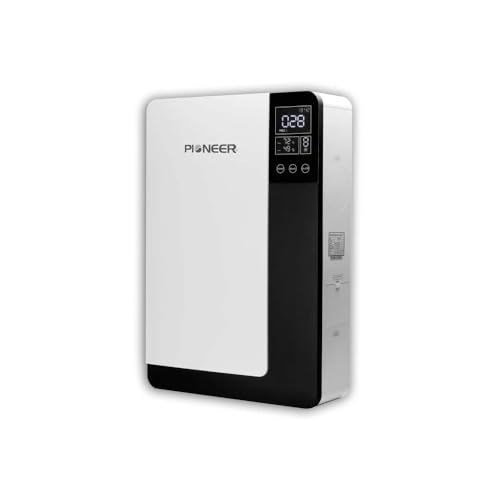
- Tracks PM2.5 and CO2 automatically
- 4-stage filtration with HEPA H10 and charcoal
- Quiet operation in rooms up to 500 sq. ft.
Best For: Single rooms needing smart, quiet air management
High-Airflow Ventilation Choice
NET.Pro 255 CFM Balanced Air ERV

- 255 CFM airflow for stronger ventilation
- Capillary core exchanges heat and cleans air
- Designed for quiet, durable operation
Best For: High-airflow installs that favor durability and simplicity
Wall-or-Ceiling Utility Pick
Broan B130E65RS AI 119 CFM ERV
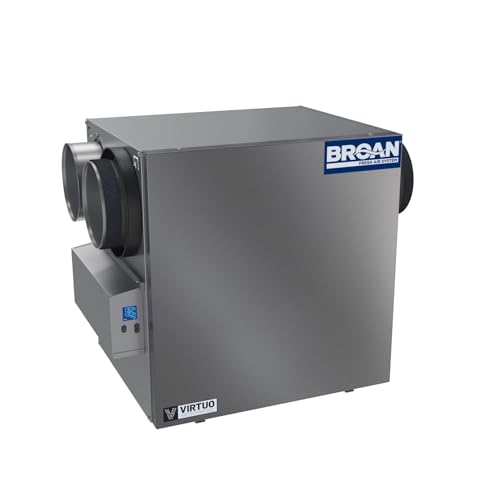
- 119 CFM steady residential airflow
- MERV 8 filters included
- Wall or ceiling mounting with side ports
Best For: Straightforward whole-home ventilation with basic filtration
Whole-Home Fresh Air Pick

- Whole-house balanced ventilation with up to 162 CFM
- Enthalpy core recovers heat and moisture
- Anti-frost protection and washable MERV 6 filters
Best For: Whole-home ventilation with cold-climate reliability
High-Capacity Wall/Ceiling Option
Broan B210E75RS AI 206 CFM ERV

- Up to 210 CFM for higher-capacity ventilation
- Wall or ceiling mount with auto-balancing
- Includes LCD screen, brushless motor, and MERV 8 filter
Best For: Higher-capacity installs with flexible mounting
Ductless Room-by-Room Choice
VENTS-US TwinFresh Comfo RB1-50-2

- Ductless through-the-wall ERV for rooms up to 500 sq. ft.
- Recovers up to 88% of heat or cooling
- Runs as quietly as 0.2 sones with as little as 4.5 watts
Best For: Single-room ventilation in retrofits and tight spaces
Premium Whole-Home Balance
Panasonic Intelli-Balance Elite Plus+ 120 CFM ERV

- 30–120 CFM adjustable airflow
- Dual MERV 13 filters included
- Ceiling, wall, or floor mount options
Best For: Homeowners wanting flexible installation and strong filtration
Budget-Friendly Attic Ventilation
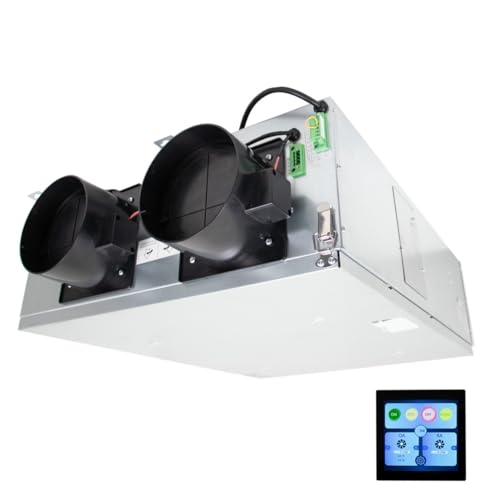
- 40–100 CFM variable airflow
- Touch screen control panel included
- Washable filters and humidity sensor
Best For: Attic-mounted installs with simple controls
Quiet Mid-Capacity Ventilation
Panasonic Intelli-Balance Elite 110 CFM ERV
- 30–110 CFM adjustable airflow
- Dual MERV 13 filters included
- Wi-Fi module and wall control included
Best For: Homes needing quieter ERV operation with included controls
Whole-Home ERV Pick – Aprilaire V22BEC 120 CFM Whole-House ERV
If you want an energy recovery ventilator for home that can support whole-house fresh air exchange, the Aprilaire V22BEC is built for larger spaces and practical installation flexibility. It brings in outdoor air, helps temper that air with recovered heat and moisture, and aims to reduce stale-air issues like odors, humidity, and airborne pollutants.
Best For: Larger homes that need balanced ventilation with wall, ceiling, or floor mounting options.
Pros:
- 120 CFM capacity is suited for homes up to 6,000 sq. ft.
- Energy recovery core helps temper incoming air and may lower HVAC load.
- Balanced supply and exhaust design helps preserve indoor comfort.
- Push-button controls make airflow adjustments straightforward.
Cons:
- Noise level is listed at 53 decibels, so it is not the quietest option here.
- Single-speed design may be less flexible than multi-speed smart units.
- Best fit appears to be dedicated whole-house installation rather than a small room.
For buyers comparing an energy recovery ventilator for home use across the whole house, this Aprilaire model stands out for capacity and installation versatility. It is a solid choice when you want balanced ventilation without giving up too much indoor temperature or humidity control.
Smart Room Ventilation Pick – Pioneer ECOasis 150 Ductless Wi-Fi ERV
The Pioneer ECOasis 150 is a ductless energy recovery ventilator for home use that focuses on single-room air quality and smart control. It combines energy recovery with built-in monitoring, so it can track PM2.5 and CO2 while adjusting airflow across eight speeds for rooms up to 500 sq. ft.
Best For: Bedrooms, living rooms, or other single spaces where quiet operation and air-quality monitoring matter.
Pros:
- Built-in PM2.5 sensor and CO2 monitor provide continuous air-quality tracking.
- 4-stage filtration includes HEPA H10 and activated charcoal for dust, smoke, and odors.
- 82% efficient heat exchanger helps recover energy from outgoing air.
- Wi-Fi, app, touchscreen, and remote control offer flexible operation.
Cons:
- Coverage is limited to rooms up to 500 sq. ft.
- Not listed as smart home compatible, despite having Wi-Fi control.
- Side or rear installation may still require careful placement planning.
For shoppers who want a compact energy recovery ventilator for home rooms rather than a whole-house system, this Pioneer unit has one of the strongest feature sets. Its monitoring, filtration, and low power draw make it especially appealing for comfort-focused everyday use.
High-Airflow Ventilation Choice – NET.Pro 255 CFM Balanced Air ERV
If you need an energy recovery ventilator for home ventilation with a stronger airflow rating, the NET.Pro model is positioned as a balanced air solution for exhausting and exchanging air. It uses a capillary core to transfer heat while cleaning air, and it is described as quiet, durable, and code compliant.
Best For: Buyers prioritizing higher airflow and simple, durable ventilation hardware.
Pros:
- 255 CFM airflow is higher than the other ERV options in this roundup.
- Capillary core exchanges heat while helping clean incoming and outgoing air.
- Low-noise motors and centrifugal fan are designed for quiet operation.
- Permanently lubricated motors and quality components support durability.
Cons:
- Product details are sparse compared with the more fully specified models.
- No filtration ratings or room coverage figures are provided in the notes.
- Control is limited to button control, with no smart or remote features listed.
This NET.Pro unit makes sense when airflow and straightforward construction matter more than bells and whistles. As an energy recovery ventilator for home setups that need a strong balanced-ventilation approach, it offers a practical, no-frills profile.
Wall-or-Ceiling Utility Pick – Broan B130E65RS AI 119 CFM ERV
The Broan B130E65RS AI is a wall- or ceiling-mounted energy recovery ventilator for home use that keeps the focus on dependable ventilation hardware. With 119 CFM, MERV 8 filters, and side ports, it is built for homeowners who want a recognized ventilation brand and a straightforward whole-home fresh-air solution.
Best For: Homeowners who want a wall- or ceiling-mounted ERV with basic filtration.
Pros:
- 119 CFM airflow is suitable for steady residential ventilation.
- MERV 8 filters add a basic layer of filtration.
- Wall or ceiling mounting provides installation flexibility.
- Side ports can make placement easier in some layouts.
Cons:
- Few performance details are supplied beyond airflow and filters.
- No noise level, efficiency rating, or control features are listed.
- It is less feature-rich than the smart or high-spec models in this roundup.
For buyers who want a practical energy recovery ventilator for home ventilation without a long feature list, this Broan model is a reasonable fit. It emphasizes established-brand ventilation basics, which may be enough for straightforward fresh-air needs.
Whole-Home Fresh Air Pick – VENTS-US Frigate ERV 120s
If you want an energy recovery ventilator for home use that supports balanced ventilation across the whole house, the VENTS-US Frigate ERV 120s is built for that job. It brings in fresh air, exhausts stale air, and helps stabilize temperature and humidity with an enthalpy core.
Best For: Whole-house ventilation in homes that need cold-climate reliability and straightforward three-speed control.
Pros:
- HVI certified whole-house air exchange for balanced supply and exhaust.
- Enthalpy core recovers heat and moisture, with up to 65% apparent sensible effectiveness.
- Anti-frost protection helps it operate more reliably in freezing conditions.
- Low-power operation on LOW speed with washable MERV 6 filters included.
Cons:
- Requires standard 5-inch duct connections and ceiling mounting space.
- Built-in controls are basic, with a simple three-key speed switch.
This is a practical pick if you want a whole-house ERV that focuses on steady air exchange, energy recovery, and cold-weather protection rather than advanced automation. The 162 CFM maximum airflow gives it enough capacity for larger ventilation needs.
High-Capacity Wall/Ceiling Option – Broan B210E75RS AI 206 CFM ERV
For buyers comparing an energy recovery ventilator for home comfort with higher airflow and flexible mounting, the Broan B210E75RS AI stands out. It is designed for wall or ceiling installation and includes VIRTUO technology with auto-balancing plus an integrated LCD screen.
Best For: Homes that want a higher-capacity ERV with flexible mounting and built-in balancing features.
Pros:
- Up to 210 CFM airflow for stronger whole-home ventilation capacity.
- Wall-mount or ceiling-mount installation gives it more placement flexibility.
- VIRTUO technology with auto-balancing and an integrated LCD screen adds convenience.
- Includes a MERV 8 filter and brushless motor.
Cons:
- Uses 270 watts, so it is not the lowest-power option here.
- Larger and heavier unit may be less convenient for compact installs.
This model makes sense if airflow capacity and installation flexibility matter more than minimal size or wattage. Its feature set is geared toward homeowners who want a more advanced ERV with built-in support for balancing and control.
Ductless Room-by-Room Choice – VENTS-US TwinFresh Comfo RB1-50-2
If you need an energy recovery ventilator for home spaces without ductwork, the VENTS-US TwinFresh Comfo RB1-50-2 is a compact through-the-wall solution. It provides continuous fresh air ventilation for rooms up to 500 sq. ft. while recovering up to 88% of heat or cooling.
Best For: Bedrooms, basements, offices, and remodels where a ductless ERV is easier than a full system.
Pros:
- Ductless through-the-wall design avoids the need for traditional ductwork.
- Recovering up to 88% of heat or cooling helps reduce HVAC load.
- Very low power use at as little as 4.5 watts and quiet operation down to 0.2 sones.
- Humidity sensor, MERV 5 filters, and remote control add everyday convenience.
Cons:
- Designed for single-room coverage rather than a full-house setup.
- Requires a wall thickness of 6 to 20 inches, which limits placement options.
This is a strong fit when you want targeted ventilation in a specific room instead of a central ERV system. Its low noise, low power draw, and frost-free design make it especially appealing for occupied spaces and colder climates.
Premium Whole-Home Balance – Panasonic Intelli-Balance Elite Plus+ 120 CFM ERV
If you want an energy recovery ventilator for home use that can handle flexible installation and tighter filtration, this Panasonic Intelli-Balance Elite Plus+ is built for that role. It offers adjustable airflow from 30 to 120 CFM, SmartFlow ECM motors for quieter automatic balancing, and a hygroscopic core that helps transfer heat and moisture while bringing in fresh air.
Best For: Homeowners who want a high-capacity ERV with strong filtration and flexible mounting options.
Pros:
- SmartFlow dual brushless motors automatically adjust to maintain airflow under static pressure.
- Customizable 30–120 CFM airflow supports balanced, positive, or negative pressure setups.
- Dual MERV 13 filters are included for incoming and outgoing air.
- Can be mounted on the ceiling, wall, or floor, with plug-in or hardwired options.
Cons:
- May be more system than a simple single-room ventilation need.
- Wi-Fi and some controls are optional accessories, not built in by default.
This model stands out for buyers who want adjustable performance and higher-grade filtration in one unit. If installation flexibility matters as much as air quality control, it is one of the more versatile home ERV options here.
Budget-Friendly Attic Ventilation – Awoco 6" ERV System 100 CFM
This Awoco energy recovery ventilator for home ventilation is geared toward buyers who want a compact, install-ready system with a control panel and washable filtration. It uses two enclosed EC motors, offers variable airflow from 40 to 100 CFM, and includes a humidity sensor, timer control, and built-in dampers for defrost and recirculation cycling.
Best For: Attic-mounted ERV setups where easy controls and washable filters are priorities.
Pros:
- Variable airflow from 40 to 100 CFM lets you tune outside air and return air settings.
- Includes a touch screen control panel plus a timer knob for run-time control.
- Washable 20 PPI filters help reduce ongoing maintenance.
- Built-in humidity sensor and defrost/recirculation dampers add convenience.
Cons:
- Designed for attic mounting, so it is less flexible than wall- or floor-mount units.
- Uses a 6-inch duct setup, which may require more specific installation planning.
Overall, this Awoco model is a practical pick for a dedicated attic installation where control features matter as much as air exchange. It balances useful automation with a straightforward, serviceable design.
Quiet Mid-Capacity Ventilation – Panasonic Intelli-Balance Elite 110 CFM ERV
For shoppers comparing an energy recovery ventilator for home comfort and efficiency, this Panasonic Intelli-Balance Elite keeps the same flexible platform in a slightly lower-capacity version. It provides 30 to 110 CFM airflow, dual MERV 13 filters, and SmartFlow ECM motors that automatically adjust to changing pressure conditions while maintaining quiet operation.
Best For: Homes that want quiet, flexible ERV performance with included control accessories.
Pros:
- SmartFlow dual brushless motors help maintain airflow under varying pressure conditions.
- 30–110 CFM range supports balanced, positive, or negative pressure setups.
- Dual MERV 13 filters are included for both incoming and outgoing air.
- Comes with a Wi-Fi module, touch screen wall control, and low-voltage timer switch.
Cons:
- Lower maximum airflow than the 120 CFM Panasonic model.
- Heavier unit at 61.7 pounds, which may matter during installation.
This is a strong fit if you want Panasonic’s flexible mounting and control ecosystem without jumping to the highest airflow rating. It makes the most sense for buyers prioritizing quiet operation and a more complete accessory package.
How We Picked These Energy Recovery Ventilator for Home Options
We prioritized airflow range, balanced ventilation performance, filtration quality, installation flexibility, and features that matter in real homes, such as freeze protection, smart controls, and quiet operation. We also looked for models suited to different layouts, from centralized whole-house systems to ductless room-by-room units.
Quick Comparison: Which Type Fits Your Home?
Whole-house ERVs are best when you want consistent fresh air across multiple rooms and already have ducting or are planning a larger install. Ductless or single-room units make more sense for apartments, additions, basements, or problem rooms where full-house ventilation is unnecessary.
Key Buying Factors for an Energy Recovery Ventilator for Home
Airflow and Home Size
Match CFM output to the space you need to ventilate. Lower-capacity units suit single rooms, while higher-CFM models are better for larger homes or higher occupancy.
Filtration and Indoor Air Quality
Filter level matters if you want stronger particulate control. MERV 8 is a solid baseline, while MERV 13 can be a better fit for households concerned about finer particles, pollen, or smoke.
Energy Recovery Core and Efficiency
Look for a proven ERV core that helps transfer moisture and thermal energy between incoming and outgoing air streams. That balance is especially useful in climates with humidity swings.
Installation and Ducting
An Energy Recovery Ventilator for Home use can be wall-, ceiling-, or duct-connected. Choose the format that best matches your existing layout and the amount of renovation you’re willing to take on.
Controls, Noise, and Maintenance
Smart controls, variable speeds, and easy filter access improve day-to-day usability. Quiet operation is important in bedrooms, offices, and living spaces, while simple filter replacement keeps long-term upkeep manageable.
Who Should Buy Which Energy Recovery Ventilator for Home?
Choose a whole-house ERV if you want broad coverage and more even ventilation throughout the home. Pick a ductless single-room unit if your goal is targeted fresh air in one space or you need a simpler install. If filtration is a top priority, lean toward models with higher-grade filters and stable airflow control. For larger homes, higher-CFM options are the safer starting point; for small spaces, compact ventilators are usually the better value.
In short, the best choice depends on your home size, climate, and installation path. Focus on the balance of ventilation capacity, filtration, and setup ease, and you’ll end up with an ERV that supports healthier indoor air without adding unnecessary complexity.