Choosing the best gravity water filter for hiking means balancing pack weight, flow rate, capacity, filtration performance, and ease of use. The right system can make treating water at camp faster and less tiring than pumping every liter by hand.
This roundup compares 10 options for solo hikers, backpacking partners, and larger groups, including compact filter bags, squeeze-compatible systems, and high-capacity gravity setups.
Best 10 Gravity Water Filter for Hiking Picks for 2026
Best Hands-Free Pick
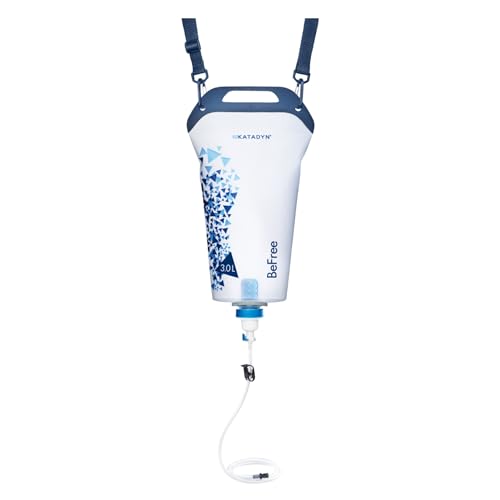
- Hands-free gravity operation
- Up to 2 L/min flow
- Lightweight, collapsible 3L bag
Best For: Solo hikers and small groups wanting easy gravity filtration
Best Long-Life Option
Sawyer Squeeze with CNOC 2L Bladder

- Rated up to 100,000 gallons
- Includes wide-mouth 2L bladder
- Cleanable hollow-fiber filter
Best For: Frequent hikers who want a reusable filtration system
Best Versatile Gravity System

- Multiple use modes
- 3L capacity for trail use
- Targets microbes and sediment
Best For: Hikers wanting a flexible filter for camp and travel
Best Ultralight Backup

- Only 2 ounces
- Works with bottles and hydration packs
- Rated up to 100,000 gallons
Best For: Ultralight hikers needing compact, flexible filtration
Best Value for Groups
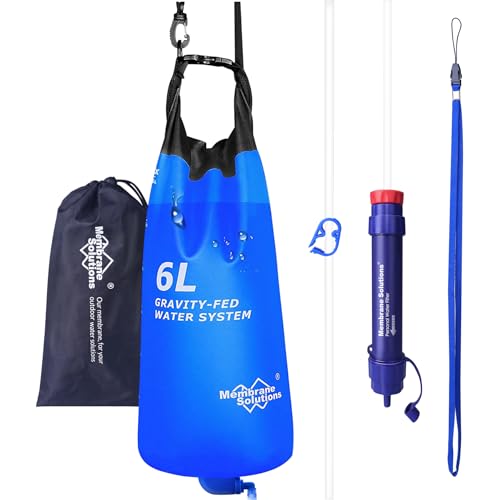
- 6-liter capacity for 3–6 people
- Four-stage, 0.1-micron filtration
- Lightweight, certified, and pump-free
Best For: Small groups, backpacking, and emergency preparedness
Best High-Flow Pick

- 10-liter reservoir for larger groups
- Fast 1.75-liter-per-minute flow
- Packs down to 8 x 4 inches
Best For: Basecamps and high-volume group water needs
Best Complete Camp Kit

- Separate 6-liter dirty and clean bags
- Fast 1.75-liter-per-minute filtration
- EPA/NSF guideline performance claims
Best For: Family camping and organized group water filtration
Best Lightweight Pick
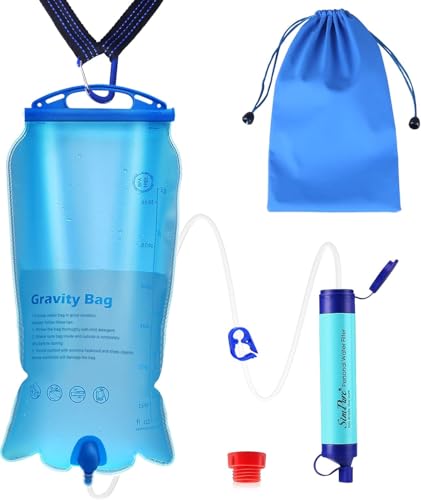
- 2.8-ounce filter rolls up for packing
- Hands-free 3-liter gravity setup
- 27 L/h flow and 5,000-liter lifespan
Best For: Ultralight hikers and compact emergency kits
Best High-Capacity Option
Waterdrop Gravity Filter Straw
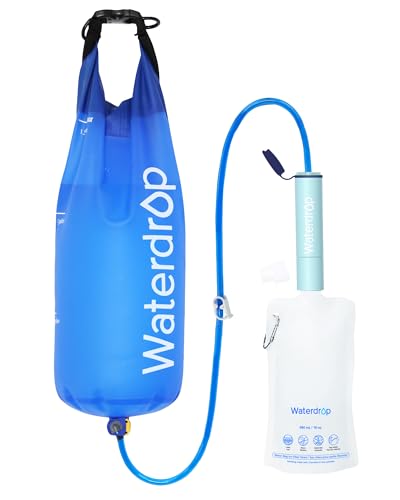
- Large 1.5-gallon gravity-fed bag
- 700 ml/min maximum flow
- Backwashable, bottle-compatible straw
Best For: Campers needing more stored water
Best Certified Design
Membrane Solutions 1-Gallon Filter

- NSF/ANSI 42, 372, and 401 listed
- Four-stage, 0.1-micron filtration
- 500 ml/min flow with backwash support
Best For: Solo hikers and small groups seeking versatility
Best Hands-Free Pick – Katadyn BeFree Gravity 3L
The Katadyn BeFree Gravity 3L is a straightforward gravity water filter for hiking when you want to fill a bag, hang it, and let water flow without pumping, squeezing, or batteries. Its 3-liter capacity and collapsible design suit solo hikers and small groups.
Best For: Hikers who prioritize hands-free filtration and a lightweight, packable setup.
Pros:
- Gravity-fed operation requires no pumping, squeezing, or power.
- 0.1-micron hollow-fiber filter processes water at up to 2 L/min.
- Lightweight 6.4-ounce, 3-liter bag packs flat when empty.
- Filter can be cleaned by shaking or swishing in water without tools.
Cons:
- Its stated filter capacity is up to 1,000 liters, lower than some reusable alternatives.
- Requires a branch, pole, or other anchor point for gravity operation.
For hikers who want simple camp water treatment with minimal effort, the BeFree combines a useful 3-liter capacity with a quick, hands-free flow rate.
Best Long-Life Option – Sawyer Squeeze with CNOC 2L Bladder
The Sawyer Squeeze system is a versatile alternative for hikers who value a reusable filter and flexible water handling. The included 2-liter CNOC bladder has a wide mouth for filling, while the filter can be cleaned and reused for up to 100,000 gallons.
Best For: Frequent hikers seeking a durable, long-lasting filtration system with manual operation.
Pros:
- Reusable hollow-fiber filter is rated for up to 100,000 gallons.
- Includes a durable 2-liter TPU bladder with a wide-mouth opening.
- Includes a cleaning coupling and plunger for backwashing.
- System weighs less than 6 ounces and removes bacteria, protozoa, cysts, sediment, and microplastics.
Cons:
- Manual squeeze operation requires more effort than a gravity-only system.
- The listed weight is about 0.27 kg, making it heavier than the included MINI filter.
This is a strong choice when long-term value and cleanability matter more than completely hands-free operation.
Best Versatile Gravity System – LifeStraw Peak Compact 3L
The LifeStraw Peak Compact is a flexible gravity water filter for hiking, camping, and travel. Its 3-liter system can also function as a squeeze bottle, straw, or bottle-mounted filter, giving you several ways to use it around camp and on the trail.
Best For: Hikers who want one compact filter that supports multiple drinking and filtration setups.
Pros:
- Can be used as a gravity system, squeeze bottle, straw, or with a water bottle.
- 3-liter capacity fits backpacking and group-camping use.
- Designed to remove bacteria, parasites, microplastics, silt, sand, and cloudiness.
- Premium materials are intended to improve durability and leak resistance.
Cons:
- At 228 grams, it is heavier than the Katadyn BeFree listed here.
- The supplied specifications list a maximum supported TDS level of 500 ppm.
The Peak stands out for adaptability: it is a practical pick when you want gravity filtration without giving up alternate ways to collect and drink water.
Best Ultralight Backup – Sawyer MINI Water Filter
The Sawyer MINI is a compact option for hikers who want to keep pack weight and bulk low. Although it is not a dedicated gravity bag system, it can attach to the included pouch, compatible bottles, or hydration packs, and it weighs only 2 ounces.
Best For: Ultralight hikers and travelers who prefer flexible, compact water filtration.
Pros:
- 2-ounce filter fits easily into a small hiking kit.
- Works with the included 16-ounce pouch, standard 28 mm bottles, hydration packs, or the included straw.
- 0.1-micron hollow-fiber filter removes bacteria, protozoa, and microplastics.
- Rated for up to 100,000 gallons and includes a cleaning plunger.
Cons:
- It is not a dedicated hands-free gravity water filter system.
- The included pouch holds only 16 ounces.
Choose the MINI when minimum weight and attachment flexibility are more important than a larger gravity reservoir or hands-free camp setup.
Best Value for Groups – 6L Gravity Water Filter Pro
If you need a gravity water filter for hiking that can also support a small camp, the Membrane Solutions 6L model offers a practical balance of capacity, portability, and filtration features. Its pump-free design produces up to 0.5 liters per minute and packs into a backpack or emergency kit.
Best For: Small groups, basecamp use, backpacking, and emergency water backup.
Pros:
- 6-liter capacity is designed for 3–6 people.
- Four-stage filtration includes a 0.1-micron hollow fiber membrane, carbon, and dual PP pre-filters.
- NSF/ANSI 42, 372, and 401 certified, with a stated 1,320-gallon filter life.
- Lightweight 12.8-ounce collapsible TPU design requires no pumping or electricity.
Cons:
- Its 0.5-liter-per-minute flow rate is slower than the larger MSR and Platypus systems.
- The 6-liter capacity may be limited for larger groups or high-volume camp chores.
This is a versatile choice when certification, compact storage, and long filter life matter more than maximum flow speed. It is especially useful for hikers who want one system for trips and preparedness.
Best High-Flow Pick – MSR AutoFlow XL 10L
The MSR AutoFlow XL is a strong gravity water filter for hiking when a larger group needs clean water quickly. Its 10-liter reservoir and 1.75-liter-per-minute flow rate make it well suited to basecamps and shared backcountry setups without requiring manual pumping.
Best For: Larger backpacking groups, basecamps, and high-volume water needs.
Pros:
- 10-liter capacity supports larger groups and extended camp use.
- Delivers water at up to 1.75 liters per minute without pumping.
- Designed to remove 99.9999% of bacteria and 99.9% of protozoa, plus dirt and debris.
- 12-ounce build packs down to 8 x 4 inches and includes a three-year limited warranty.
Cons:
- The 10-liter reservoir is larger than necessary for solo hikers or minimalist trips.
- The supplied details list the power source as battery powered, despite the system being described as gravity-operated.
Choose the AutoFlow XL if throughput and capacity are your priorities. Its durable reservoir, sediment trap, and compact packed size add useful features for frequent group camping.
Best Complete Camp Kit – Platypus GravityWorks 6L
The Platypus GravityWorks 6L is a convenient gravity water filter for hiking when you want separate dirty- and clean-water reservoirs in one complete kit. It can provide six liters of filtered water in under four minutes, making it practical for group camping, cooking, and camp cleanup.
Best For: Family camping, group trips, and hikers who want a ready-to-use two-reservoir system.
Pros:
- Includes separate 6-liter dirty and clean water reservoirs.
- Produces up to 1.75 liters per minute with no pumping.
- Meets EPA/NSF guidelines for removing 99.9999% of bacteria and 99.9% of protozoa.
- Replaceable cartridge filters up to 1,500 gallons and includes a three-year warranty.
Cons:
- The two-reservoir setup may take more packing space than a single-bag system.
- Its 6-liter capacity is smaller than the MSR AutoFlow XL’s 10-liter reservoir.
GravityWorks stands out for its organized clean-water workflow and fast output. It is a sensible choice for campers who value a complete kit and easy separation between untreated and filtered water.
Best Lightweight Pick – SimPure 3L Gravity Filter
If you want a lightweight gravity water filter for hiking, the SimPure Portable Gravity-Fed Water Filter combines a 3-liter bag with flexible drinking options. Its tree-strap setup requires no pumping or squeezing, making it practical for backpacking camps and emergency kits.
Best For: Hikers who prioritize low weight, hands-free filtration, and multiple connection options.
Pros:
- Filter weighs just 2.8 ounces and rolls up for compact packing.
- 3-liter TPU bag provides a useful water reserve for camp.
- 0.1-micron hollow fiber, activated carbon, and PP filtration help reduce contaminants, chlorine, odors, and poor taste.
- Can connect to a bottle or extension tube and filter up to 27 liters per hour.
Cons:
- The complete system weighs about 3.2 ounces, slightly more than the filter alone.
- The 3-liter capacity may be limiting for larger groups.
With its very low filter weight, long rated 5,000-liter lifespan, and versatile setup, this is a strong choice when pack space matters more than maximum water capacity.
Best High-Capacity Option – Waterdrop Gravity Filter Straw
The Waterdrop Gravity Water Filter Straw is a useful gravity water filter for hiking when you need a larger camp supply. Its 1.5-gallon bag can hold enough water for extended outdoor use, while the straw also connects with compatible bottles and includes a backwash function.
Best For: Hikers and campers who want high capacity with bottle and pouch compatibility.
Pros:
- 1.5-gallon gravity bag supports a substantial outdoor water supply.
- 0.1-micron ultrafiltration helps reduce chlorine, sediment, particulates, odors, and bad taste.
- Rated flow reaches up to 700 milliliters per minute.
- Backwashable design can be connected to the included pouch, a water bag, or a compatible bottle.
Cons:
- The system requires air to be emptied from the hose to avoid vacuum-related flow problems.
- The listed filter warranty is limited to 30 days.
This model stands out for group-friendly capacity and fast stated flow, although its setup instructions require a little more attention than a simple squeeze or pump filter.
Best Certified Design – Membrane Solutions 1-Gallon Filter
For shoppers seeking a gravity water filter for hiking with a compact one-gallon format, the Membrane Solutions system offers a balanced setup. It uses a 0.1-micron, four-stage filter, an adjustable tree strap, and a backwashable design that can connect to standard water bottles.
Best For: Solo hikers or small groups wanting a versatile, standards-certified gravity system.
Pros:
- One-gallon capacity suits solo and small-group trips without excessive bulk.
- NSF/ANSI 42, 372, and 401 standards are listed for the filtration system.
- Four-stage filtration combines hollow fiber, activated carbon, and dual PP fiber filters.
- 500 ml/min flow, bottle compatibility, extension-hose support, and backwashing add flexibility.
Cons:
- At 11.2 ounces, it is substantially heavier than the SimPure filter-only setup.
- The one-gallon bag offers less capacity than the Waterdrop’s 1.5-gallon bag.
This is a practical middle-ground option: it provides useful filtration versatility and a listed standards-based design, while keeping capacity manageable for smaller hiking groups.
How We Picked the Best Gravity Water Filter for Hiking
We focused on the features that matter most outdoors: total system weight, reservoir capacity, portability, filtration design, expected flow, setup simplicity, and compatibility with common hydration containers. We also considered whether each option suits solo trips, multi-day backpacking, or group camping.
A gravity system should be judged as a complete kit, not only by its filter cartridge. A larger dirty-water bag may improve camp efficiency but add bulk, while a compact setup may be easier to carry but require more frequent refills. Always check the manufacturer’s instructions for backflushing, cartridge replacement, and water-quality limitations.
Quick Comparison
| Type | Best For | Main Advantage | Potential Trade-Off |
|---|---|---|---|
| Compact gravity systems | Solo hikers and lightweight backpackers | Low pack bulk | Smaller capacity |
| Squeeze-compatible filters | Flexible backpacking setups | Works with bottles or reservoirs | May require more manual handling |
| 3–6 liter systems | Couples and small groups | Good balance of capacity and portability | Heavier when packed |
| 8–10 liter systems | Group camping | Fewer refills at camp | Larger storage footprint |
Key Buying Factors for a Gravity Water Filter for Hiking
Capacity and Pack Weight
For solo trips, a 2- to 3-liter reservoir is often sufficient and easier to pack. Groups may benefit from 6 to 10 liters, especially when collecting water once for cooking and drinking. Remember that water weighs about 1 kilogram per liter, so high capacity is most useful near camp rather than during long carries.
Filtration and Water Conditions
Look for a filter rated for the contaminants relevant to your route. Most hiking filters target bacteria and protozoa, but not every model removes viruses, chemicals, or dissolved minerals. Avoid assuming that a “purifier” label means identical performance across brands, and follow the stated source-water limits.
Flow Rate and Maintenance
A faster flow rate is valuable when filling several bottles, but performance can slow as the filter loads with sediment. Backflushing or cleaning may be required. Choose a design with accessible connections and clear instructions if you expect silty lakes, rivers, or frequent use.
Usability and Durability
Inspect the bag material, hose connections, shutoff valves, and included adapters. A wide opening makes filling easier, while a transparent reservoir can help monitor water levels. For cold-weather trips, protect the filter from freezing, which can damage internal membranes.
Who Should Buy Which Gravity Water Filter for Hiking?
Solo ultralight hikers: Choose the smallest compact gravity or squeeze-compatible option that meets your daily water needs.
Couples and small backpacking groups: A 3- to 6-liter system offers a practical balance of refill frequency, weight, and camp convenience.
Family or group campers: Prioritize a larger reservoir, durable fittings, and a strong sustained flow rate over minimum trail weight.
Flexible gear users: Consider a filter that connects to standard bottles, hydration reservoirs, or replacement bags so it can adapt to different trips.