Hidden moisture is one of the earliest warning signs of mold, whether it is trapped behind drywall, absorbed into flooring, or collecting in wood framing. The right meter can help you scan suspect areas quickly without immediately opening walls or damaging finished surfaces.
This roundup compares 10 moisture meters for mold prevention, including non-destructive pinless models, pin-type testers, and combination meters with humidity and temperature readings. Use the guide below to match the meter’s sensing method, depth, display, and alarm features to your home or job site.
Best 10 Moisture Meter for Mold Prevention Picks for 2026
Best Pinless Option
Klein Tools ET140 Moisture Meter

- Pinless readings up to 3/4 inch deep
- Calibrated for four common building materials
- Reverse-contrast display with LED range bar
Best For: Home leak and dampness checks without surface damage
Best for Wood Detail
Mecurate Digital Pin-Type Moisture Meter

- Eight calibrated wood scales plus building-material mode
- Three-color moisture indicators and backlit display
- Includes calibration aid, pouch, and replacement pins
Best For: Detailed wood and wall moisture checks
Best Home-Use Pinless Meter
Kiprim WM01 Pinless Moisture Tester

- Four modes for wood, walls, and masonry
- Scans up to 40 mm without surface damage
- Hold function and selectable audible alerts
Best For: Routine household dampness screening
Best Combination Meter
General Tools MMH800 Moisture Meter

- Pin and pinless sensors for flexible testing
- Displays moisture, temperature, and humidity
- Visual and audible high-moisture indications
Best For: Detailed home inspection and remediation checks
Best Overall
ERICKHILL Pinless Moisture Meter

- Scans up to 2 inches deep
- Tests wood, walls, and masonry
- Includes alarm and material modes
Best For: Broad home-inspection and mold-prevention checks
Best Budget Pick
MT28 Pinless Wall Moisture Tester

- Simple pinless surface scanning
- Works on walls, floors, wood, and masonry
- Compact 7-ounce design
Best For: Basic DIY dampness checks on finished surfaces
Best for Area Scans
LASELION MS04 Ball Probe Meter

- Ball probe scans corners and broad areas
- Detects moisture 5–40 mm deep
- Customizable MID and WET alarms
Best For: Non-destructive leak checks across walls, floors, and ceilings
Best with Extra Features

- Pinless scanning protects finished surfaces
- Four modes for wood, walls, and masonry
- Color display with moisture alerts
Best For: Home inspections across wood and building materials
Best for Detailed Wood Checks
Tavool Pin-Type Moisture Detector
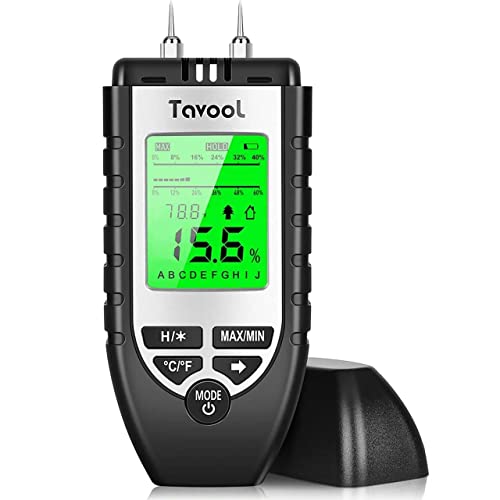
- Eight wood calibration scales
- Separate wood and building-material modes
- Backlit display with memory and hold
Best For: Woodworking, flooring, lumber, and targeted dampness checks
Best Rechargeable Upgrade
AWT-380 Pinless Moisture Meter

- Reads in about one second
- USB-C rechargeable battery
- Custom alarms with data storage
Best For: Frequent, non-destructive home moisture monitoring
Best Pinless Option – Klein Tools ET140 Moisture Meter
If you want a straightforward moisture meter for mold prevention, the Klein Tools ET140 provides noninvasive readings without puncturing finished surfaces. Its electromagnetic sensing reaches up to 3/4 inch and is calibrated for drywall, masonry, hardwood, and softwood.
Best For: Homeowners checking walls, floors, and wood after leaks or flooding.
Pros:
- Pinless, nondestructive detection up to 3/4 inch deep
- Works with drywall, masonry, hardwood, and softwood
- Reverse-contrast display and nine-LED moisture range indicator
- Includes a 9V battery, instructions, and 2-meter drop protection
Cons:
- Calibrated only for the four listed material types
- Does not provide pin-style readings for pinpoint testing
The ET140 is a practical choice when preserving surfaces matters. Hold, audible-alert, low-battery, and auto-off features make routine leak checks simple, though users needing broader material compatibility may want another model.
Best for Wood Detail – Mecurate Digital Pin-Type Moisture Meter
The Mecurate is a useful moisture meter for mold prevention when you need material-specific readings and visible alerts. Its pin sensors measure wood and building materials, while eight wood scales help accommodate different wood types.
Best For: Woodworkers, painters, and homeowners testing wood or building materials in varied lighting.
Pros:
- Wood and building-material modes with 0.1% resolution
- Eight calibrated wood scales and a self-testing calibration aid
- Color indicators and on-screen icons flag low, medium, or high moisture
- Backlit display, temperature readings, pouch, and replacement pins included
Cons:
- Pin-type testing leaves small insertion marks
- Correct wood-scale selection is required for the most useful readings
With its detailed wood settings and quick visual feedback, the Mecurate suits targeted checks around damp materials. The backlight and temperature function add convenience for inspections in different conditions.
Best Home-Use Pinless Meter – Kiprim WM01 Pinless Moisture Tester
The Kiprim WM01 is a pinless moisture meter for mold prevention that scans surfaces without leaving probe holes. It offers separate modes for softwood, hardwood, walls, and masonry and detects moisture up to 40 mm deep.
Best For: Homeowners screening wood, floors, walls, and masonry for hidden dampness.
Pros:
- Non-destructive testing with four material modes
- Detects moisture up to 40 mm deep
- One-key data hold and audible alerts with mute option
- Includes a carrying pouch, user manual, and 9V battery
Cons:
- Not recommended for drywall or other low-density materials
- Metal, pipes, and wiring behind a surface can interfere with readings
- Positioned as a home-use rather than professional-grade instrument
The WM01 provides convenient preliminary screening before moisture damage worsens. Its material limitations and potential interference mean readings should be taken carefully and confirmed when a problem is suspected.
Best Combination Meter – General Tools MMH800 Moisture Meter
For broad moisture investigations, the General Tools MMH800 combines pinless scanning with pin-type follow-up readings. As a moisture meter for mold prevention, it also displays ambient temperature and relative humidity to help assess damp conditions.
Best For: Home inspections and remediation checks requiring both surface scanning and more targeted testing.
Pros:
- Combines pin and pinless sensors in one meter
- Measures moisture percentage, temperature, and relative humidity
- Audible and visual indicators identify low, medium, and high moisture
- Useful for floors, plastered walls, and wood
Cons:
- Pin testing can leave marks in the material
- Heavier and bulkier than the compact meters listed here
- Listed as corded-electric in the supplied specifications despite battery components
The MMH800 is the most versatile option of this group for investigating suspicious stains and deciding whether further remediation may be needed. Its dual sensor design adds flexibility, while the larger form factor may be less convenient for quick spot checks.
Best Overall – ERICKHILL Pinless Moisture Meter
The ERICKHILL is a versatile moisture meter for mold prevention when you need to scan walls, wood, drywall, masonry, and other building materials without making holes. Its selectable material modes, deep sensing, visual indicator, and moisture alarm make it useful for routine checks and early detection.
Best For: Homeowners and inspectors who want broad material coverage, deeper scans, and an adjustable alarm.
Pros:
- Pinless, non-destructive sensing reaches up to 2 inches deep.
- Supports softwood, hardwood, wall, and masonry testing with selectable correction factors.
- Tri-color bar indicator, backlit LCD, audible alarm, and auto-off improve usability.
- Includes three AAA batteries and a user manual.
Cons:
- Wood accuracy is listed as ±4%, so readings should be treated as an indication rather than a definitive diagnosis.
- Its range of settings may require more setup than a basic meter.
With its wide measuring ranges and customizable material modes, this is the most feature-rich option of the three. It is a strong choice for locating damp areas before they contribute to mold or water damage.
Best Budget Pick – MT28 Pinless Wall Moisture Tester
The MT28 is a straightforward moisture meter for mold prevention and early water-damage checks. Its pinless sensor scans walls, floors, wood, and masonry without leaving holes, making it practical for finished surfaces and occasional DIY inspections.
Best For: Homeowners, renovators, and DIY users who want a simple, non-destructive dampness check.
Pros:
- Pinless operation is suitable for painted walls, finished floors, tile, furniture, and other sensitive surfaces.
- Detects moisture in wood, walls, and masonry to a maximum depth of 0.75 inches.
- Compact 7-ounce design is easy to handle and store.
- Includes a 9V battery and user manual.
Cons:
- Its 0.75-inch sensing depth is shallower than the other listed meters.
- Metal pipes, wiring, and steel studs can interfere with readings.
- The supplied notes do not specify an accuracy rating or audible alarm.
This model keeps the process simple and portable, but its shallower scan depth makes it better for surface-level screening than investigating deeply hidden moisture. Keep it away from metal during testing for more reliable results.
Best for Area Scans – LASELION MS04 Ball Probe Meter
The LASELION MS04 is a moisture meter for mold prevention designed for broader, non-destructive area scans. Its ball probe can cover corners and hard-to-reach areas, while the 5–40 mm measuring depth helps identify both surface and subsurface moisture in walls, floors, ceilings, and wood.
Best For: Users who need convenient area scanning, customizable moisture alerts, and leak detection around corners and larger surfaces.
Pros:
- Ball-shaped probe supports larger-area and corner scans without puncturing surfaces.
- Measures moisture from 5–40 mm deep in wood, walls, and construction materials.
- Customizable MID and WET thresholds provide alerts when readings exceed chosen limits.
- Built-in flashlight and carrying case add convenience for inspections.
Cons:
- The supplied notes do not specify a numerical accuracy rating.
- At 210 g, it is heavier than the compact MT28.
- Its alarm thresholds may require user setup before testing.
The MS04 stands out for scanning coverage rather than maximum depth. Its ball probe, adjustable alarms, and flashlight make it particularly useful when checking corners, ceilings, and larger areas for hidden moisture.
Best with Extra Features – Povlen 4-Mode Moisture Meter
If you want a moisture meter for mold prevention without puncturing finished surfaces, the Povlen pinless meter is a practical option. It scans wood, drywall, masonry, and other materials using four selectable modes, while its color LCD, analog bar, and alerts help you identify elevated moisture before it becomes a larger problem.
Best For: Homeowners, carpenters, and inspectors checking walls, wood, drywall, concrete, cement, and other building materials.
Pros:
- Pinless, non-invasive design helps avoid holes and scratches.
- Four modes cover softwood, hardwood, walls, and masonry.
- Color LCD, hold function, analog bar, and audible or visual alerts support quick checks.
- Includes three AAA batteries and offers auto shutoff with a low-battery indicator.
Cons:
- Listed measurement accuracy is ±4%.
- Requires manual density adjustment in Softwood Mode for different wood types.
Its broad material coverage and non-invasive scanning make this a flexible choice for routine leak checks and mold-prevention inspections. The adjustable modes are especially useful when moving between wood and wall surfaces.
Best for Detailed Wood Checks – Tavool Pin-Type Moisture Detector
For targeted readings in wood and building materials, the Tavool pin-type detector offers a straightforward way to investigate damp areas as part of a moisture meter for mold prevention toolkit. Its two pins penetrate the surface, while eight wood calibration scales help distinguish moisture levels across different wood types.
Best For: Woodworkers, flooring installers, inspectors, lumber suppliers, and homeowners checking wood, walls, floors, paper, and other building materials.
Pros:
- Two precision stainless-steel pins provide quick readings in the test surface.
- Eight wood calibration scales and separate wood and building-material modes support varied applications.
- Backlit LED, hold, memory, and maximum/minimum readings simplify repeated checks.
- Measures wood from 6% to 60% and building materials from 0% to 40%.
Cons:
- Pin-type testing can leave small holes in the surface.
- Requires selecting the appropriate wood scale; the manual notes a specific setting for red and white oak.
- Uses a single included battery rather than a rechargeable power system.
This model is a strong fit when you need wood-specific detail and do not mind contact pins. Its moisture ranges, calibration options, and memory features are useful for comparing readings during flooring, lumber, or leak investigations.
Best Rechargeable Upgrade – AWT-380 Pinless Moisture Meter
The AWT-380 combines fast, non-destructive scanning with rechargeable convenience, making it a useful moisture meter for mold prevention and recurring home inspections. It reads in about one second, scans up to 0.79 inches deep, and lets you set visual and audible alarms for moisture levels that need attention.
Best For: Homeowners performing repeat checks on walls, floors, furniture, firewood, drywall, wood, and masonry.
Pros:
- Pinless scans avoid leaving holes and reach up to 20 mm into materials.
- Built-in USB Type-C rechargeable battery suits frequent use.
- Color display shows readings, battery status, and alarm indicators clearly.
- Adjustable visual and audible alarms, max hold, and data storage support ongoing inspections.
Cons:
- Supplied notes do not specify a measurement accuracy percentage.
- Its flat-pad design may be less targeted than a pin meter for pinpointing moisture in small areas.
- Requires charging when the built-in lithium-ion battery is depleted.
With rapid readings, saved data, and customizable alerts, the AWT-380 is well suited to monitoring recurring damp spots or checking whether materials have dried. The rechargeable design also reduces reliance on disposable batteries.
How We Picked the Best Moisture Meter for Mold Prevention
We focused on meters suited to common moisture investigations in homes, workshops, and renovation projects. The selection includes pinless scanners for broad, non-destructive checks; pin-type models for more targeted readings; and combination tools that add temperature or relative humidity data.
We also considered practical features such as stated detection depth, material modes, calibration options, color-coded displays, audible alarms, backlighting, data hold, rechargeable batteries, and ease of reading in dim spaces. Because moisture readings vary by material and conditions, a useful meter should provide clear results without pretending to replace professional inspection equipment.
Quick Comparison
| Meter type | Best for | Main advantage |
|---|---|---|
| Pinless | Walls, floors, and finished surfaces | Fast scanning without punctures |
| Pin-type | Wood and precise spot checks | Direct contact readings |
| Pin/Pinless combination | Versatile diagnosis | Broad scans plus targeted testing |
| With humidity and temperature | Indoor mold investigations | More environmental context |
Key Buying Factors for a Moisture Meter for Mold Prevention
Pinless Versus Pin-Type Sensing
A pinless moisture meter is usually the better first tool for painted walls, drywall, flooring, and other finished surfaces because it scans without leaving holes. Pin meters can be more useful for confirming moisture at a specific point in wood, but their probes may mark the material. Combination meters offer the most flexibility if you inspect several material types.
Material Coverage and Detection Depth
Check whether the meter supports wood, drywall, masonry, and other building materials. A stated sensing depth can help when checking thicker boards or looking for moisture beneath a surface, but readings may be affected by metal, wiring, density, salts, and uneven construction. Treat unusual readings as clues that need verification.
Display, Alarms, and Calibration
Color indicators and adjustable alarms make it easier to identify areas requiring attention, especially during a large scan. Backlighting helps in basements and crawl spaces. Multiple calibration settings or material modes can improve consistency, while temperature and humidity readings provide useful context for assessing condensation risk.
Power and Everyday Handling
Consider battery type, automatic shutoff, grip, screen visibility, and whether the meter can be operated with one hand. Rechargeable models may be convenient for frequent inspections, while replaceable batteries are often easier to keep ready for occasional household use.
Who Should Buy Which Moisture Meter for Mold Prevention?
Homeowners: Choose a simple pinless model with clear wetness indicators for checking around windows, plumbing, bathrooms, basements, and exterior walls.
DIY renovators: A combination pin/pinless meter or a model with multiple material settings offers better flexibility before painting, installing flooring, or closing a wall.
Woodworkers and contractors: Look for pin-type capability, suitable wood ranges, reliable calibration, and a readable display for lumber and framing checks.
Mold-conscious property managers: A pinless scanner with alarms and humidity or temperature measurements can speed up routine surveys across multiple rooms. No meter confirms mold by itself, so investigate the source of moisture and seek professional help when readings remain high, damage is extensive, or occupants have health concerns.