Plastic welders can make cracked bumpers, bins, housings, tanks, and household parts repairable without replacing the entire item. The right kit can help hobbyists create stronger, cleaner fixes while keeping costs and waste under control.
This roundup compares 10 popular plastic welding kits, including hot staplers, soldering-style welders, and multipurpose models. Use the guide below to match power, controls, accessories, and safety features to the repairs you expect to perform.
Best 10 Plastic Welders for Hobbyists Picks for 2026
Versatile Staple Repairer

- 1,000 stainless steel staples in six styles
- Heats staples in about 1–2 seconds
- Front light, ergonomic grip, and carry case
Best For: DIY staple repairs on automotive, household, and recreational plastics
Deluxe Rod Welder

- UL-certified 80W plastic welding iron
- Heats up to 525°F
- Includes rods, mesh, tape, tips, and stand
Best For: Rod-based repairs on automotive, marine, household, and recreational plastics
High-Capacity Staple Kit
WRDLOSY 1200-Piece Plastic Welder

- Includes 1,200 mixed stainless steel staples
- Heats staples in about 1–2 seconds
- LED, ergonomic grip, cutter, and carry case included
Best For: Frequent PP, ABS, and PLA staple repairs
Certified Starter Kit
JOUNJIP Standard 80W Plastic Welder

- UL-certified 80W plastic welding iron
- Heats up to 525°F
- Includes tips, rods, mesh, tape, and sandpaper
Best For: Beginners handling automotive, marine, household, and toy repairs
Best All-in-One Kit

- 100W welder plus soldering iron
- Includes 1,000 plastic staples
- Reaches up to 800°F
Best For: Broad automotive and DIY plastic repairs
Best for Material Variety
100W 2-in-1 Plastic Welding Kit

- Includes 56 rods in seven materials
- Three temperature settings
- Also functions as a soldering iron
Best For: Multi-material plastic repair projects
Best 3-in-1 Design
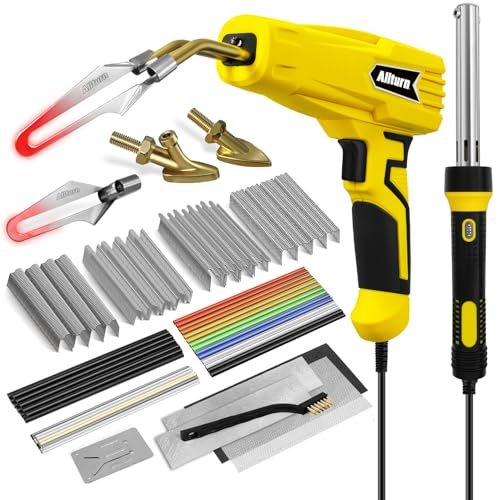
- Welding, ironing, and hot-cutting functions
- Includes 1,000 staples and 38 rods
- Built-in overheating protection
Best For: Versatile DIY repairs and hot cutting
Most Versatile Kit

- 220W design for rapid heating
- Hot-staple and plastic-rod repair methods
- Includes 1,000 staples and 100 rods
Best For: Hobbyists needing a broad, multi-purpose plastic repair kit
Best Focused Automotive Pick

- Designed for ABS crack and bumper repairs
- Includes 200 staples in four shapes
- LED light and overheat protection
Best For: Automotive hobbyists focused on hot-staple repairs
Best Beginner Bundle

- Stated 2–3-second heat-up to 400°C
- Includes up to 1,000 hot staples
- Front light and one-year quality guarantee
Best For: Beginners handling household and basic automotive plastic repairs
Versatile Staple Repairer – ATOLS Upgraded Plastic Welder
For hobbyists who want a broad-use option among plastic welders for hobbyists, the ATOLS kit focuses on staple-based repairs. It heats staples in about 1–2 seconds and includes six staple styles for reinforcing cracks and joining plastic parts.
Best For: DIY automotive, motorcycle, household, and recreational-plastic repairs where reinforcement staples are useful.
Pros:
- Includes 1,000 stainless steel staples in six shapes and sizes.
- Front light helps illuminate the repair area.
- Ergonomic rubber handle and included carry case support portable use.
- Designed for bumpers, dashboards, lamp holders, radiators, spoilers, handles, and other plastic parts.
Cons:
- This is a corded AC tool, so it requires access to an outlet.
- The kit is centered on staple welding rather than hot-air welding with plastic rods.
Its large assortment of staples makes the ATOLS a practical choice for hobbyists tackling varied cracks and broken tabs. Choose it if quick staple heating and a portable case matter more than a rod-based welding setup.
Deluxe Rod Welder – JOUNJIP UL-Certified 80W Kit
The JOUNJIP Deluxe kit is a strong fit for plastic welders for hobbyists who prefer a hot-airless iron and filler rods. Its 80W design reaches up to 525°F and comes with multiple tips, rods, mesh, tape, and cleanup accessories.
Best For: Hobbyists repairing automotive parts, kayaks, boats, ATVs, plastic containers, outdoor furniture, and toys with thermoplastic rods.
Pros:
- UL-certified welder and factory provide an added safety credential.
- 80W iron heats up to 525°F for professional-grade plastic repairs.
- Includes 20 PolyPlaz rods, 40 PP rods, two triangle tips, and two boot tips.
- Comes with reinforcing mesh, aluminum tape, sandpaper, a stand, and wire brush.
Cons:
- Temperature can vary with the work area temperature.
- As a corded 110–120V tool, it is intended for outlet-based use.
This deluxe package offers one of the more complete setups in the group for users who want both repair materials and interchangeable tips. It is especially appealing when a rod-based repair workflow is preferable to embedding staples.
High-Capacity Staple Kit – WRDLOSY 1200-Piece Plastic Welder
For plastic welders for hobbyists that emphasize staple quantity, this WRDLOSY kit supplies 1,200 mixed staples and heats them in about 1–2 seconds. A built-in LED, ergonomic grip, cutter, and case make it suited to repeated DIY crack and tab repairs.
Best For: Hobbyists repairing bumpers, dashboards, fenders, appliance handles, trash cans, lawn equipment, and PLA projects with staple reinforcement.
Pros:
- Includes 1,200 staples: wave, flat, inside-corner, and outside-corner styles.
- Stainless steel staples resist rust and the wavy design distributes load.
- Built-in LED helps illuminate hairline cracks and placement areas.
- Works with common PP, ABS, and PLA plastics according to the supplied notes.
Cons:
- Staples are designed for the WRDLOSY brand and specified 0.03-inch crown width.
- Not recommended in the notes for nylon or TPO.
- The kit uses staple reinforcement rather than filler rods.
The WRDLOSY stands out for its generous staple supply and clearly stated material guidance. It is a sensible pick for hobbyists who expect to make many staple repairs and want an LED and cutter included from the start.
Certified Starter Kit – JOUNJIP Standard 80W Plastic Welder
The JOUNJIP Standard kit is a straightforward choice among plastic welders for hobbyists who want a rod-based repair tool with a compact accessory set. Its 80W iron reaches up to 525°F and includes triangle tips, mesh, tape, rods, and sandpaper.
Best For: Beginners and DIY users repairing bumpers, dashboards, headlights, kayaks, canoes, tanks, tabs, toys, and recycling bins.
Pros:
- UL-certified welder, factory, and manufacturing process.
- 80W iron operates at 110–120V and heats up to 525°F.
- Includes two triangle tips, wire mesh, aluminum tape, 20 PolyPlaz rods, and sandpaper.
- Supplied notes list compatibility with HDPE, LDPE, PP, ABS, PE, TPO, PA, and most other plastics.
Cons:
- The standard kit includes fewer accessories than the deluxe version.
- It is a corded tool with a 70-inch cord rather than a cordless design.
With its certified construction and focused accessory package, this kit is well suited to hobbyists who want to learn rod welding without paying for a larger deluxe bundle. The one-year manufacturer warranty and stated U.S. customer support are useful extras.
Best All-in-One Kit – RX WELD 2-in-1 Plastic Welder
For hobbyists who want a broad plastic-repair setup, the RX WELD 2-in-1 combines a 100W plastic welding gun with a soldering iron. Its 1,000-piece staple assortment and stated 800°F maximum temperature make it a versatile option for automotive repairs and DIY projects.
Best For: Hobbyists repairing bumpers, dashboards, kayaks, toys, fuel tanks, and other plastic items.
Pros:
- Combines plastic welding and soldering functions in one kit.
- Includes 1,000 plastic welding staples.
- Reaches a maximum stated temperature of 800°F within five minutes.
- Includes a one-year quality guarantee.
Cons:
- Uses corded 110V power, so portability is limited by access to an outlet.
- The kit’s higher temperature may require careful handling for small or heat-sensitive work.
This is a strong choice among plastic welders for hobbyists who value a generous staple supply and the added flexibility of a separate soldering iron for smoothing repaired surfaces.
Best for Material Variety – 100W 2-in-1 Plastic Welding Kit
This 100W kit is designed for plastic welders for hobbyists who work with different plastic types. It offers three temperature settings, multiple tips, and 56 rods covering ABS, PP, PE, TPE, PC, PUR, and PA, while also functioning as a soldering iron.
Best For: Hobbyists who want material-specific rods and adjustable heat for bumpers, dashboards, kayaks, and general plastic repairs.
Pros:
- Includes 56 rods in seven plastic materials.
- Three adjustable temperature settings support different repair tasks.
- Works as both a plastic welder and soldering iron.
- Includes tips, mesh, foil tape, sandpaper, and basic accessories.
Cons:
- Only three temperature settings are provided rather than continuous adjustment.
- The manufacturer notes that a small amount of smoke may appear during first use.
Its broad rod selection is the standout feature, making this kit particularly practical for hobbyists who repair more than one kind of plastic and want a supplied assortment to get started.
Best 3-in-1 Design – Allturn Plastic Welding Kit
The Allturn 3-in-1 kit gives hobbyists a plastic welder, welding iron, and hot-cutting capability in one 110V tool set. It includes welding staples, rods, cutting tips, and basic preparation accessories for repairs ranging from car bumpers to household plastic projects.
Best For: Hobbyists seeking one tool for plastic welding, hot cutting, and varied DIY repairs.
Pros:
- Combines welding and hot-cutting functions.
- Includes 1,000 staples, 38 plastic rods, and multiple tips.
- Rubberized handle is designed for comfortable extended use.
- Internal overheating protection stops operation until the tool cools.
Cons:
- At 3.04 pounds, it is heavier than some compact hobby tools.
- Its 110V AC power limits use away from an outlet.
- The supplied notes do not specify a maximum operating temperature.
Choose the Allturn if versatility matters most: its hot-cutting tips and safety shutoff add capabilities beyond basic plastic welding, while the included staples and rods support a range of repairs.
Most Versatile Kit – Upgraded 220W Plastic Welder
For hobbyists who want one of the more flexible plastic welders for hobbyists, this 220W kit combines hot-staple repairs with plastic-rod welding. Its broad accessory selection makes it suitable for occasional automotive, household, and recreational-plastic repairs.
Best For: Hobbyists who want a high-output, multi-material repair kit with plenty of staples and rods.
Pros:
- 220W output is designed for rapid heating.
- Supports both hot staples and plastic welding rods.
- Includes 1,000 hot staples, 100 plastic rods, mesh, smoothing tips, pliers, and other accessories.
- LED headlamp, non-slip handle, and overheat protection add convenience and safety.
Cons:
- The large accessory assortment may be more than a beginner needs.
- It is a corded 110V tool, so portability is limited by access to an outlet.
This is the strongest all-around choice of the three for hobbyists tackling varied plastic types and repair styles. The combination of high wattage and extensive consumables is especially useful for building a general-purpose repair setup.
Best Focused Automotive Pick – WEP 960-V Plastic Welder Kit
If your plastic welders for hobbyists search is mainly about bumper and crack repairs, the WEP 960-V keeps the setup focused. It uses rapidly heated staples to join broken plastic and includes the basic accessories needed to get started.
Best For: Hobbyists and mechanics repairing ABS bumpers, dashboards, plastic tanks, motorcycles, and similar parts.
Pros:
- Includes 200 hot staples in four repair shapes for different crack types.
- Built-in LED light helps illuminate the weld point.
- Compact kit includes pliers and a 110V welder.
- Overheat protection and one-year USA technical support are included.
Cons:
- It does not include plastic rods or the larger consumable assortment found in some kits.
- It is intended for 110–127V USA power and must not be connected to a 220V outlet.
- Plastic welding produces fumes, so suitable respiratory protection is needed.
The WEP 960-V is a practical option when hot-staple reinforcement is your primary repair method. Its smaller, targeted kit can be easier to manage than a multi-function bundle, particularly for automotive projects.
Best Beginner Bundle – SONNLER 100W Plastic Welder
For beginners comparing plastic welders for hobbyists, this 100W SONNLER kit offers a straightforward 2-in-1 approach with a large supply of hot staples and several supporting accessories. Its stated 2–3-second heat-up time is aimed at keeping small repairs moving.
Best For: Beginners and household users who want an accessible kit for bumpers, plastic parts, and general crack repair.
Pros:
- Heats to a stated 400°C/752°F in about 2–3 seconds.
- Includes up to 1,000 hot staples plus rods, mesh, abrasive paper, aluminum tape, and tools.
- Front light supports visibility while working.
- One-year quality guarantee is provided.
Cons:
- At 100W, it has less stated power than the 220W kit.
- The supplied notes do not specify the plastic types supported by the included rods.
- The 2.05 kg listed weight may feel substantial for extended handheld work.
This kit balances a beginner-friendly design with a generous supply of consumables. It makes the most sense for users who value quick heating and a complete accessory package over maximum power or a specialized automotive configuration.
How We Picked These Plastic Welders for Hobbyists
We focused on features that matter during real DIY repairs: heating performance, included staple and plastic-rod supplies, handling, versatility, and ease of use. The selection includes compact 80W-class kits, higher-powered models, hot staplers, and tools with interchangeable tips or temperature controls.
We also considered whether each kit is suited to common hobby tasks such as reinforcing cracked plastic, repairing automotive trim, joining compatible plastic pieces, and making small workshop repairs. Accessory counts are useful, but they do not automatically indicate better performance; the quality and suitability of the welder itself matter more.
Quick Comparison
| Feature | What to look for | Best suited to |
|---|---|---|
| Power | About 80W to 220W, depending on material thickness and workload | Light repairs through heavier or more frequent work |
| Staple supply | Multiple shapes and a generous quantity of compatible staples | Crack reinforcement and bumper repairs |
| Temperature control | Adjustable settings or speed control | Working with different plastics and avoiding excess heat |
| Extra tips and rods | Hot-cutting tips, soldering tips, and plastic welding rods | More versatile workshop use |
| Safety features | UL certification where applicable, stable grip, insulated housing, and clear controls | More confident and controlled operation |
Key Buying Factors for Plastic Welders for Hobbyists
Power and Heat Control
Higher wattage can shorten warm-up times and help with thicker plastic, but raw power is not the only consideration. Adjustable heat or speed control gives you more flexibility when working with thin housings, trim, containers, and different plastic types. A lower-powered tool may be easier to control for occasional repairs.
Hot Stapler Design
Hot staplers embed metal staples across a crack to reinforce the damaged area. Look for kits with several staple shapes, such as wave, M-shaped, and V-shaped options. Confirm that replacement staples are easy to find, since this consumable determines how useful the tool remains over time.
Accessories and Versatility
Plastic rods can help fill or join compatible materials, while soldering or hot-cutting tips expand the tool’s uses. A large accessory bundle is worthwhile only if it includes supplies suited to your projects. Pliers, storage cases, and built-in lighting can also improve convenience.
Ergonomics and Safety
Choose a comfortable handle and controls that are easy to reach without shifting your grip. Work in a ventilated area, wear eye protection and heat-resistant gloves, and keep the hot tip away from flammable surfaces. Always identify the plastic before welding, because some materials release hazardous fumes or do not bond reliably.
Who Should Buy Which Plastic Welders for Hobbyists?
For occasional household repairs: An 80W-class kit with hot staples and basic tips is usually sufficient and keeps the setup simple.
For automotive trim and bumper work: Prioritize a hot stapler with varied staple shapes, fast heating, a comfortable grip, and plenty of replacement staples.
For a more versatile hobby workshop: Choose a model with adjustable temperature or speed, plastic rods, soldering tips, and a hot-cutting accessory.
For frequent or heavier repairs: A higher-wattage kit can provide faster heating and better endurance, but use its controls carefully on thin plastic. Regardless of the model, practice on scrap material first to learn the correct heat, pressure, and timing.