Plastic repairs can be faster and less expensive than replacing an entire bumper, panel, or molded component—provided you use a welder suited to the material and damage.
These 10 plastic welders under $300 range from compact airless tools to adjustable-temperature kits and hot staplers. Use the guide below to match heating power, accessories, control, and repair style to your projects.
Best 10 Plastic Welders Under 300 Picks for 2026
High-Heat Choice
Polyvance 5700HT Mini Weld Model 7

- 200-watt ceramic heating element
- Eight automotive plastic rod types included
- Two interchangeable welding tips
Best For: High-melting-point automotive plastic repairs
Certified DIY Kit
JOUNJIP Deluxe 80W Plastic Welder

- UL-certified 80-watt welder
- Multiple tips, rods, mesh, and tape included
- Designed for automotive and household repairs
Best For: Broad DIY thermoplastic repair projects
Staple Repair Specialist

- 800 plastic welding staples included
- 100-watt tool with rods and hot tips
- Overheating protection and UL-certified cord
Best For: Reinforced bumper and thermoplastic repairs
Versatile Temperature Control

- Three adjustable temperature settings
- 56 rods across seven plastic types
- Includes soldering and welding tips
Best For: General-purpose home and automotive repairs
Best Overall
GNI 150W Digital Adjustable Plastic Welder

- 150W heater reaches temperature in about 15 seconds
- LCD control covers 200–600°C with temperature lock
- Includes rods, tips, mesh, sandpaper, and repair tools
Best For: DIY users handling varied plastic and electronics repairs
Best for Automotive Repairs
WRDLOSY Hot Stapler Bumper Repair Kit
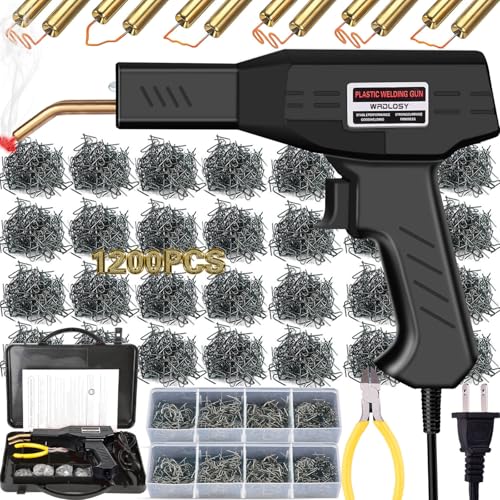
- Includes 1,200 mixed stainless steel repair staples
- Heats staples in 1–2 seconds for quick crack reinforcement
- Built-in LED, ergonomic grip, cutter, and carry case included
Best For: Bumper, dashboard, and other PP, ABS, or PLA repairs
Best Budget-Friendly Option
QWORK 80W Adjustable Plastic Welder

- Adjustable temperature from 200–480°C
- Includes three tips, 40 rods, mesh, stand, and brush
- Insulated handle and heat-dissipation design
Best For: Occasional household and automotive plastic repairs
Best All-Around Kit

- 220W rapid-heating output
- 1,002 staples plus 100 plastic rods
- Hot-staple and plastic-rod repair options
Best For: DIY users needing a versatile, well-stocked repair kit
Best Two-Tool Combo

- 150W hot stapler with rapid heating
- Separate 60W soldering iron
- Includes staples, rods, tools, and sandpaper
Best For: Users wanting reinforcement and surface finishing in one kit
Best Portable Staple Kit

- Pure copper transformer for rapid heating
- 1,000 staples in six styles
- Includes carry case, pliers, and front light
Best For: Automotive and DIY hot-staple crack repairs
High-Heat Choice – Polyvance 5700HT Mini Weld Model 7
For shoppers comparing plastic welders under 300, the Polyvance 5700HT stands out for high-melting-point thermoplastics. Its 200-watt ceramic heating element reaches up to 250 °C and the kit includes automotive-focused rods and interchangeable tips.
Best For: Automotive repairs involving nylon radiator tanks and other high-melting-point plastics.
Pros:
- 200-watt element is designed for high-melting-point plastics.
- Includes eight types of welding rod for common automotive plastics.
- Two easy-to-swap tips support different rod applications.
- Includes stainless steel reinforcing mesh and a cleaning brush.
Cons:
- Its supplied specifications emphasize industrial and automotive use rather than broad household use.
- The maximum temperature is listed as 250 °C, which may be less than some specialty welders.
This is a focused, higher-powered option for users who prioritize automotive plastic compatibility and included material variety over a large accessory bundle.
Certified DIY Kit – JOUNJIP Deluxe 80W Plastic Welder
Among plastic welders under 300, the JOUNJIP Deluxe kit is a practical choice for DIY repairs on vehicles, boats, recreational equipment, and household items. It combines an 80-watt iron with UL certification and a broad selection of rods, tips, mesh, and preparation supplies.
Best For: DIY users repairing bumpers, headlight tabs, kayaks, bins, tanks, and other thermoplastic items.
Pros:
- UL-certified welder and power cord support a safety-focused design.
- Includes 40 PP rods and 20 PolyPlaz rods.
- Two boot tips and two triangle tips suit different repair tasks.
- Comes with reinforcing mesh, aluminum tape, sandpaper, a stand, and a brush.
Cons:
- At 80 watts, it has less stated power than several 100- and 200-watt options.
- Temperature can vary with work-area temperature.
The Deluxe kit offers a well-rounded starting package, especially for occasional repairs where safety certification and ready-to-use accessories matter.
Staple Repair Specialist – Allturn 2-in-1 Plastic Welder
For buyers seeking plastic welders under 300 with reinforcement capability, the Allturn combines plastic-rod welding with hot staple repair. The 100-watt tool includes 800 staples, 38 rods, hot-cutting and smoothing accessories, and internal overheating protection.
Best For: Car bumpers, dashboards, tanks, radiators, and other repairs that benefit from embedded plastic welding staples.
Pros:
- Includes 800 staples in flat, wavy, M-type, and V-type styles.
- Comes with 38 multi-type welding rods for different thermoplastics.
- Staples heat to a stated maximum of 1380 °F in one to two seconds.
- Internal overheating protection and a UL-certified power cord are included.
Cons:
- The M6 smoothing and M8 cutting tips should be used for no more than five minutes continuously.
- At 3.39 pounds, it is heavier than some compact welding irons.
This kit is especially compelling when structural reinforcement is as important as melting and joining plastic, though its auxiliary tips require careful duty-cycle management.
Versatile Temperature Control – 100W 2-in-1 Plastic Welder
This 100-watt 2-in-1 model is a flexible contender among plastic welders under 300, offering three temperature settings and interchangeable soldering and welding tips. Its 56 included rods cover ABS, PP, PE, TPE, PC, PUR, and PA for varied repair work.
Best For: Home users repairing car bumpers, dashboards, kayaks, and mixed thermoplastic items.
Pros:
- Three adjustable temperature settings provide control for different jobs.
- 100-watt ceramic heater is designed to heat quickly.
- 56 rods cover seven listed plastic types.
- 2-in-1 design can handle plastic surface repairs and soldering tasks.
Cons:
- The instructions call for waiting several minutes for the iron to heat fully.
- A small amount of first-use smoke may occur from protective liquid on the metal tube.
With broad rod compatibility and adjustable heat, this is a useful general-purpose kit for household and automotive repairs, provided users follow the setup and heating guidance.
Best Overall – GNI 150W Digital Adjustable Plastic Welder
For shoppers comparing plastic welders under 300, the GNI stands out as a versatile, high-powered kit with fast heating, digital temperature control, and supplies for several repair types. Its 150W ceramic heating core reaches the selected temperature in about 15 seconds, while the adjustable 200–600°C range supports different plastics and projects.
Best For: DIY users who want one kit for plastic repairs, automotive work, and occasional electronics soldering.
Pros:
- 150W rapid-heating design with a 200–600°C adjustable range
- LCD display and temperature-locking function improve control
- Includes 106 welding rods, four tips, wire mesh, sandpaper, and other accessories
- Suitable for bumpers, dashboards, kayaks, toys, and electronics repairs
Cons:
- The broad accessory selection may be more than needed for simple repairs
- Temperature control and multiple materials require some practice for consistent results
This is a strong all-around choice if you want a plastic welder with substantial power, broad temperature adjustment, and a ready-to-use accessory set. The ergonomic pen-style body and ventilation holes also support longer repair sessions.
Best for Automotive Repairs – WRDLOSY Hot Stapler Bumper Repair Kit
Among plastic welders under 300, this WRDLOSY kit takes a focused hot-stapler approach for reinforcing cracks rather than melting plastic rods. It heats staples in 1–2 seconds and includes 1,200 mixed stainless steel staples, making it particularly practical for repeated bumper, dashboard, and household plastic repairs.
Best For: Automotive and general plastic repairs where embedded staples can reinforce cracks and broken sections.
Pros:
- Includes 1,200 staples in wave, flat, inside-corner, and outside-corner styles
- Heats quickly and uses a built-in LED to illuminate repair areas
- Ergonomic grip and included staple cutter support extended repair work
- Works with common PP, ABS, and PLA plastics
Cons:
- Staples are designed for the Wrdlosy system and use a 0.03-inch crown width
- Not recommended for nylon or TPO according to the supplied specifications
- It is a hot stapler, so it does not provide the rod-and-tip versatility of a conventional plastic welder
Choose this kit when crack reinforcement and staple quantity matter more than general-purpose plastic melting. The carry case, LED, and large staple assortment make it well suited to recurring automotive repair projects.
Best Budget-Friendly Option – QWORK 80W Adjustable Plastic Welder
For buyers seeking plastic welders under 300 for occasional household or automotive work, the QWORK offers a straightforward corded design with adjustable heat and essential accessories. Its 80W output and 200–480°C temperature range cover common plastic repair tasks, including bumpers, dashboards, and kayaks.
Best For: Home users who need a simple adjustable-temperature plastic welder for routine surface repairs.
Pros:
- Adjustable 200–480°C temperature range accommodates different repair needs
- Includes three copper tips, stainless steel mesh, stand, brush, and 40 rods
- Insulated handle and heat-dissipation holes support safer handling
- Simple 110V corded operation is suitable for residential use
Cons:
- At 80W, it has less power than the 150W GNI model
- The supplied instructions indicate waiting about two minutes after powering on
- Includes fewer rods and accessories than some larger kits
The QWORK is a sensible pick for basic repairs when you want adjustable heat without paying for a larger, more elaborate kit. Its included mesh, rods, and copper tips provide a practical starting point for home projects.
Best All-Around Kit – Upgraded 220W Plastic Welder
For shoppers comparing plastic welders under 300, this 220W kit stands out for its broad accessory selection and two repair methods. It supports both hot-staple reinforcement and plastic-rod repairs, making it practical for vehicle plastics and household projects.
Best For: DIY users who want a high-powered, well-stocked kit for varied plastic repairs.
Pros:
- 220W output supports rapid heating.
- Includes 1,002 hot staples in six shapes and 100 plastic rods.
- Works with several plastic types, including ABS, PP, TPO, TPE, PC, and more.
- Includes an LED light, overheat protection, pliers, mesh, and smoothing tips.
Cons:
- Its large assortment may be more than needed for occasional small repairs.
- The kit is corded and requires a 110V outlet.
This is a strong value-focused choice when you want maximum versatility and plenty of consumables in one package. The included materials and dual repair methods reduce the need for immediate add-on purchases.
Best Two-Tool Combo – SEESII 150W Plastic Welder
Among plastic welders under 300, the SEESII is a practical option for repairs that need both reinforcement and surface finishing. Its hot stapler handles cracks, while the separate 60W soldering iron melts filler rods and helps smooth the repaired area.
Best For: DIYers and garage users who want a complete repair-and-finishing setup.
Pros:
- 150W welder heats staples to 600°C in about three seconds, according to the supplied specifications.
- Includes a separate 60W soldering iron for filler-rod work and surface blending.
- Comes with 200 staples, 20 plastic rods, pliers, a utility knife, and sandpaper.
- Lightweight tools with soft-grip handles help reduce hand fatigue.
Cons:
- Includes fewer plastic rods than some larger kits.
- The two-tool setup takes more storage space than a single welder.
The SEESII is especially appealing when appearance matters as much as structural strength. Having a dedicated soldering iron makes it easier to finish, blend, and prepare repairs for sanding.
Best Portable Staple Kit – ATOLS Upgraded Plastic Welder
For buyers seeking plastic welders under 300 with a straightforward hot-staple design, the ATOLS kit focuses on quick reinforcement repairs. Its copper transformer, front light, ergonomic handle, carry case, and six staple styles make it suitable for common automotive and plastic repair tasks.
Best For: Vehicle owners and DIY users who primarily repair cracks with hot staples.
Pros:
- Pure copper transformer and rapid heating are designed for quick staple insertion.
- Includes 1,000 stainless steel staples in six shapes and sizes.
- Suitable for bumpers, dashboards, lamp holders, radiators, spoilers, headlights, and other listed plastic parts.
- Carry case, pliers, front light, and rubber handle support portable use.
Cons:
- The supplied package details do not list plastic welding rods or a separate soldering iron.
- At 2.18 pounds, it is somewhat heavier than the SEESII welder listed above.
This kit makes sense if your priority is dependable hot-staple reinforcement rather than a broader rod-welding system. Its varied staple assortment and case are useful for keeping a repair setup organized and ready to transport.
How We Picked the Best Plastic Welders Under 300
We focused on repair versatility, temperature or power control, included accessories, handling, and the types of jobs each kit is designed to support. The selection includes dedicated plastic welders, dual-purpose tools, and hot-stapler kits for reinforcing cracked bumpers and panels. We also considered practical details such as staple and rod supplies, tip options, heat-up performance, and whether the tool is better suited to occasional home use or repeated repairs.
Because plastic types vary, no welder is universally ideal. A good result depends on identifying the plastic, cleaning and aligning the damaged area, and using compatible welding rod or reinforcement.
Quick Comparison
| Best For | What to Look For | Recommended Type |
|---|---|---|
| Small household repairs | Compact design and simple controls | 80W to 100W kit |
| Automotive bumper work | Hot stapler, multiple tips, and plastic rods | Dual-purpose repair kit |
| Frequent or heavier repairs | Higher output and adjustable temperature | 150W to 220W welder |
| Controlled plastic joining | Stable heat and material compatibility | Dedicated airless or adjustable welder |
Key Buying Factors for Plastic Welders Under 300
Power and Heat Control
Higher wattage can shorten heat-up time and help with thicker plastics, but raw power is not everything. Adjustable temperature is more useful when working with different materials because excessive heat can burn, warp, or weaken a panel. For light repairs, an 80W or 100W tool may be sufficient; heavier automotive work benefits from more output and thermal reserve.
Welding Method and Accessories
Airless welders use heated tips to fuse plastic, while hot staplers embed metal staples across a crack for reinforcement. Dual-purpose kits offer more flexibility, particularly for bumper repairs. Check for compatible welding rods, staple shapes, smoothing or cutting tips, pliers, and storage accessories before buying. A large accessory count is helpful only if the included parts match your repair needs.
Material Compatibility and Technique
Look for markings such as PP, PE, ABS, or PVC on the plastic and select a matching rod whenever possible. Clean the area thoroughly, practice on scrap material, and use ventilation. A welder with excellent specifications cannot compensate for incompatible plastic or poor surface preparation.
Safety and Usability
Prioritize UL certification or clearly stated electrical specifications, insulated handles, a stable stand, and a cord long enough for your workspace. Wear eye protection and heat-resistant gloves, and keep hot tips and staples away from flammable surfaces. Digital temperature displays can improve repeatability, while simple analog controls may be faster for occasional jobs.
Who Should Buy Which Plastic Welders Under 300?
Choose a compact 80W to 100W kit if you need an affordable tool for occasional household, hobby, or light automotive repairs. These models are generally easier to store and operate.
Choose a hot-stapler or dual-purpose kit if cracked bumpers, tabs, brackets, and panels are your main targets. Staples add mechanical support before or alongside plastic fusion, making this format especially practical for structural cracks.
Choose a 150W to 220W adjustable model for repeated repairs, thicker components, and faster heat-up. Confirm that its temperature range and included tips suit the plastics you handle.
Choose a dedicated airless plastic welder when you value controlled finishing and primarily perform plastic-fusion work rather than staple reinforcement. Regardless of the model, match the rod to the base plastic and test your technique before working on a visible surface.