Portable power stations with solar input make it easier to keep essential devices running when outlets are unavailable. The models in this roundup range from compact 300W units for phones and small electronics to high-capacity systems designed for appliances, RVs, and home backup.
Use the guide below to compare battery capacity, inverter output, solar charging capability, portability, and safety features before choosing the right power station for your needs.
Best 10 Portable Power Stations with Solar Input Picks for 2026
High-Capacity Backup

- 3,840Wh expandable LiFePO4 capacity
- 3,600W output with 2,000W solar input
- 15 ports, wheels, and Bluetooth app
Best For: Home backup, RVs, and extended emergencies
Compact Long-Run Pick

- 2,010Wh LFP battery in a 35.7-pound body
- 1,500W output and 3,000W peak power
- Up to 400W solar input with UPS function
Best For: Portable essential-load backup and camping
Fast-Charging Heavy-Duty Option
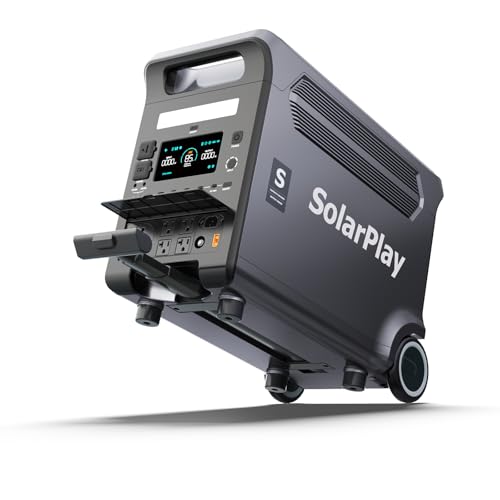
- 3,840Wh LiFePO4 battery and 3,600W output
- 2,000W solar input with adjustable charging
- 15 ports, UPS mode, wheels, and telescoping handle
Best For: High-load backup, RVs, and rapid solar replenishment
Built-In Solar Portability

- Integrated 40W solar panel and MPPT controller
- 1,024Wh capacity with 1,600W output
- 26-pound design with LiFePO4 battery
Best For: Camping, car travel, and lighter emergency loads
Best Value Solar-Ready Backup

- 519.48Wh capacity with 500W pure sine wave output
- 10-device charging with AC, USB, DC, car, and wireless ports
- Solar, wall, and car recharging options
Best For: Camping, road trips, and smaller home backup needs
Best High-Capacity Solar System
AFERIY P280 2800W Power Station

- 2048Wh LiFePO4 capacity expandable to 10.24kWh
- 2800W output with dual solar inputs
- Fast charging and sub-10ms UPS backup
Best For: Home backup, RVs, and high-demand appliances
Best Lightweight Solar Option

- 9.5-pound design with 288Wh LFP capacity
- 600W output plus 1500W Power Lifting Mode
- Solar charging, fast wall charging, and 10ms UPS
Best For: Camping, road trips, and lightweight emergency backup
High-Capacity Choice
PurMars 1075Wh Portable Power Station

- 1075Wh capacity with 1200W output and 2400W peak
- Solar, AC, and car charging support
- 10 outlets plus app control and pull handle
Best For: Home backup, RVs, camping, and emergency power
Solar Kit Value Pick
ZeroKor 300W Generator with 60W Panel

- Includes a foldable 60W solar panel
- 300W output for small electronics and camping gear
- AC, car, DC, USB, and MPPT solar charging options
Best For: Tent camping, phones, tablets, laptops, and small devices
High-Capacity Backup – ABOK Ark3600
The ABOK Ark3600 is a strong choice among portable power stations with solar input when you need substantial backup capacity for home appliances, RV use, or extended outages. Its 3,840Wh LiFePO4 battery, expandable capacity, and 2,000W solar input make it suited to longer-duration power needs.
Best For: Home backup, RV trips, camping, and emergency power for multiple appliances.
Pros:
- 3,840Wh capacity expandable to 11,520Wh
- 3,600W rated output and 4,500W peak power
- 2,000W solar input and combined AC/PV charging
- 15 output ports plus wheels, telescoping handle, and Bluetooth control
Cons:
- At 92 pounds, it is less convenient to carry than smaller units
- Its large capacity and output may be more than needed for basic device charging
The Ark3600 prioritizes capacity, output, and expandability over lightweight portability. Choose it if you want a solar-ready system capable of supporting demanding loads and extended backup sessions.
Compact Long-Run Pick – Anker SOLIX S2000
The Anker SOLIX S2000 is a practical option among portable power stations with solar input for shoppers who want substantial capacity in a comparatively compact package. Its 2,010Wh LFP battery, 1,500W continuous output, and support for up to 400W of solar input cover camping and essential home-backup tasks.
Best For: Compact emergency backup, camping, refrigerators, and essential appliances.
Pros:
- 2,010Wh LFP battery with a stated 15-year lifespan
- 35.7-pound design is lighter than many comparable 2kWh systems
- 1,500W output with 3,000W peak power
- Supports up to 400W solar input and under-10ms UPS switchover
Cons:
- No 12V DC port
- Solar input is lower than that of the larger high-capacity models in this roundup
The S2000 stands out for balancing useful battery capacity with easier handling. Its lower solar-input limit and lack of a 12V DC port are worth considering, but its compact form and UPS capability are attractive for essential loads.
Fast-Charging Heavy-Duty Option – SolarPlay Q3600
The SolarPlay Q3600 combines a 3,840Wh LiFePO4 battery with 2,000W maximum solar input, making it one of the more capable portable power stations with solar input for high-demand backup. Its adjustable input, UPS mode, and 15-port layout add flexibility for home, RV, and outdoor use.
Best For: High-load home backup, RVs, outdoor use, and users who prioritize rapid recharging.
Pros:
- 3,600W pure sine wave output with 5,500W peak power
- 3,840Wh LiFePO4 capacity rated for 4,000-plus cycles
- Up to 2,000W solar input and fast AC-plus-solar charging
- 15 ports, wheels, telescoping handle, and up-to-8ms UPS mode
Cons:
- At about 93 pounds, it is difficult to move frequently
- The stated 18-month manufacturer coverage is shorter than some competing warranties
The Q3600 is built for users who need serious output and fast replenishment rather than a lightweight travel battery. Its broad port selection and UPS function make it versatile, while its weight favors occasional repositioning over frequent carrying.
Built-In Solar Portability – BROWEY S1600
The BROWEY S1600 takes a different approach to portable power stations with solar input by integrating a 40W solar panel into its compact design. With 1,024Wh of capacity, 1,600W output, and a 26-pound weight, it is easier to take on camping trips or keep ready for smaller emergency loads.
Best For: Camping, car travel, light off-grid use, and compact emergency backup.
Pros:
- Built-in 40W solar panel with support for additional solar panels
- 1,024Wh capacity and 1,600W pure sine wave output
- 26-pound portable design with eight ports
- LiFePO4 battery rated for 3,000-plus cycles and 10-plus years
Cons:
- Its built-in 40W panel charges more slowly than the larger units’ solar-input systems
- Lower capacity and output make it less suitable for extended high-demand backup
The S1600 favors convenience and portability over maximum runtime. Its built-in panel can help maintain the battery in sunny conditions, but shoppers powering large appliances for long periods should consider a higher-capacity model.
Best Value Solar-Ready Backup – 500W Portable Power Station
For shoppers comparing portable power stations with solar input, this 519.48Wh model offers a practical balance of capacity, portability, and device flexibility. Its 500W pure sine wave inverter can support everyday electronics, small appliances, and select CPAP machines, while solar, wall, and car charging provide three ways to replenish the battery.
Best For: Camping, road trips, home emergency backup, and powering smaller electronics away from an outlet.
Pros:
- 500W pure sine wave AC output with 519.48Wh capacity
- Up to 10 devices can connect through AC, USB, DC, car, and wireless outputs
- Supports compatible 100W or 200W solar panels, plus wall and car charging
- Built-in battery management and protective features help safeguard connected devices
Cons:
- Solar panel is not included
- Not intended for devices rated above 500W
- At about 18 pounds, it is less ultralight than compact entry-level units
This is a sensible mid-capacity choice when you need several charging options and broad device compatibility without moving up to a large home-energy system. Just account for the 500W output limit and remember to switch off AC output when it is not needed.
Best High-Capacity Solar System – AFERIY P280 2800W Power Station
Among portable power stations with solar input, the AFERIY P280 is built for shoppers who need substantial capacity and high output. Its 2048Wh LiFePO4 battery, 2800W inverter, dual solar inputs, and expandable storage make it suited to extended backup, RV use, and demanding appliances.
Best For: Home backup, RVs, high-wattage appliances, CPAP use, and longer off-grid power needs.
Pros:
- 2800W AC output with 5600W peak capability
- 2048Wh LiFePO4 battery expandable to 10.24kWh with extra batteries
- 1800W AC input and 1200W PV input can charge from 0% to 80% in about 38 minutes
- Dual PV inputs and sub-10ms UPS response support flexible charging and backup operation
Cons:
- At 44 pounds, it is considerably heavier than compact portable stations
- Its larger capacity and output may be more than casual day-trip users need
- Extra batteries and solar panels add to the overall system cost
The P280 is the strongest fit here for users treating a power station as a serious backup system rather than a simple travel battery. Its expansion capability and solar-input design offer room to grow, while the LiFePO4 chemistry is rated for 4000-plus cycles and up to 10 years of durability.
Best Lightweight Solar Option – BLUETTI Elite 30 V2
If portability is the priority, the BLUETTI Elite 30 V2 is a compact option among portable power stations with solar input. Weighing about 9.5 pounds, it combines a 288Wh LFP battery with 600W continuous output, 1500W Power Lifting Mode, multiple charging methods, and a 10ms UPS function.
Best For: Camping, road trips, storm preparedness, laptops, CPAP machines, car refrigerators, and other moderate loads.
Pros:
- Lightweight 9.5-pound design with 288Wh capacity
- 600W continuous output and 1500W Power Lifting Mode
- Solar, AC, car, and other charging options, with 0%-to-80% wall charging in about 45 minutes
- 10ms UPS backup and 140W USB-C PD fast charging
Cons:
- 288Wh capacity is more limited than larger home-backup models
- Solar panel is not listed among the included components
- Power Lifting Mode is intended for compatible high-wattage loads, not a general increase in continuous output
The Elite 30 V2 is a good match for users who want useful AC power without carrying a heavy battery system. It is especially appealing for mobile emergencies and weekend trips, though shoppers needing multi-day or whole-home backup should consider a higher-capacity model.
High-Capacity Choice – PurMars 1075Wh Portable Power Station
For shoppers comparing portable power stations with solar input, the PurMars B1200A stands out for its 1075Wh capacity, 1200W output, and broad selection of ports. It accepts solar, AC, or car charging and includes app control for added convenience.
Best For: Home backup, RV use, camping, emergency power, and users who need to run several devices at once.
Pros:
- 1075Wh battery and 1200W continuous output, with 2400W peak capacity.
- Supports solar, AC, and car charging; the listed AC recharge time is about 1.8 hours.
- Offers 10 outlets across AC, USB, USB-C PD100W, DC, and car-port connections.
- LiFePO4 battery chemistry, 2000+ cycle rating, multiple BMS protections, wheels, and a telescoping handle.
Cons:
- At 36.9 pounds, it is substantially heavier than compact camping power banks.
- The solar panel is not included.
- The first-use instructions call for fully discharging and then charging the unit.
The PurMars is a feature-rich option when capacity and outlet variety matter more than minimal carry weight. Its wheels and pull handle help offset the bulky design, while the solar-input capability makes it suitable for extended off-grid use.
Lightweight Fast-Charging Pick – VTOMAN Jump 600X Portable Power Station
The VTOMAN Jump 600X is a practical choice among portable power stations with solar input when portability is a priority. Weighing 9.92 pounds, it offers 600W continuous output, up to 120W MPPT solar input, and fast AC-plus-DC recharge options.
Best For: Road trips, lightweight camping, mobile work setups, laptops, lights, fans, and smaller RV loads.
Pros:
- Compact 9.92-pound design with a flat top and one-handed portability.
- Supports up to 120W MPPT solar input, 12V car charging, and AC charging.
- Can reach 80% in about 50 minutes and fully recharge in about 75 minutes using the stated AC-plus-DC charging setup.
- LiFePO4 battery rated for 3,000 cycles while retaining 80% capacity, with 600W output and 1200W peak power.
Cons:
- The 600W continuous limit is not intended for high-wattage appliances.
- The solar panel is sold separately.
- Its smaller battery is less suited to long-duration backup than larger-capacity stations.
Choose the Jump 600X if easy carrying and quick recharging are more important than maximum runtime. Its 100W USB-C port and solar-input support make it especially useful for portable electronics and modest off-grid loads.
Solar Kit Value Pick – ZeroKor 300W Generator with 60W Panel
For buyers seeking portable power stations with solar input in a ready-to-use package, the ZeroKor 300W model includes a 60W foldable solar panel. It is designed for smaller electronics and camping accessories, with AC, USB, DC, car, and solar charging options.
Best For: Tent camping, charging phones and tablets, powering laptops and small electronics, and buyers who want a panel included.
Pros:
- Includes a 60W monocrystalline solar panel with stated 20.5% conversion efficiency.
- Provides two 300W-max AC outlets, USB ports, a quick-charge USB port, and a DC output.
- Can recharge from a wall outlet, car port, or compatible solar input with built-in MPPT.
- Includes reading and SOS flashlight modes plus BMS protections for common electrical and temperature risks.
Cons:
- The 300W limit rules out appliances such as coffee makers, hair dryers, and water pumps.
- The included 60W panel is intended for smaller power needs and may recharge slowly compared with larger solar setups.
- The panel junction box is not waterproof and should be kept dry.
The ZeroKor is a convenient starter package for low-power outdoor use because the solar panel is included. It makes the most sense for electronics and small camping gear rather than heating appliances or equipment with compressors.
How We Picked the Best Portable Power Stations with Solar Input
We focused on the specifications that matter most in real-world use: usable battery capacity, continuous and peak AC output, solar-input limits, charging speed, battery chemistry, port selection, portability, and backup features such as UPS functionality. The selection also includes several capacity classes so shoppers can compare compact emergency power banks with larger solar generators.
Because advertised capacity and output can vary by operating conditions, treat manufacturer ratings as maximum figures. Actual runtime depends on inverter losses, connected devices, temperature, and battery age.
Quick Comparison
| Power class | Best suited to | What to prioritize |
|---|---|---|
| 300–600W | Phones, laptops, lights, cameras, and small appliances | Low weight, USB-C charging, and convenient solar panels |
| 1,000–2,100Wh | Camping, travel, refrigerators, and short outages | Balanced capacity, inverter output, and charging flexibility |
| 2,800W and above | Large appliances, job sites, RVs, and extended backup | High surge output, LiFePO4 cells, and fast solar charging |
Key Buying Factors for Portable Power Stations with Solar Input
Battery Capacity and Runtime
Watt-hours indicate how much energy the battery stores. A 300Wh-class unit is practical for small electronics, while 1,000Wh or more is better for refrigerators, CPAP machines, and multiple devices. To estimate runtime, divide watt-hours by the device’s watt draw, then allow for conversion losses.
Inverter Output and Surge Capacity
Continuous wattage determines which devices can run normally. Check startup or peak output for refrigerators, pumps, power tools, and other motor-driven equipment. Pure sine wave output is generally preferable for sensitive electronics.
Solar Input and Charging Speed
Higher solar-input limits can reduce charging time when sunlight is strong, but the panel voltage and current must match the station’s specifications. A built-in panel improves convenience, while separate compatible panels usually offer more charging power and better positioning.
Battery Chemistry, Ports, and Safety
LiFePO4 batteries typically offer longer cycle life than standard lithium-ion packs, though they may add weight. Also check AC outlet count, USB-C power delivery, 12V outputs, display quality, app controls, thermal protection, and whether pass-through charging or UPS operation is supported.
Who Should Buy Which Portable Power Stations with Solar Input?
Choose a compact 300W–600W model if you mainly need phone, laptop, camera, lighting, or small-device charging. A midrange 1,000Wh–2,100Wh station is the better all-purpose option for camping, van travel, and short household outages. For demanding appliances, extended off-grid use, or job-site equipment, choose a high-capacity model with at least 2,800W of continuous output and strong solar-input support.
Finally, confirm the unit’s dimensions, weight, warranty, panel compatibility, and local availability. The best choice is not simply the most powerful model—it is the station whose capacity, output, charging speed, and portability match the equipment you actually need to run.