Choosing a smart indoor air quality monitor can make it easier to spot problems before they affect comfort, sleep, or health.
Below, we focus on the features that matter most: accurate sensing, clear alerts, app support, and the right measurements for your space.
Best 10 Smart Indoor Air Quality Monitor Picks for 2026
Alexa-Friendly Pick
Amazon Smart Air Quality Monitor

- Tracks PM2.5, VOCs, CO, humidity, and temperature
- Shows air quality through Alexa app and LED indicators
- Can automate compatible Alexa devices with routines
Best For: Alexa users who want easy air quality monitoring and automation
Radon-Plus Monitoring

- Tracks radon, CO2, PM2.5, VOCs, humidity, temperature, and pressure
- Battery powered for flexible, cable-free placement
- App offers live readings, alerts, and long-term trends
Best For: Buyers who want radon monitoring and broad indoor air coverage
Fast-Refresh Option
GoveeLife Air Quality Monitor H5106

- Refreshes readings every 2 seconds for quick changes
- Measures PM2.5, temperature, and humidity
- Works with GoveeLife purifiers, humidifiers, heaters, and fans
Best For: Govee smart home users who want fast PM2.5 tracking
Advanced Air Insight

- Tracks CO2, PM1/2.5/10, TVOC, formaldehyde, humidity, and temperature
- App provides alerts, remote viewing, and 30-day history
- Quick-calibration tools help with setup and accuracy
Best For: Users who want detailed indoor air data beyond basic sensors
Precision CO2 Watcher
GoveeLife Smart Air Quality Monitor H5140

- SCD4x CO2 sensor with 5-second refresh
- Displays CO2, temp, humidity, and time
- App alerts plus 2 years of data tracking
Best For: Bedrooms, offices, and nurseries focused on CO2 monitoring
Whole-Home IAQ Guide
AprilAire Smart Indoor 5-in-1 Monitor
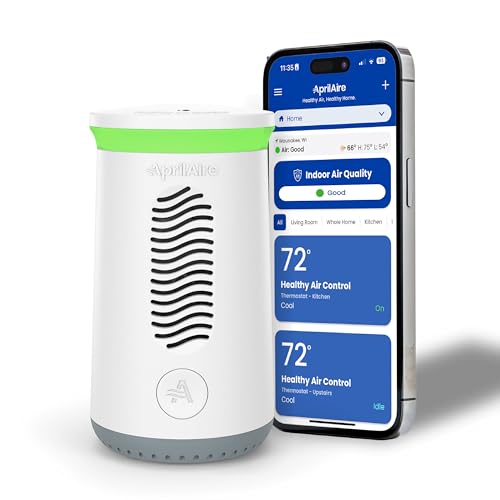
- Measures CO2, VOCs, PM2.5, humidity, and temperature
- Healthy Air App gives alerts and explanations
- Works with AprilAire filtration and ventilation systems
Best For: Homeowners wanting broad IAQ monitoring and app guidance
Wildcard Readout Station
16 in 1 Air Quality Monitor Indoor

- Tracks CO2, PM2.5, HCHO, TVOC, and more
- 7-inch display with three brightness settings
- Cordless operation with built-in rechargeable battery
Best For: Homes that want a large display and broad pollutant readouts
Compact Matter Air Monitor

- Tracks PM2.5, PM10, temperature, and humidity
- Matter-compatible with major smart home platforms
- 3.73-inch screen plus sound, LED, and app alerts
Best For: Bedrooms, nurseries, and smart-home users who want simple, visible air tracking
All-Round WiFi Air Detector

- Tracks AQI, CO2, PM2.5, PM1.0, PM10, TVOC, and HCHO
- Smart Life and Tuya app support with history storage
- Wall-mountable with auto-brightness and screen-off mode
Best For: Homes and offices needing broader air metrics plus app-based remote monitoring
18-in-1 Dual-Chip Air Monitor

- Measures AQI, CO2, PM2.5, PM1.0, PM10, TVOC, and HCHO
- Dual-chip design for sensor processing and display control
- Smart Life/Tuya app with stored historical data
Best For: Users who want broad monitoring in one connected indoor air quality monitor
Alexa-Friendly Pick – Amazon Smart Air Quality Monitor
If you want a smart indoor air quality monitor that’s simple to set up and easy to read, this Amazon option focuses on the essentials. It tracks PM2.5, VOCs, carbon monoxide, humidity, and temperature, then turns the data into a color-coded LED signal and an easy-to-read air quality score in the Alexa app.
Best For: Alexa households that want straightforward air quality tracking and smart home automation.
Pros:
- Tracks 5 key factors, including PM2.5, VOCs, CO, humidity, and temperature
- Color-coded LED plus air quality score in the Alexa app makes readings easy to understand
- Real-time alerts can notify your phone or Echo devices when air quality drops
- Can trigger Alexa routines for compatible purifiers, dehumidifiers, fans, and thermostats
Cons:
- Designed around Alexa, so it’s less flexible outside that ecosystem
- No mention of radon, CO2, or particulate bands beyond PM2.5
- Needs a plugged-in setup, so placement depends on outlet access
Overall, this is a practical pick if you want indoor air monitoring that fits neatly into an Alexa-based home. It keeps the interface simple while still giving you enough data to automate comfort devices.
Radon-Plus Monitoring – Airthings View Plus
The Airthings View Plus is a smart indoor air quality monitor built for buyers who want broader environmental coverage, including radon. It continuously measures radon, PM2.5, CO2, VOCs, humidity, temperature, and air pressure, with live data and cloud-backed history through the Airthings app.
Best For: Homes where radon awareness and always-on multi-sensor monitoring matter most.
Pros:
- Measures radon plus PM2.5, CO2, VOCs, humidity, temperature, and pressure
- Battery-powered design allows cable-free placement around the home
- Live data, notifications, and trend tracking are available in the Airthings app
- Customizable eInk screen and 5-year warranty option add value
Cons:
- The monitor requires the Airthings app and internet access to function fully
- An account is required during setup
- Higher-end feature set may be more than basic users need
This is the most comprehensive monitor in the group if radon is a priority. Its cable-free design and always-on sensors make it a strong fit for long-term indoor air tracking.
Fast-Refresh Option – GoveeLife Air Quality Monitor H5106
If you want a smart indoor air quality monitor that reacts quickly, the GoveeLife H5106 emphasizes fast updates and easy remote viewing. It measures PM2.5, temperature, and humidity, with a two-second refresh and app-based data storage for tracking changes over time.
Best For: Govee users who want quick PM2.5 monitoring and automatic device control.
Pros:
- Two-second refresh helps show recent changes in PM2.5, temperature, and humidity
- Remote monitoring works through Bluetooth or Wi-Fi
- Supports automation with compatible GoveeLife purifiers, humidifiers, heaters, and fans
- Offers 13-day charts and up to 2 years of exportable data
Cons:
- Requires a power connection and has no built-in battery
- 2.4G Wi-Fi is needed for time display
- Only measures three air quality factors, so it’s less comprehensive than some rivals
This model is best if responsiveness matters more than maximum sensor depth. It’s a good fit for users already invested in GoveeLife smart devices and looking for simple automation.
Advanced Air Insight – BREATHE Airmonitor Plus
The BREATHE Airmonitor Plus is a smart indoor air quality monitor aimed at users who want more detailed gas and particle readings. It tracks CO2, PM1, PM2.5, PM10, TVOC, formaldehyde, temperature, and humidity in real time, making it useful for homes, offices, bedrooms, and classrooms.
Best For: Buyers who want a more complete picture of indoor air, including CO2 and formaldehyde.
Pros:
- Monitors CO2, PM1, PM2.5, PM10, TVOC, formaldehyde, temperature, and humidity
- App support includes remote monitoring, instant alerts, and 30-day history
- Built-in quick calibration tools help simplify setup and accuracy checks
- Compact design suits home, office, or bedroom placement
Cons:
- Corded power means it needs to stay near an outlet
- Only works with Android v6.0+ and iOS v13.0+ for app access
- Less plug-and-play than simpler monitors if you want just a basic reading
This monitor stands out when you want deeper insight into what’s affecting indoor air quality. It’s especially useful in spaces where ventilation, cooking, cleaning, or occupancy can change conditions throughout the day.
Precision CO2 Watcher – GoveeLife Smart Air Quality Monitor H5140
If you want a smart indoor air quality monitor focused on CO2, this GoveeLife model is built for fast, always-on awareness. It combines CO2, temperature, humidity, and time on a readable display, with app-connected alerts and historical tracking for bedrooms, offices, and other spaces where stale air can affect comfort and concentration.
Best For: Bedrooms, offices, and nurseries where CO2 visibility and sleep-friendly alerts matter most.
Pros:
- Uses an SCD4x CO2 sensor with claimed ±(40ppm + 5%) accuracy and a 5-second refresh rate.
- Shows CO2, temperature, humidity, and time in one at-a-glance display.
- Offers buzzer, app, and email alerts when custom thresholds are exceeded.
- Tracks up to two years of data and can export CSV reports.
Cons:
- Requires app setup for some features, including the clock display.
- CO2 alerts can connect with humidifiers and tower fans, but not air purifiers.
- Needs AC power, so it is not a portable battery unit.
Overall, this is a practical choice if CO2 is your main concern and you want continuous monitoring with smart alerts. Its strength is clear, focused room feedback rather than broad pollutant detection.
Whole-Home IAQ Guide – AprilAire Smart Indoor 5-in-1 Monitor
This smart indoor air quality monitor is designed for people who want a broader view of home air conditions. The AprilAire unit measures CO2, VOCs, PM2.5, humidity, and temperature, then presents the results in the Healthy Air App with instant notifications and plain-language guidance.
Best For: Homeowners who want a multi-sensor monitor with app guidance and ecosystem integration.
Pros:
- Tracks five key indoor metrics, including CO2, VOCs, PM2.5, humidity, and temperature.
- Healthy Air App offers instant notifications, trends, and explanations for readings.
- Simple color status makes it easy to check conditions at a glance.
- Can integrate with AprilAire filtration and ventilation solutions when paired with compatible equipment.
Cons:
- Requires the AprilAire Healthy Air App to function.
- Some healthy-air integrations need a separate compatible AprilAire Wi-Fi thermostat.
- Best value comes from users who plan to stay within the AprilAire ecosystem.
As a roundup pick, this monitor stands out for its broad IAQ coverage and educational app experience. It is a strong option if you want monitoring plus a path toward action through AprilAire-compatible devices.
Wildcard Readout Station – 16 in 1 Air Quality Monitor Indoor
If you want a smart indoor air quality monitor with a large screen and wide pollutant coverage, this model takes a very feature-heavy approach. It displays CO2, PM2.5, PM1.0, PM10, HCHO, TVOC, temperature, humidity, AQI, and time, making it useful when you want one device to surface a lot of information at once.
Best For: Buyers who want a big display and broad pollutant readouts for home use.
Pros:
- Monitors nine key parameters, including CO2, PM2.5, PM1.0, PM10, HCHO, and TVOC.
- 7-inch display makes readings easy to see without menu diving.
- Includes seven AQI alert buzzers plus a mute button for alarms.
- Runs cordlessly for up to 8 hours on the built-in 2500mAh battery.
Cons:
- Battery life is limited compared with plug-in monitors.
- Accuracy and sensor performance depend on keeping sensors clean and avoiding perfumes or strong odors.
- Heavier feature set may be more than casual users need.
This is a good fit if you value a large, easy-to-read display and lots of readouts in one unit. It is especially appealing for homes wanting broad air-quality visibility during wildfire season or other high-pollution periods.
Compact Matter Air Monitor – SONOFF SAWF-07P
If you want a smart indoor air quality monitor that fits neatly into a bedroom, nursery, or office, this SONOFF unit keeps the essentials front and center. It tracks PM2.5, PM10, temperature, and humidity on a 3.73-inch screen, while Matter support makes it easier to tie into a broader smart home setup.
Best For: Buyers who want a compact, Matter-compatible monitor with clear on-device readings and simple alerting.
Pros:
- Tracks PM2.5, PM10, temperature, and humidity in one display
- Matter-compatible for use with Apple Home, Alexa, Google Home, SmartThings, and Home Assistant
- Triple alert system with sound, LED, and app notifications
- 12 months of historical data with chart viewing and export
Cons:
- Monitors fewer air metrics than broader all-in-one competitors
- Requires continuous power for 2-second data updates
For shoppers focused on the most visible indoor comfort factors, this model is a practical, easy-to-read option. It leans more toward straightforward daily monitoring than deep multi-gas analysis, but its Matter support and alert options make it a strong smart-home pick.
All-Round WiFi Air Detector – Smart Life / Tuya Model
This smart indoor air quality monitor is built for buyers who want broader environmental coverage and remote access through an app. It measures AQI, CO2, PM2.5, PM1.0, PM10, TVOC, HCHO, temperature, and humidity, then adds WiFi connectivity and historical tracking for more complete at-home monitoring.
Best For: Users who want a feature-rich monitor with app control, wall mounting, and broader pollutant coverage.
Pros:
- Monitors AQI, CO2, PM2.5, PM1.0, PM10, TVOC, HCHO, temperature, and humidity
- Works with Smart Life and Tuya Smart apps for remote tracking and settings
- Wall-mountable design with auto-brightness and screen-off monitoring
- 3000mAh battery with Type-C charging for portable use
Cons:
- Requires 2.4GHz WiFi and compatibility mode for WiFi 6+ routers
- Battery life is limited to 7-15 hours when not plugged in
Compared with simpler monitors, this one aims to cover more of the indoor air picture, including gases and VOCs, not just particulates. That makes it a strong fit if you want app-based oversight and a wider set of readings in one device.
18-in-1 Dual-Chip Air Monitor – Bcetasy Smart Detector
If you want a smart indoor air quality monitor with a broad sensor set and a simple app workflow, this Bcetasy model is built to do a lot in one device. It reports AQI, CO2, PM2.5, PM1.0, PM10, TVOC, HCHO, time, date, temperature, and humidity, while also supporting WiFi app tracking and saved history.
Best For: Shoppers who want maximum metric coverage and a straightforward connected monitor for everyday use.
Pros:
- 18-in-1 layout covering key air metrics plus time and date
- Dual-chip design for sensor processing and display control
- Smart Life and Tuya app support with historical data storage
- HD LCD screen with adjustable brightness and color-coded alerts
Cons:
- Needs 2.4GHz WiFi and compatibility mode for WiFi 6+ routers
- Battery-backed use is limited to 7-15 hours per the supplied notes
As a roundup choice, this monitor stands out for packing in a very wide set of readings without making the setup idea overly complicated. It is best viewed as a versatile home or workplace detector for people who want broad visibility and app-based trend tracking.
How We Picked These Smart Indoor Air Quality Monitor Options
We prioritized monitors that cover the most useful indoor air metrics, including PM2.5, CO2, VOCs, humidity, and temperature. We also looked for models with practical app features, readable displays, and alert systems that help you act quickly when conditions change.
Because homes have different needs, we included compact units for basic monitoring, data-rich models for detailed tracking, and higher-end picks for users who want broader sensor coverage or more advanced alerts.
Quick Comparison: What the Sensor Mix Tells You
A monitor focused on CO2 is useful for ventilation and stuffiness. A unit with PM2.5 helps track smoke, cooking particles, and wildfire intrusion. VOC and formaldehyde sensing can be helpful for renovation, cleaning products, or new furnishings. Humidity and temperature readings round out the picture by explaining why a room feels too dry, damp, or uncomfortable.
Key Buying Factors for a Smart Indoor Air Quality Monitor
Match the Sensors to Your Main Concern
If you want everyday air health tracking, choose a balanced monitor that covers CO2, PM, and humidity. If you are mainly concerned about wildfire smoke or cooking pollution, prioritize particle sensing. If you are monitoring a nursery, bedroom, or home office, temperature and humidity may matter just as much as pollutant readings.
Check the Display, Alerts, and App Experience
A good screen makes it easier to interpret trends at a glance, while audible or app-based alerts help you respond without watching the device constantly. For a Smart Indoor Air Quality Monitor, app quality matters: look for clear history graphs, remote monitoring, and easy calibration or export tools when available.
Consider Placement and Power Style
Some units are best left on a desk or shelf, while battery-powered options offer more placement flexibility. If you plan to move the monitor between rooms, portability may matter more than a large screen. For permanent monitoring, a wired model with a bright display can be the better fit.
Who Should Buy Which Smart Indoor Air Quality Monitor?
Buy a simpler model if you mainly want basic awareness and easy setup. Choose a more advanced Smart Indoor Air Quality Monitor if you want deeper trend data, multiple pollutant readings, or better control through an app. Families, allergy-sensitive households, renters in busy urban areas, and anyone dealing with smoke, poor ventilation, or renovation dust will benefit most from a more capable monitor.
In short, the best choice is the one that tracks the air quality issues you actually face every day, not the one with the longest spec sheet.