Choosing among solar charge controllers for home backup means matching panel voltage, battery chemistry, system voltage, and expected load—not simply choosing the highest amp rating.
This roundup compares 10 options ranging from compact PWM regulators to high-capacity MPPT and inverter-charger systems, so you can build a safer, more efficient backup setup.
Best 10 Solar Charge Controllers for Home Backup Picks for 2026
High-Capacity Backup Hub
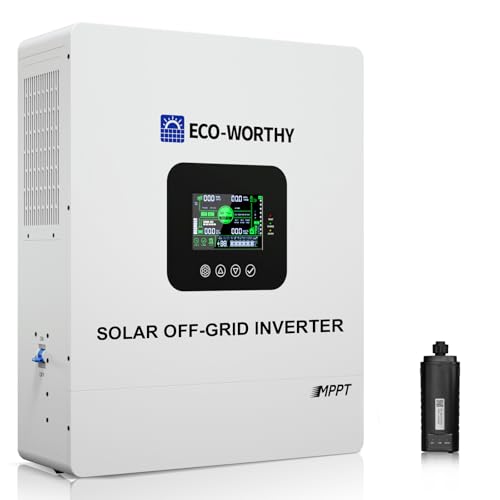
- 100A MPPT controller plus 40A AC charger
- 5000W pure sine wave output
- Parallel support for up to six units
Best For: Large 48V home-backup systems
Compact 12V Battery Manager

- 30A PWM charging for 12V systems
- Supports LiFePO4 and lead-acid batteries
- Compact housing with LED status indicators
Best For: Small 12V backup and off-grid banks
Smart MPPT Optimizer
Victron SmartSolar 100/50 MPPT

- MPPT tracking for improved solar harvest
- Bluetooth app with history and alarms
- Supports 12V and 24V battery systems
Best For: Monitored, expandable backup systems
Budget LCD Regulator

- Automatic 12V/24V system recognition
- LCD status display with timer settings
- Dual USB outputs for small devices
Best For: Basic lead-acid backup systems
Best Smart Monitoring Pick

- MPPT charging for improved solar harvesting
- Bluetooth app with live and historical data
- Compact 12V/24V, 15A design
Best For: Smaller home backup systems needing efficient charging and app monitoring
Best Higher-Capacity Choice
Renogy Rover 40A MPPT Controller

- 40A MPPT charging for larger systems
- Supports lead-acid and lithium batteries
- LCD, temperature sensor, and safety protections
Best For: Higher-capacity 12V/24V backup and off-grid installations
Best Budget-Friendly Option

- 30A 12V/24V PWM charging
- Built-in Bluetooth and LCD display
- Dual USB outputs and multiple protections
Best For: Budget-focused smaller systems needing simple monitoring and USB charging
High-Capacity Pick

- 12V–96V automatic system detection
- 120A MPPT charging capacity
- LCD monitoring and broad battery support
Best For: Large off-grid homes and high-capacity backup systems
Compact Feature Pick
Renogy Wanderer 10A PWM Controller
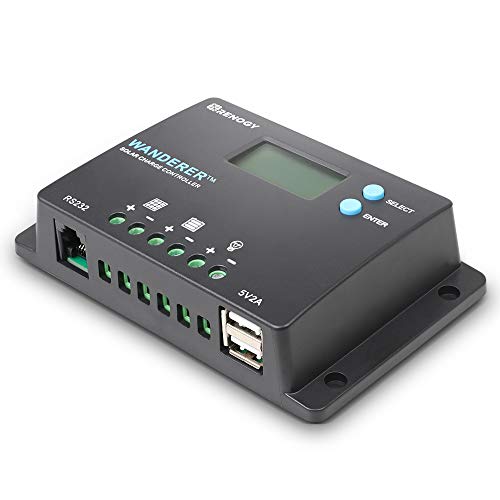
- 12V/24V battery compatibility
- Four-stage charging and multiple protections
- LCD, USB, and optional Bluetooth monitoring
Best For: Small RV, marine, and off-grid battery systems
Weatherproof Budget Pick
SOLPERK 10A Waterproof Controller

- IP67 waterproof outdoor construction
- Automatic 12V/24V operation
- Simple LED status indicators and SAE connection
Best For: Small outdoor RV, boat, and deep-cycle battery systems
High-Capacity Backup Hub – 5000W 48V Inverter Charger
For shoppers comparing solar charge controllers for home backup, this ECO-WORTHY unit is a complete 48V power system rather than a standalone controller. It combines a 100A MPPT controller, 40A AC charger, and 5000W pure sine wave inverter, with support for lead-acid and LiFePO4 batteries.
Best For: Large 48V off-grid systems, whole-home backup projects, and users who may want to parallel multiple units.
Pros:
- Combines inverter, MPPT controller, and battery charger in one unit.
- Supports up to six parallel units, with a stated maximum of 30kW.
- Offers multiple charging modes, timed mains charging, LCD monitoring, and protection features.
Cons:
- Its 48V installation is more complex and the manufacturer recommends professional installation.
- Large, heavy-duty systems may be excessive for small backup loads.
This is the most capable option here for a substantial home-backup build, especially when expansion and uninterrupted power are priorities. Confirm system voltage, battery compatibility, and installation requirements before buying.
Compact 12V Battery Manager – Renogy Wanderer Li 30A PWM
For smaller solar charge controllers for home backup setups, the Renogy Wanderer Li is a compact 30A PWM choice for 12V battery banks. It supports LiFePO4, AGM, gel, and flooded batteries, while LED indicators show charging stages and selected battery information.
Best For: Small 12V backup banks, RVs, boats, and compact off-grid installations using modest solar arrays.
Pros:
- Supports several common battery chemistries, including LiFePO4 and lead-acid types.
- Uses staged charging with bulk, boost, float, and automatic equalization functions.
- Compact IP32-rated housing supports wall or DIN-rail mounting.
Cons:
- It is a PWM controller limited to 12V systems and 30A charging.
- Bluetooth monitoring requires the separately sold BT-1 module.
The Wanderer Li makes sense when simplicity, size, and battery-chemistry flexibility matter more than maximum solar harvest. For a higher-voltage or larger home-backup array, choose a more powerful MPPT-based system.
Smart MPPT Optimizer – Victron SmartSolar 100/50 MPPT
Among solar charge controllers for home backup, the Victron SmartSolar MPPT 100/50 stands out for app-based monitoring and efficient power tracking. Its MPPT design is intended to maximize available solar output, including when panels are partially shaded, and it supports 12V or 24V battery systems.
Best For: Home-backup or off-grid users who want detailed system monitoring, configurable charging, and scalable controller coordination.
Pros:
- MPPT tracking helps optimize available panel power, including in partial shade.
- VictronConnect provides real-time data, performance history, settings, firmware updates, and alarms.
- Multiple units can synchronize charging stages across a system.
Cons:
- It does not include an inverter, so separate backup-power equipment is required.
- There is no built-in display; monitoring relies on compatible connectivity and the app.
This is a strong controller-only option for a thoughtfully designed backup system, particularly where monitoring and future expansion are important. Verify the panel voltage stays within the 100V rating and match it to a 12V or 24V battery bank.
Budget LCD Regulator – Upgraded 30A PWM Controller
This upgraded 30A PWM controller is a straightforward option for basic solar charge controllers for home backup applications. It automatically adapts to 12V or 24V systems, includes an LCD for operating data, and adds dual USB outputs for charging small devices.
Best For: Basic 12V or 24V lead-acid battery systems, small household backup projects, and users who want an inexpensive controller with a built-in display.
Pros:
- Automatically adapts to 12V or 24V systems.
- LCD provides operating information and supports timer and manual settings.
- Includes dual 5V/2.5A USB outputs and several automatic protection functions.
Cons:
- It is designed only for lead-acid batteries and should not be used with lithium or nickel-metal hydride batteries.
- PWM charging is less suitable for demanding, high-output backup arrays than MPPT.
Choose this controller for a simple lead-acid setup where basic status information and USB charging are useful. Its battery restriction is important, so confirm the battery chemistry before connecting the system.
Best Smart Monitoring Pick – Victron SmartSolar MPPT 75/15
For home backup systems that prioritize efficient charging and useful system data, the Victron Energy SmartSolar MPPT 75/15 is a compact option among solar charge controllers for home backup. Its MPPT tracking, Bluetooth connectivity, and configurable load output make it especially practical for smaller 12V or 24V battery setups.
Best For: Home backup users who want app-based monitoring, MPPT charging, and a compact controller for a smaller solar-battery system.
Pros:
- MPPT tracking is designed to maximize available solar power, including during partial shade.
- Bluetooth access through the VictronConnect app provides real-time data and 30-day performance history.
- Multiple units can synchronize charging stages, and the load output can disconnect loads at a configured low voltage.
Cons:
- Its 15A rating is better suited to smaller systems than higher-demand home backup arrays.
- The product listing specifies LED or minimal display capability, so detailed monitoring relies on the app.
This is a strong fit when efficient MPPT charging and a polished monitoring experience matter more than maximum current capacity. Check the controller’s voltage and current limits against your panel and battery specifications before building the system.
Best Higher-Capacity Choice – Renogy Rover 40A MPPT Controller
The Renogy Rover 40A is a higher-capacity choice for solar charge controllers for home backup, pairing MPPT charging with 12V/24V automatic detection. Its LCD, battery compatibility, protective features, and optional app connectivity make it suitable for users who want more charging capacity and flexible configuration.
Best For: Home backup and off-grid systems that need a 40A MPPT controller with support for lead-acid or lithium batteries.
Pros:
- 40A MPPT capacity and claimed 98% conversion rate support larger charging setups than a basic small-system controller.
- Supports Gel, AGM, flooded, and lithium batteries with distinct charging stages.
- Includes LCD monitoring, a remote temperature sensor, and protections against reverse polarity, overcharge, overload, and short circuits.
- Specified operating range of -40°F to 149°F suits demanding environmental conditions.
Cons:
- Bluetooth app connectivity requires the separately sold BT-2 accessory.
- Its larger 40A capacity may be unnecessary for a small panel and battery installation.
The Rover 40A is the most capable choice here for a more substantial 12V/24V backup system. Its broad battery support and built-in safeguards add flexibility, while the optional communications accessory is an extra consideration for remote monitoring.
Best Budget-Friendly Option – ECO-WORTHY 30A PWM Controller
The ECO-WORTHY 30A controller offers a straightforward, feature-rich approach to solar charge controllers for home backup. It supports 12V/24V systems, includes Bluetooth and an LCD, and adds dual USB outputs, making it convenient for smaller setups that need basic monitoring and direct device charging.
Best For: Budget-conscious home, industrial, or commercial users with 12V/24V lead-acid, gel, or lithium phosphate battery systems.
Pros:
- 30A capacity supports more charging current than a small 15A controller.
- Built-in Bluetooth, LCD status display, and claimed measurement accuracy within 1% simplify monitoring.
- Dual USB outputs provide 5V/2.5A maximum charging for compatible devices.
- Includes short-circuit, open-circuit, reverse, overload, and reverse-current protection.
Cons:
- It uses PWM charging rather than MPPT, so it may not harvest as much solar energy as an MPPT controller under comparable conditions.
- The unit can heat during operation and requires installation on a flat, well-ventilated surface.
- Its discharge current is listed as 10A, which limits the connected load.
This controller is practical when affordability, USB charging, and accessible status information are priorities. For a home backup array where maximizing panel harvest is critical, compare its PWM design with an MPPT alternative and observe the stated wiring sequence during installation.
High-Capacity Pick – POWLAND 120A MPPT Controller
For larger solar charge controllers for home backup systems, the POWLAND 120A MPPT controller stands out for its unusually broad voltage compatibility and high charging capacity. It automatically supports 12V through 96V systems, accepts up to 230V solar input, and includes an LCD for at-a-glance system information.
Best For: High-capacity off-grid homes, mobile power stations, and larger battery banks using compatible lithium or lead-acid batteries.
Pros:
- Automatic compatibility with 12V, 24V, 36V, 48V, 60V, 72V, 84V, and 96V systems
- 120A MPPT charging with claimed efficiency of up to 98%
- Supports LiFePO4, AGM, GEL, and flooded lead-acid batteries
- LCD shows PV input, charging stage, warnings, and diagnostics
Cons:
- Its 120A capacity may be excessive for small backup systems
- The supplied notes do not specify an included remote-monitoring feature
This is the most versatile and powerful option in the group, but buyers should carefully match the controller’s ratings to their panel array, battery voltage, wiring, and installation requirements.
Compact Feature Pick – Renogy Wanderer 10A PWM Controller
The Renogy Wanderer is a compact choice for smaller solar charge controllers for home backup setups, RVs, and marine systems. Its 10A PWM design supports 12V and 24V batteries, offers multiple charging stages, and provides several installation and monitoring features.
Best For: Small 12V or 24V battery systems, RV electrical cabinets, marine panels, and modest off-grid projects.
Pros:
- Supports AGM, Gel, Flooded, and manually configured lithium batteries
- Four-stage charging helps manage battery charging and maintenance
- Includes load-control modes for lighting, pumps, and other DC loads
- LCD display, USB charging ports, and optional Bluetooth-app connectivity
Cons:
- 10A capacity limits it to relatively small solar arrays
- PWM technology is less suited to maximizing energy harvest than MPPT
- Bluetooth monitoring requires the separately sold BT-1 module
With its compact design, protections, two-year warranty, and flexible load controls, the Wanderer is practical for smaller systems, though it is not intended for high-power home backup arrays.
Weatherproof Budget Pick – SOLPERK 10A Waterproof Controller
The SOLPERK 10A is a straightforward option for compact solar charge controllers for home backup and outdoor applications. Its IP67 waterproof construction, automatic 12V/24V recognition, and simple LED status indicators make it convenient for RVs, boats, and other exposed installations.
Best For: Small outdoor 12V or 24V systems using AGM, GEL, or flooded deep-cycle batteries.
Pros:
- IP67 waterproof design for outdoor use
- Supports up to 150W at 12V or 300W at 24V
- Provides three-stage PWM charging and multiple protective functions
- SAE port and pre-drilled mounting holes simplify installation
Cons:
- 10A output is suited to small systems rather than large home backup arrays
- LED indicators provide less detailed information than an LCD
- The supplied notes list compatibility with AGM, GEL, and flooded batteries, but not lithium batteries
The SOLPERK is a sensible choice when weather resistance and simple installation matter more than advanced monitoring or maximum charging efficiency. Confirm the panel wattage and battery type before buying.
How We Picked the Best Solar Charge Controllers for Home Backup
We evaluated the listed controllers by charging technology, supported battery and system voltages, rated current, solar input limits, monitoring features, installation flexibility, and suitability for backup power systems. MPPT models generally receive stronger consideration for larger or less consistently oriented arrays because they can extract more usable energy than PWM designs. PWM controllers remain practical for smaller, budget-conscious 12V or 24V systems.
We also separated integrated inverter-charger products from standalone controllers. An inverter charger can simplify a complete backup build, but it should be compared by its inverter output, charging functions, protection features, and battery compatibility—not only by its controller rating.
Quick Comparison
- Small 12V systems: 10A PWM controllers suit compact panels, maintenance charging, and lightweight RV or emergency setups.
- Basic 12V/24V systems: 30A PWM models offer an affordable step up for modest battery banks.
- More efficient charging: 15A, 40A, and 50A MPPT controllers are better suited to larger arrays and variable solar conditions.
- Integrated backup power: A 48V inverter charger with a built-in MPPT controller can reduce wiring and component count.
- Large custom arrays: High-current, wide-voltage controllers require careful system design, fusing, and manufacturer verification.
Key Buying Factors for Solar Charge Controllers for Home Backup
System Voltage and Battery Chemistry
Confirm whether your battery bank is 12V, 24V, 48V, or another supported voltage. Lithium batteries may require a dedicated lithium profile or configurable charging settings, while lead-acid batteries need appropriate bulk, absorption, and float parameters. Never assume a controller is lithium-compatible solely because it has an LCD or Bluetooth connection.
MPPT Versus PWM
MPPT is usually the better choice for home backup when the solar array is sizable, panel voltage is higher than battery voltage, or winter and shaded conditions matter. PWM can be adequate for small, closely matched arrays where low cost and simple installation are priorities.
Solar Input, Current, and Safety Margins
Check both maximum PV voltage and maximum charging current. Calculate the array’s cold-weather open-circuit voltage, then leave a safety margin below the controller limit. Include appropriately rated breakers, fuses, disconnects, cable sizes, grounding, and ventilation. A higher amp rating is not automatically safer or more useful if the panels and battery cannot support it.
Monitoring and Installation
Bluetooth or app monitoring can make it easier to check battery voltage, charging history, and faults. Displays are useful at the installation site, but neither feature replaces proper configuration or an external battery-management system where required.
Who Should Buy Which Solar Charge Controllers for Home Backup?
Choose a compact PWM controller for a small battery, RV, boat, vehicle, or occasional emergency panel. Select a 30A PWM model for a straightforward, economical 12V/24V setup. Choose a Victron or Renogy MPPT model when efficiency, configurable charging, and better performance in changing solar conditions are priorities. A high-capacity controller or integrated inverter charger is best for larger home backup banks, provided its voltage range and installation requirements match the complete system. For any high-voltage or high-current design, verify specifications with the manufacturer or a qualified installer before connecting equipment.