The best soldering stations for electronics give you stable temperature control, comfortable handling, and the flexibility to work on everything from circuit boards to connectors. The right choice depends on your projects, workspace, and whether you need hot-air rework.
We compared 10 capable stations across power, controls, included accessories, safety features, and versatility to help you choose a reliable setup without paying for functions you will not use.
Best 10 Soldering Stations for Electronics Picks for 2026
Best for Reliable Temperature Control
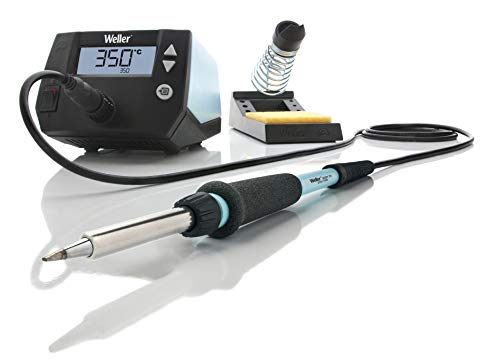
- 70W digital station with LCD display
- ±4°F temperature stability and temperature lock
- ESD-safe design with ergonomic iron
Best For: Repeatable electronics repair and assembly
Best All-in-One Workbench Kit
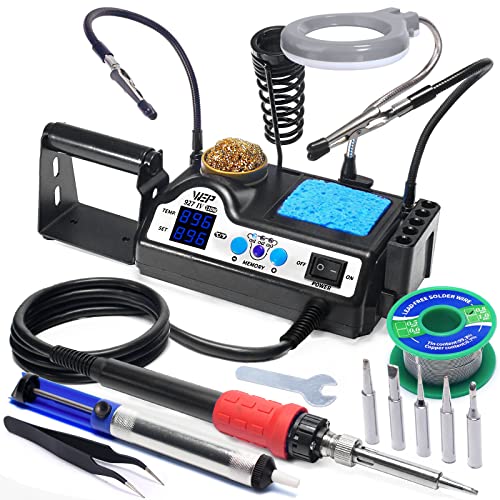
- 110W heating with 194°F–896°F range
- Three preset temperature channels
- Built-in magnifier, helping hands, and storage
Best For: Compact, accessory-rich electronics workbenches
Best for Precise Adjustments

- 100W digital station with rotary encoder
- ±1.8°F listed temperature stability
- Includes holder, cleaner, sponge, and T18-D16 tip
Best For: Controlled bench soldering with a focused interface
Best for High-Power Versatility

- 200W output with claimed three-second melting
- F210 and F245 handles with nine tips
- TFT display, presets, sleep mode, and helping hands
Best For: Fast, flexible electronics repair across varied jobs
Best 2-in-1 Value
YIHUA 862BD+ SMD Rework Station
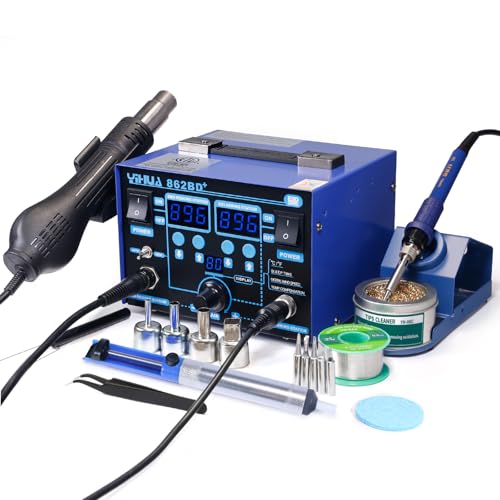
- Combines a 75W soldering iron and hot-air rework station
- PID control with three digital displays
- Includes tips, nozzles, solder, tweezers, and desoldering tools
Best For: DIY electronics repair and SMD rework
Best Beginner Kit
100W Digital Soldering Station

- 100W power with a 356°F–896°F range
- Includes two helping hands and a broad accessory kit
- Auto-hibernate timer and Celsius/Fahrenheit conversion
Best For: Beginners and general-purpose DIY electronics
Best Tip Selection

- Includes 10 soldering tips and four hot-air nozzles
- PID control with dual displays and separate power switches
- ESD-safe design with hot-air fail-safe protection
Best For: Versatile board repair and component rework
Compact Starter Pick

- Compact station with integrated iron holder
- 392°F–896°F PID temperature control
- Includes five tips and essential accessories
Best For: Beginners and space-conscious hobbyists
Accessory-Rich Beginner Choice
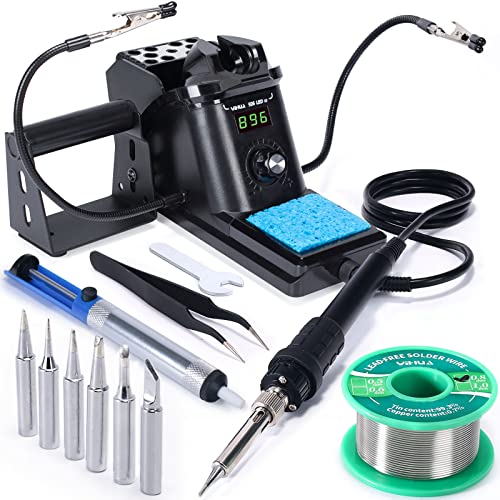
- Includes two helping hands and six tips
- 60W PID-controlled digital station
- Adjustable sleep mode and calibration support
Best For: Beginners working on small bench projects
Versatile Rework Pick

- Combines soldering iron and hot-air rework
- Separate temperature and airflow controls
- Includes nozzles, tips, solder, and rework tools
Best For: Component rework and mixed electronics projects
Best for Reliable Temperature Control – Weller WE1010NA
The Weller WE1010NA is a practical choice among soldering stations for electronics when stable heat, repeatable results, and a familiar digital interface matter. Its 70-watt output, LCD display, and temperature lock suit routine electronics repair and assembly.
Best For: Electronics work requiring consistent temperature control and an ergonomic, ESD-safe setup.
Pros:
- 70-watt power helps jobs heat up faster than the models it replaces.
- Temperature stability is rated at ±4°F, with a lock to protect settings.
- Includes an ergonomic iron, heat-resistant silicone cable, safety rest, sponge, and tip.
- Standby, auto setback, and password protection add useful control features.
Cons:
- Its 70-watt output is lower than several higher-power stations.
- Only one channel is listed.
- The package includes one tip.
Choose this Weller when dependable operation and controlled heat are more important than a large accessory bundle or maximum wattage.
Best All-in-One Workbench Kit – WEP 927-IV
The WEP 927-IV stands out among soldering stations for electronics by combining a 110-watt iron with integrated workbench accessories. Preset channels, a magnifying light, helping hands, and storage make it useful when you want a compact, ready-to-use station.
Best For: Electronics hobbyists who need built-in component support, illumination, and accessory storage.
Pros:
- 110-watt heating element and a 194°F–896°F adjustable range support varied work.
- Three preset channels reduce repeated temperature adjustments.
- Integrated helping hands, LED magnifier, solder dispenser, tip storage, and cleaner save bench space.
- Includes five extra tips, tweezers, solder wire, and a desoldering pump.
Cons:
- Uses WEP #1400 soldering iron tips.
- Rated for 110–127V USA specifications and should not be connected to 220V.
- The compact integrated layout may be less flexible than separate tools.
This is a strong value-oriented pick if convenience and a comprehensive accessory set matter more than a minimalist station design.
Best for Precise Adjustments – Hakko FX888DX
The Hakko FX888DX-010 is a focused option among soldering stations for electronics, with a digital interface designed for straightforward rotary temperature adjustment. Its 100-watt output and listed ±1.8°F stability make it suited to controlled bench work.
Best For: Users who prioritize precise temperature adjustment and a compact, dedicated station.
Pros:
- 100-watt station with an upper temperature rating of 899°F.
- Listed temperature stability of ±1.8°F supports consistent soldering.
- Rotary encoder provides a more intuitive adjustment method than the prior FX-888D interface.
- Includes an iron holder, sponge, tip cleaner, manual, and T18-D16 chisel tip.
Cons:
- No manufacturer warranty is listed in the supplied details.
- Only one included tip is specified.
- It does not include the integrated helping hands and magnifier found on some kits.
The FX888DX is best viewed as a streamlined, precision-oriented station for buyers who already have supporting bench accessories.
Best for High-Power Versatility – FNIRSI DWS-200
The FNIRSI DWS-200 is a high-power choice among soldering stations for electronics, pairing 200 watts with two handle types and nine tips. Its TFT display, preset temperatures, and adjustable temperature range are designed for both precision work and more demanding soldering tasks.
Best For: Electronics repairers who need fast heating, multiple handle options, and broad tip coverage.
Pros:
- 200-watt power is designed for fast heating, with a claimed three-second melting time.
- Includes F210 and F245 handles plus three F210 and six F245 tips.
- TFT display offers temperature, curve, or combined display modes.
- Three temperature presets, sleep mode, auto standby, and two adjustable helping hands add flexibility.
Cons:
- The temperature range starts at 212°F and tops out at 842°F.
- The supplied details list temperature stability as 672°F, which is not a conventional stability specification.
- Its high-power feature set may be more than needed for simple soldering tasks.
Consider the DWS-200 when speed and handle versatility are priorities, especially for users working across small precision jobs and higher-power applications.
Best 2-in-1 Value – YIHUA 862BD+ SMD Rework Station
If you need soldering stations for electronics that can handle both conventional soldering and hot-air rework, the YIHUA 862BD+ is a versatile option. It combines a 75W soldering iron with a hot-air station, PID temperature control, three digital displays, and a broad accessory kit.
Best For: Electronics repairers and DIY users working with circuit boards, SMD components, and varied rework tasks.
Pros:
- Combines soldering and hot-air rework in one station.
- PID control monitors and corrects the soldering iron temperature every 20 milliseconds.
- Includes five soldering tips, four hot-air nozzles, lead-free solder, ESD-safe tweezers, and desoldering tools.
- Offers adjustable sleep mode from 0 to 99 minutes and detachable, replaceable tools.
Cons:
- Designed for 110–127V operation with a US-standard plug.
- The two-function design may be more capability than users who only need basic soldering require.
With stable temperature control, ESD-safe accessories, and both hot-air and iron functions, this is a strong choice for users who want a flexible electronics rework setup.
Best Beginner Kit – 100W Digital Soldering Station
For shoppers comparing soldering stations for electronics, this 100W digital station emphasizes straightforward controls and a useful starter kit. It heats from 356°F to 896°F, supports Celsius/Fahrenheit conversion, and includes helping hands for holding small parts during repairs.
Best For: Beginners and hobbyists handling circuit boards, crafts, mobile-phone repairs, appliances, and general electronics projects.
Pros:
- 100W station with an adjustable 356°F–896°F temperature range.
- LED display, temperature calibration, and Celsius/Fahrenheit conversion simplify setup.
- Includes two helping hands, five tips, solder wire, a pump, tweezers, and cleaning tools.
- Auto-hibernate timer can be set from 0 to 600 seconds, with a separate on/off switch.
Cons:
- It is a single-channel soldering station and does not include hot-air rework.
- The supplied temperature stability specification is listed as 180°C, so precision-focused users may want to review their requirements carefully.
This compact kit offers the practical accessories and simple digital controls that make it approachable for entry-level electronics work, especially when a helping hand is useful.
Best Tip Selection – YIHUA 8786D I 2-in-1 Station
The YIHUA 8786D I is one of the more versatile soldering stations for electronics because it pairs an iron with hot-air rework and supplies ten soldering tips. Its PID temperature control, ESD-safe design, dual displays, and hot-air fail-safe protection support detailed board-repair work.
Best For: Users who need multiple soldering-tip options and hot-air capability for component removal and rework.
Pros:
- Combines a soldering station and hot-air rework station with separate power controls.
- Includes ten assorted soldering tips, four hot-air nozzles, lead-free solder, and desoldering tools.
- PID temperature control provides rapid temperature monitoring and compensation.
- ESD-safe construction and automatic power cutoff help protect components and improve safety if hot-air airflow stops unexpectedly.
Cons:
- Designed for 110–127V operation with a US-standard plug.
- The dual-function setup may be unnecessary for users seeking a basic soldering iron station.
With its unusually generous tip selection and dedicated hot-air function, the 8786D I is a practical fit for electronics users who expect to perform varied soldering and rework jobs.
Compact Starter Pick – WEP 926LED V3
For hobbyists seeking soldering stations for electronics, the WEP 926LED V3 is a compact, temperature-controlled kit with the core accessories needed to begin common soldering and desoldering tasks. Its integrated holder helps conserve desk space, while the digital display and PID temperature stabilization support consistent work.
Best For: Beginners and hobbyists who want a space-saving all-in-one soldering kit.
Pros:
- Includes solder wire, five tips, tweezers, a desoldering pump, and a tip cleaner.
- Temperature adjusts from 392°F to 896°F with a real-time LED display.
- Integrated holder, sleep mode, and Fahrenheit/Celsius conversion add convenience.
Cons:
- Designed for 110–127V USA power specifications.
- Provides one soldering channel rather than a combined hot-air rework setup.
The WEP 926LED V3 is a practical choice when compact storage and a complete starter accessory set matter more than advanced rework capabilities. Its temperature control and sleep mode make it more versatile than a basic fixed-temperature iron.
Accessory-Rich Beginner Choice – YIHUA 926 III
The YIHUA 926 III is one of the more accessory-rich soldering stations for electronics, combining a 60W digitally controlled iron with two helping hands and six replacement tips. Its adjustable sleep mode, calibration support, and lead-free solder make it suitable for learning and routine bench work.
Best For: Beginners who want helping hands and a broad set of included accessories.
Pros:
- Includes two helping hands, six tips, lead-free solder, tweezers, and a desoldering pump.
- Offers PID temperature stabilization and a 194°F–896°F adjustable range.
- Features adjustable sleep mode, digital calibration, and Celsius/Fahrenheit conversion.
Cons:
- Its 60W rating is lower than the 130W maximum rating of the WEP 926LED V3.
- Designed for 110–127V operation with a US-standard plug.
Choose the YIHUA 926 III if you value hands-free project support and included supplies. The helping hands and lead-free solder are particularly useful for beginners, while digital controls provide useful adjustment as skills develop.
Versatile Rework Pick – WEP 882D 2-in-1
For electronics work that extends beyond standard joints, the WEP 882D combines a soldering iron with a variable-air hot air rework station. Separate displays and controls let you adjust soldering temperature, hot-air temperature, and airflow, making it the most versatile option here for component rework.
Best For: Electronics users who need both conventional soldering and hot-air rework in one compact unit.
Pros:
- Combines a soldering station and hot air station in one compact body.
- Provides soldering adjustment from 392°F–896°F and hot air from 212°F–896°F.
- Includes three hot-air nozzles, five soldering tips, two solder spools, tweezers, and a desoldering pump.
Cons:
- Its broader rework functionality may be unnecessary for users who only solder through-hole joints.
- Designed for 110–127V USA power specifications.
The WEP 882D is the strongest fit when a single soldering station for electronics must also handle hot-air tasks. Sleep, standby, automatic shutdown, Celsius/Fahrenheit conversion, and calibration functions add control, though the expanded feature set may be more than a casual beginner needs.
How We Picked the Best Soldering Stations for Electronics
We focused on features that make bench work more consistent and less frustrating: temperature stability, heat-up performance, usable controls, ESD-conscious design, replacement-tip availability, and overall kit value. We also considered included accessories, such as helping hands, tip cleaners, solder, tweezers, and hot-air nozzles.
The lineup includes dedicated soldering stations as well as combination systems with hot-air rework. Power ratings are useful for understanding heating capacity, but they do not guarantee better performance; tip design, thermal recovery, calibration, and temperature regulation matter just as much.
Quick Comparison
- Best all-around dedicated station: Weller WE1010NA offers a familiar professional-style setup and straightforward digital control.
- Best for proven bench reliability: Hakko FX888DX-010 is a strong choice for users who value an established station platform and replaceable tips.
- Best for hot-air work: YIHUA 862BD+, YIHUA 8786D I, and WEP 882D combine a soldering iron with hot-air rework functions.
- Best for included accessories: The WEP and YIHUA kits bundle useful bench tools, tips, cleaners, and soldering supplies.
- Best for high-power heating: The FNIRSI DWS-200 and 100W-plus stations suit larger joints and demanding thermal recovery needs.
Key Buying Factors for Soldering Stations for Electronics
Temperature Control and Recovery
Look for a clear display, easy adjustment, and stable regulation across your working range. Fast recovery is especially helpful when soldering ground planes, connectors, thick wires, or lead-free joints.
Iron Comfort and Tip Support
A lightweight handle and flexible cable reduce hand fatigue during detailed PCB work. Before buying, check whether compatible replacement tips are easy to find and whether the station supports the tip shapes your projects require.
Power, Safety, and ESD Protection
Higher wattage can help with heat-heavy jobs, but it should be paired with controlled output and a safe stand. For sensitive electronics, prioritize ESD-safe construction, grounding provisions, auto-sleep or standby features, and an insulated holder.
Hot-Air Rework Capability
A 2-in-1 station is useful for removing and installing surface-mount components, shrinking tubing, and handling jobs that are difficult with an iron alone. Choose one with adjustable airflow, multiple nozzles, and a cool-down function.
Who Should Buy Which Soldering Stations for Electronics?
Beginners and occasional users should choose a straightforward digital station with a complete accessory kit and simple temperature controls. Frequent hobbyists will benefit from better tip availability, faster recovery, sleep modes, and a comfortable handle. Repair technicians and advanced makers should consider a hot-air combination station if they regularly work with SMD components. Professional or production users should prioritize established support, calibration consistency, durable construction, and readily available replacement parts over the largest advertised wattage.