Stainless steel gravity water filters offer a practical way to improve drinking water without electricity, plumbing, or complicated installation. This roundup compares 10 countertop systems selected for different household sizes, filtration approaches, and budgets.
Before choosing, consider more than filter count or stage numbers. Capacity, independent certification, replacement costs, flow rate, cleaning requirements, and the contaminants each filter is tested to reduce all affect long-term value.
Best 10 Stainless Steel Gravity Water Filters Picks for 2026
Best Washable Ceramic Option
Purewell 3-Stage Gravity Filter

- Washable ceramic and activated carbon filtration
- 2.25-gallon stainless steel countertop design
- No electricity; includes stand and spigot
Best For: Households wanting washable ceramic filtration
Best Simple Carbon System
Waterdrop King Tank Gravity Filter

- 2.25-gallon capacity for household use
- Coconut activated carbon reduces chlorine
- Easy setup with no electricity or plumbing
Best For: Families prioritizing simple carbon filtration
Best Fluoride-Focused Filtration

- Eight-stage filtration with hollow-fiber UF
- Dedicated filters target fluoride and chlorine
- Includes four filters and a water-level spigot
Best For: Users prioritizing fluoride reduction
Best Established Countertop Design

- Polished AISI 304 stainless steel construction
- Includes two Black Berkey filter elements
- No electricity or plumbing required
Best For: Portable everyday household filtration
Best High-Capacity Pick

- 3-gallon 304 stainless steel body
- Eight-stage filtration with chlorine reduction
- Sight-glass spigot and replaceable filters
Best For: Families needing high-capacity, energy-free filtration
Best Certified Option
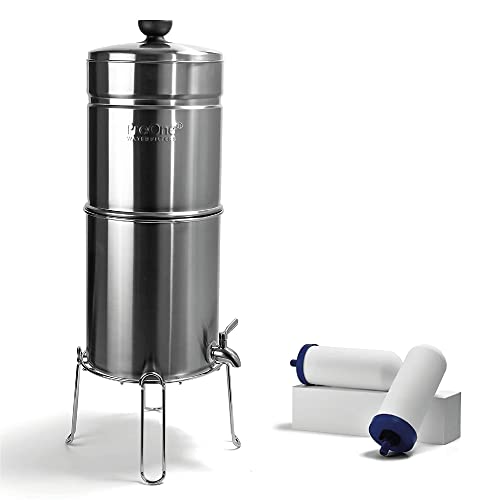
- IAPMO-certified contaminant reduction
- Two filters rated for up to nine months
- 3-gallon polished stainless steel dispenser
Best For: Buyers seeking broad filtration claims and long filter life
Best Value Pick
2.25-Gallon Carbon Gravity Filter

- Over 99% chlorine reduction claim
- Includes two replacement filters
- Portable stackable stainless steel design
Best For: Households wanting simple, portable carbon filtration
Best Overall
Purewell 6-Stage Ultra-Filtration System

- Six-stage filtration with a 0.01-micron UF membrane
- Visible water-level window helps prevent overfilling
- Up to 6,000 gallons across two filters
Best For: Families wanting detailed filtration and easy water-level monitoring
Best for Low-Maintenance Use
Upgraded 2.25-Gallon Stainless Steel Filter

- 304 stainless steel tank with leak and overflow protection
- Includes two fluoride and two carbon filters
- Tool-free assembly with detachable parts for cleaning
Best For: Small kitchens, offices, outdoor use, and cost-conscious buyers
Best Compact Design
Purewell 3-Stage 0.01-Micron System

- Compact 2.25-gallon stainless steel countertop design
- 0.01-micron UF membrane with carbon and silver-ion filtration
- Includes metal spigot and non-slip stand
Best For: Buyers wanting compact placement and useful included accessories
Best Washable Ceramic Option – Purewell 3-Stage Gravity Filter
For shoppers comparing stainless steel gravity water filters, the Purewell 3-Stage system combines a 2.25-gallon countertop design with washable ceramic filters and activated carbon filtration. It works without electricity and includes a stand and stainless steel spigot.
Best For: Households wanting a washable ceramic filter for indoor or outdoor use.
Pros:
- Three-stage ceramic, activated carbon, and silver-ion filtration reduces chlorine and particulate contaminants.
- Washable filters can be scrubbed with the included sponge to extend service life.
- Includes a 304 stainless steel housing, spigot, and non-slip stand.
- Each filter is rated for up to 5,000 gallons, depending on water quality.
Cons:
- The filter does not lower TDS.
- The bottom chamber must not be overfilled, or adding water to the upper chamber may cause leaking.
- Filters require a one-minute faucet flush before use.
This is a practical choice if washable ceramic elements and included accessories matter more to you than TDS reduction. Its gravity-fed operation also makes it suitable for locations without convenient power.
Best Simple Carbon System – Waterdrop King Tank Gravity Filter
The Waterdrop King Tank is one of the more straightforward stainless steel gravity water filters for home, travel, or emergency use. Its 2.25-gallon tank uses coconut-shell activated carbon to reduce chlorine and improve water taste and odor without electricity.
Best For: Families seeking a simple, self-installed carbon gravity filter.
Pros:
- Large 2.25-gallon capacity is designed to meet the needs of a family of four.
- Activated carbon filters reduce chlorine and impurities while improving taste and odor.
- No plumbing experience or electricity is required for setup and operation.
- The stainless steel system includes a metal spigot.
Cons:
- The system does not reduce TDS.
- Its two installation holes limit the setup to two carbon filters or two carbon filters with two fluoride filters.
- Carbon filters are rated for up to 6,000 gallons, while fluoride filters are rated for up to 1,000 gallons.
The King Tank keeps the feature set focused on carbon filtration and easy ownership. Consider it when chlorine reduction, capacity, and no-electricity operation are your main priorities.
Best Fluoride-Focused Filtration – Purewell 8-Stage UF System
Among stainless steel gravity water filters, the Purewell 8-Stage system stands out for its broader filter media and dedicated fluoride cartridges. The 2.25-gallon countertop unit uses hollow-fiber UF, activated carbon, silver-ion, sediment, and fluoride-reduction media.
Best For: Users who specifically want fluoride reduction alongside chlorine and sediment filtration.
Pros:
- Eight-stage filtration includes a 0.01-micron hollow-fiber UF membrane and activated carbon.
- Dedicated fluoride filters are designed to reduce fluoride by 90%.
- Includes four filters, a metal water-level spigot, stainless steel housing, and stand.
- Operates by gravity without electricity and can be used indoors or outdoors.
Cons:
- The filter does not lower TDS.
- Fluoride filters are rated for up to 1,000 gallons, compared with 6,000 gallons for the carbon filters.
- The manufacturer recommends replacing filter elements every six months for optimum performance.
This model is a strong fit for buyers who want more specialized filtration than standard carbon-only systems. Its fluoride-focused cartridges add capability but also introduce more replacement planning.
Best Established Countertop Design – Big Berkey Gravity Filter
The Big Berkey is a well-known stainless steel gravity water filter for everyday household use. Its 2.25-gallon system includes two Black Berkey elements and requires no electricity, plumbing, tools, or water pressure.
Best For: Households, apartments, offices, and RVs needing a portable everyday gravity system.
Pros:
- Polished AISI 304 stainless steel construction is designed for long-term countertop use.
- Includes two authentic Black Berkey BB9-2 filter elements and installation accessories.
- No electricity, plumbing, permanent installation, or specialized tools are typically required.
- Each pair of filters is rated for up to 6,000 gallons before replacement is recommended.
Cons:
- The stated flow rate is relatively slow at 0.03 gallons per minute.
- Replacement filter pairs are sold separately.
- The supplied warranty is six months for the system, with a separate prorated warranty for the elements.
The Big Berkey emphasizes durable construction, portability, and long filter life. It is worth considering for buyers comfortable with its slower gravity-fed flow and ongoing replacement-filter costs.
Best High-Capacity Pick – IceJoy 8-Stage Gravity Filter
If you need stainless steel gravity water filters for a family, the IceJoy combines a 3-gallon capacity with an eight-stage filtration design. It works without electricity or plumbing and uses a lead-free 304 stainless steel body for countertop, outdoor, or emergency use.
Best For: Families wanting large-capacity, energy-free filtration with multiple filter stages.
Pros:
- Eight-stage media is designed to reduce 99.9% of chlorine and capture rust, sediment, organic compounds, and heavy metals.
- Durable, food-grade, lead-free 304 stainless steel construction.
- Three-gallon capacity and sight-glass spigot make daily use and water-level monitoring convenient.
- Replaceable filters can last up to 3,000 gallons for the black carbon filter and 1,000 gallons for the white filter.
Cons:
- The filter does not reduce TDS levels.
- The lower chamber can overflow if the upper chamber is filled while it is full.
Choose this model if capacity, rugged construction, and layered filtration matter more than TDS reduction. Its gravity-only operation also makes it practical where power and plumbing are unavailable.
Best Certified Option – ProOne Big+ Gravity Filter
The ProOne Big+ is one of the more feature-rich stainless steel gravity water filters for countertop or RV use. Its 3-gallon polished stainless steel dispenser includes two filters and is IAPMO certified to reduce lead, total PFAS, microplastics, chlorine taste, and odor.
Best For: Buyers prioritizing broad contaminant-reduction claims, certification, and long filter life.
Pros:
- IAPMO certified to reduce lead, total PFAS, microplastics, chlorine taste, and odor.
- Two included ProOne G2.0 filters can last up to nine months with regular daily use.
- Polished stainless steel construction is corrosion- and rust-resistant and includes a stainless steel spigot and stand.
- Operates without electricity for home, RV, camping, or emergency use.
Cons:
- The supplied details do not specify a maximum TDS level.
- Its two-filter configuration may require more setup than a single-filter system.
This is a strong choice when documented filtration coverage and extended filter life are central to your buying decision. The stainless steel stand and portable, no-power design add everyday flexibility.
Best Value Pick – 2.25-Gallon Carbon Gravity Filter
For shoppers seeking compact stainless steel gravity water filters, this 2.25-gallon countertop system offers a straightforward activated-carbon setup. Its coconut-shell carbon filters are designed to reduce chlorine by over 99%, and the stackable construction suits home, camping, and outdoor use.
Best For: Households wanting a portable, lower-capacity system with included replacement filters.
Pros:
- Natural coconut-shell activated carbon reduces chlorine by over 99%.
- Food-grade stainless steel construction is BPA-free, lead-free, and corrosion-resistant.
- Includes two filter replacements and is rated to filter up to 6,000 gallons.
- Stackable design, stainless steel spigot, and lightweight 8.8-pound build support portability.
Cons:
- The 2.25-gallon capacity is smaller than the 3-gallon systems in this roundup.
- The supplied filtration details focus on chlorine reduction and do not list broader contaminant claims.
This model is a practical fit when you want a portable gravity-fed dispenser and lower refill demands without electrical requirements. Its included replacements can also reduce ongoing filter-buying hassle.
Best Overall – Purewell 6-Stage Ultra-Filtration System
For shoppers comparing stainless steel gravity water filters, the Purewell BO-2.25G stands out with a 304 stainless steel countertop build, a visible water-level window, and six filtration stages. Its 0.01-micron hollow-fiber UF membrane, activated carbon, KDF, silver ions, and other layers are designed to reduce chlorine, sediment, rust, organic matter, and heavy metals without electricity.
Best For: Families wanting detailed filtration and easy water-level monitoring.
Pros:
- Six-stage filtration includes a 0.01-micron UF membrane, activated carbon, KDF, and silver ions.
- Transparent water-level window helps prevent overfilling.
- Dual filters provide up to 6,000 gallons total, with a recommended six-month replacement schedule.
- NSF/ANSI 42 and 372 certifications support chlorine reduction and lead-free material compliance.
Cons:
- The system does not lower TDS, since it retains minerals such as calcium and magnesium.
- It is incompatible with filter elements from other brands.
- The 20-inch height may require checking available countertop clearance.
This is a strong all-around option if filtration depth and usability matter most. The level window is particularly practical, while the large stated filter capacity helps control replacement frequency.
Best for Low-Maintenance Use – Upgraded 2.25-Gallon Stainless Steel Filter
This upgraded countertop model is one of the more practical stainless steel gravity water filters for households that want a compact, no-electricity setup. Its 2.25-gallon 304 stainless steel tank uses six-stage filtration, includes four replacement filters, and is designed for tool-free assembly, faster water flow, and easier cleaning.
Best For: Small kitchens, offices, outdoor use, and buyers focused on long-term filter costs.
Pros:
- Food-safe 304 stainless steel tank resists rust and surface discoloration.
- Includes two fluoride filters and two carbon filters.
- Tool-free assembly and removable parts simplify setup and cleaning.
- Leak-resistant seals and an overflow barrier are designed to help prevent messy spills.
Cons:
- The product notes provide fewer specific contaminant-reduction details than some competing models.
- Its stated maximum supported TDS level is 500 ppm.
- At 11 by 11 inches, it has a wider footprint than the slimmer Purewell systems.
This model emphasizes convenience and durability rather than an especially compact footprint. The included filter set, stainless steel construction, and tool-free maintenance make it a sensible choice for flexible home or off-grid use.
Best Compact Design – Purewell 3-Stage 0.01-Micron System
The Purewell PW-OB-K is a compact choice among stainless steel gravity water filters, pairing a 304 stainless steel housing with a metal water-level spigot and stand. Its three-stage composite filters use activated carbon, silver ions, and a 0.01-micron UF membrane to reduce chlorine and intercept rust, sediment, organic matter, and heavy metals.
Best For: Buyers wanting a compact countertop system with a metal spigot and stand included.
Pros:
- 0.01-micron UF membrane is designed for fine filtration while maintaining a stated flow rate of 4 gallons per hour.
- Includes a metal water-level spigot and non-slip stand.
- 304 food-grade stainless steel housing offers a sturdy, long-lasting structure.
- Operates without electricity and supports indoor or outdoor use.
Cons:
- Three-stage filtration is less extensive than the six-stage systems in this roundup.
- The filter does not lower TDS.
- Adding water to the upper chamber while the lower chamber is full can cause leaking.
This system is a good fit when countertop space, included accessories, and simple operation are priorities. Its 2.25-gallon capacity and compact 8.8-inch square footprint make it easier to place than wider gravity units.
How We Picked These Stainless Steel Gravity Water Filters
We focused on countertop gravity systems made with stainless steel, including models with ceramic, ultrafiltration, or multi-stage cartridges. The selection covers compact 2.25-gallon units, larger 3-gallon designs, and systems aimed at home, emergency, or outdoor use.
We compared stated filtration technology, available certifications, capacity, included filters, water-level visibility, construction details, stands, spigots, and likely maintenance needs. Where performance claims vary, verify the manufacturer’s current documentation and contaminant-reduction data before buying.
Quick Comparison
| What to compare | Why it matters |
|---|---|
| Capacity | Determines how often you need to refill the upper chamber. |
| Filter configuration | Affects flow rate, service life, and the contaminants addressed. |
| Certification | Provides third-party evidence for specific performance claims. |
| Build and accessories | Influences stability, visibility, dispensing, and everyday convenience. |
| Replacement cost | Often matters more than the initial purchase price over several years. |
Key Buying Factors for Stainless Steel Gravity Water Filters
Capacity and Countertop Footprint
A 2.25-gallon system is generally suitable for couples, small families, or limited counter space. A 3-gallon model reduces refills for larger households but needs more vertical and horizontal clearance. Measure the space beneath cabinets and leave room to remove the upper chamber.
Filtration Claims and Certification
Do not assume that more stages automatically mean better filtration. Look for the specific contaminants addressed, pore size where relevant, and certifications such as NSF/ANSI standards or IAPMO validation. Certification applies to particular claims, not necessarily every contaminant or component.
Maintenance and Replacement Filters
Gravity systems require regular cleaning, and ceramic or membrane elements may need rinsing or replacement. Check the expected filter life, replacement availability, priming instructions, and whether the housing can be cleaned easily. A lower-cost system is less appealing if replacement cartridges are difficult to find.
Materials and Usability
304 stainless steel is commonly chosen for durability and corrosion resistance. Also inspect the spigot material, lid fit, stand stability, water-level window, and whether the unit dispenses comfortably into your usual glasses or pitchers.
Who Should Buy Which Stainless Steel Gravity Water Filters?
Choose a compact 2.25-gallon model if you want a straightforward everyday countertop filter or have limited space. Larger 3-gallon systems make more sense for families, frequent cooking, or fewer refills. Models with ultrafiltration and very fine stated pore sizes may appeal to shoppers prioritizing broader particulate filtration, while ceramic systems can be attractive for simple maintenance and washable elements.
If verified contaminant reduction is your priority, favor a model with clear, current third-party certification for the contaminants you care about. For backup water supplies or outdoor use, prioritize rugged construction, manageable weight, replacement-filter availability, and operation without electricity. In every case, match the filter’s tested capabilities to your incoming water rather than relying on stage count alone.