Portable solar panels make it easier to recharge a power station away from the grid, whether you are camping, traveling by RV, or preparing for outages.
Our 2026 roundup compares 10 foldable and high-output options, with attention to wattage, efficiency, compatibility, portability, and outdoor durability.
Best 10 Portable Solar Panels Picks for 2026
Best High-Efficiency Pick
Renogy 200W Portable Solar Panel

- 25% efficiency with N-Type cells
- 13.9-pound folding design
- USB-C and dual USB-A charging
Best For: Efficient camping and RV charging with direct device support
Best High-Output Value

- 400W rated maximum power
- Six-fold, 22.9-pound design
- Includes multiple adapter cables
Best For: Higher-capacity power-station charging on outdoor trips
Best Bifacial Design
GEYOTO 200W Bifacial Solar Panel

- Up to 26% cell conversion efficiency
- Rear-side collection in suitable conditions
- Includes reflective case and 10-foot cable
Best For: Reflective-surface setups for camping and RV charging
Best Rugged 400W Option
Renogy 400W Portable Solar Panel

- 400W output with 23% efficiency
- Fiberglass, ETFE, and IP67 construction
- Parallel wiring helps with individual shadows
Best For: Durable RV, overlanding, and blackout-backup charging
Best All-Around Value
ZOUPW 100W Foldable Solar Panel

- 23.5% efficient monocrystalline cells
- Five connector types for broad compatibility
- USB-C and USB-A device charging
Best For: Camping, RV trips, and emergency charging with smaller power stations
Best 200W Midrange Option
BougeRV 200W N-Type Solar Panel

- 200W output with 25% claimed efficiency
- Fiberglass-reinforced foldable construction
- Includes an 8.2-foot extension cable
Best For: RV travel and camping with compatible 200W-capable power stations
Best High-Output Choice

- 450W output for large power stations
- N-Type 16BB cells with 25% claimed efficiency
- Includes cables, ground stakes, and storage bag
Best For: Large 40–60V power stations used for RVing and off-grid backup
Best with Extra Features
CTOLITY 400W Foldable Solar Panel

- 400W output with 23% conversion efficiency
- Foldable design with adjustable kickstand
- IP65 construction and broad power-station compatibility
Best For: RV trips, camping, and emergency backup charging
Premium Efficiency Pick
ZOUPW 480W Bifacial Solar Panel

- 480W N-Type 16BB panel with claimed 25% efficiency
- Bifacial design may add output on reflective surfaces
- IP68 durability with cables, stakes, and 36-month warranty
Best For: Large power stations, RVs, and off-grid systems
Versatile Mid-Size Pick
SOKIOVOLA 200W Foldable Solar Panel
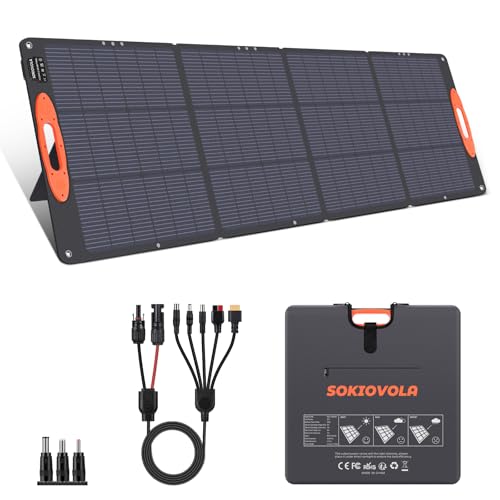
- 200W output with claimed 25% efficiency
- 5-in-1 connector cable supports many power stations
- Folds to 21 by 23 inches with a carry handle
Best For: Camping, RV use, and flexible power-station charging
Best High-Efficiency Pick – Renogy 200W Portable Solar Panel
For shoppers comparing portable solar panels for camping, RV travel, or blackout backup, this Renogy model combines a 200W output with 25% efficiency in a relatively compact folding design. It also includes direct USB charging for smaller devices.
Best For: Campers and RV owners who want efficient power-station charging plus convenient phone, tablet, laptop, or camera charging.
Pros:
- 25% efficiency from 16BB N-Type cells.
- Folds to 23.72 x 22.99 x 1.97 inches and weighs 13.9 pounds.
- USB-C PD 45W and dual USB-A ports support direct device charging.
- Four kickstands, reinforced grommets, and multiple positioning angles aid outdoor setup.
Cons:
- Uses MC4 output; the 4-in-1 adapter is sold separately.
- Its 200W capacity is lower than the 400W options in this roundup.
This is a practical choice when portability and efficiency matter more than maximum panel capacity. Verify your power station’s voltage, current, and connector requirements before buying.
Best High-Output Value – 400W Portable Solar Panel
This 400W model is one of the more powerful portable solar panels for charging compatible power stations during camping, RV trips, and off-grid backup. Its six-fold design, included cables, and adjustable kickstand help simplify setup.
Best For: Buyers who prioritize higher rated output and broad cable compatibility while still needing a foldable solar suitcase.
Pros:
- 400W maximum power with a stated 23.5% conversion rate.
- Includes a 3m MC4 cable plus MC4-to-XT60, Anderson, and DC8020 connections.
- Six-angle kickstand supports positioning toward the sun.
- Oxford fabric and CPC lamination are described as tear-resistant, dustproof, and waterproof.
Cons:
- Weighs 22.9 pounds, making it heavier than the 200W alternatives.
- Its folded size is approximately 26.18 x 22.44 x 2.95 inches.
- Output still depends on sunlight, positioning, and the power station’s input limits.
The combination of 400W capacity and included connection cables makes this appealing for larger power stations. Check connector fit and charging limits before connecting it to your equipment.
Best Bifacial Design – GEYOTO 200W Bifacial Solar Panel
Among portable solar panels, this 200W GEYOTO stands out for its bifacial design: the front captures direct sunlight while the rear can collect reflected light in suitable conditions. A reflective carrying case and integrated setup features make it suited to portable outdoor use.
Best For: Campers and RV users who can position a panel over a reflective surface and want a 200W foldable setup with a long connection cable.
Pros:
- N-Type cells are rated for up to 26% conversion efficiency.
- Bifacial construction can use reflected light when conditions and placement allow.
- Includes a reflective carrying case and 10-foot MC4-to-XT60 cable.
- IP68-rated panel surface and carbon-steel Y-shaped kickstand support outdoor setup.
Cons:
- Rear-side gains depend on angle, shading, ground reflectivity, and available light.
- The junction box is not waterproof and must be protected from rain and standing water.
- The included cable is specifically MC4-to-XT60, so other power stations may need an additional cable.
This panel is most interesting when you can deliberately use reflected light, rather than simply placing it on any surface. Treat the bifacial output as condition-dependent and protect the junction box during wet weather.
Best Rugged 400W Option – Renogy 400W Portable Solar Panel
For buyers seeking portable solar panels for demanding RV travel, overlanding, or home backup, this Renogy 400W model emphasizes durable materials and weather resistance. Its folding suitcase format offers high rated capacity without the footprint of a rigid panel installation.
Best For: RV owners, marine users, off-grid cabin operators, and emergency-backup shoppers who want a rugged 400W panel with broad listed power-station compatibility.
Pros:
- 400W maximum power with 23% stated efficiency.
- Fiberglass reinforcement, ETFE coating, Grade A+ cells, and aluminum backsheet support long-term outdoor use.
- IP67 waterproofing, corner protection, and hail-resistant construction are designed for varied weather.
- Parallel wiring can help reduce the impact of individual shadows.
Cons:
- At 30.2 pounds, it is heavier than the other listed options.
- MC4 output cables are included, but the Renogy 4-in-1 adapter is sold separately.
- A compatible solar charge controller is required for 12V/24V battery systems and is not included.
This is the strongest fit for users who value construction and 400W capacity over minimum carry weight. Confirm your power station’s voltage, current, connector, and input limits, especially because real-world output varies with conditions.
Best All-Around Value – ZOUPW 100W Foldable Solar Panel
For shoppers comparing portable solar panels for camping, RV use, or emergency charging, the ZOUPW 100W stands out for its broad connector support and compact foldable design. Its 23.5% efficient monocrystalline cells, adjustable kickstands, and direct USB charging ports make it a flexible option for smaller power stations and personal devices.
Best For: Campers and emergency-preparedness users who need a versatile 100W panel with multiple power-station connections.
Pros:
- 23.5% efficient A+ monocrystalline cells with two adjustable kickstands.
- Five connector options support many Jackery, EcoFlow, Anker, and Bluetti models.
- Foldable 9.5-pound design with ETFE coating and IP67 waterproof protection.
- Built-in USB-C and USB-A ports can charge compatible devices directly.
Cons:
- Its 100W output is better suited to smaller power stations than high-capacity units.
- Actual charging speed depends on the connected power station’s input limit.
- The included cable’s broad compatibility still requires checking your device’s input requirements.
This is a practical, travel-friendly choice when portability and connector flexibility matter more than maximum wattage. Verify your power station’s input limit before buying, since a generator capped at 60W will not draw the panel’s full rated output.
Best 200W Midrange Option – BougeRV 200W N-Type Solar Panel
The BougeRV 200W is a strong middle-ground choice among portable solar panels, offering more rated output than compact 100W models without moving into the weight and setup demands of larger high-capacity panels. Its N-Type cells, fiberglass reinforcement, foldable form, and long extension cable suit regular outdoor use.
Best For: RV travelers and campers who want a portable 200W panel for compatible power stations, fridges, or backup systems.
Pros:
- 200W rated output with claimed 25% conversion efficiency from N-Type cells.
- Fiberglass reinforcement helps resist cracking and surface abrasion during transport.
- 8.2-foot extension cable allows flexible panel and power-station placement.
- Foldable design with built-in handles weighs 13.8 pounds.
Cons:
- Only XT60 and DC7909 connectors are specified, so compatibility should be checked carefully.
- IP65 protection is intended for water and dust resistance, not full waterproof immersion.
- At 31.1V output, it may not suit lower-voltage power stations.
The BougeRV balances useful output and portability for users with a compatible power station. Its reinforced construction is appealing for repeated trips, while the extension cable makes it easier to place the panel in direct sun without moving your equipment.
Best High-Output Choice – ZOUPW 450W N-Type Solar Panel
For buyers seeking portable solar panels for large power stations, the ZOUPW 450W offers substantially more rated capacity than compact foldable models. Its N-Type 16BB cells, 25% claimed efficiency, four adjustable kickstands, and included connection cables are designed for compatible systems with 40–60V solar input.
Best For: RV boondocking, overlanding, and emergency power users with large EcoFlow, Anker, Bluetti, or similar power stations.
Pros:
- 450W rated output with N-Type 16BB cells and claimed 25% efficiency.
- Fiberglass construction keeps the panel lighter than comparable rigid panels at 29.5 pounds.
- IP68-rated panel construction with bypass diodes for partial-shade performance.
- Includes a 13.12-foot extension cable, four-in-one adapter cable, ground stakes, and storage bag.
Cons:
- Not compatible with low-voltage units requiring less than 30V input, including the listed Jackery 300, 500, and 1000 models.
- At 29.5 pounds, it is considerably heavier than smaller portable panels.
- Connectors should not be soaked, despite the panel’s IP68 rating.
This is the performance-oriented pick for large power stations, but voltage compatibility is critical. It makes the most sense for buyers who can use its 40–60V input range and who value faster charging over the lightest possible carry weight.
Best with Extra Features – CTOLITY 400W Foldable Solar Panel
For shoppers comparing portable solar panels for camping, RV travel, or emergency backup, the CTOLITY 400W model emphasizes high output without giving up foldable portability. Its 23% conversion rate, adjustable kickstand, and broad power-station compatibility make it a practical option for larger solar charging setups.
Best For: Campers, RV owners, and households seeking a higher-output panel for compatible power stations.
Pros:
- 400W rating and 23% conversion efficiency support substantial solar generation.
- Foldable design and adjustable kickstand simplify transport and setup.
- Compatible with Jackery and EcoFlow power stations.
- IP65-rated construction and protective charging features suit outdoor use.
Cons:
- Its 400W, 40V design may exceed the input limits of some portable power stations.
- At this output level, it may be less convenient for lightweight backpacking than smaller panels.
The CTOLITY is a strong fit when charging capacity matters more than minimizing packed size. Verify your power station’s input specifications before buying, then use the adjustable stand to improve sun exposure.
Premium Efficiency Pick – ZOUPW 480W Bifacial Solar Panel
The ZOUPW 480W is one of the more advanced portable solar panels in this roundup, pairing N-Type 16BB cells with a bifacial design. It is aimed at RV travelers and off-grid users who want high output, added performance from reflective surfaces, and a durable package for demanding outdoor conditions.
Best For: RV owners and off-grid users with large power stations who can take advantage of high-voltage, high-output charging.
Pros:
- 480W output and claimed 25% conversion rate provide strong charging potential.
- Bifacial construction can capture additional reflected light on snow or sand.
- IP68-rated composite construction is designed for rain, heat, and outdoor travel.
- Includes connector cables, ground stakes, a storage bag, and a 36-month warranty.
Cons:
- The 42.5V architecture requires careful compatibility checking with your power station.
- Bifacial gains depend on reflective surfaces and favorable placement.
- The manufacturer advises against long-term fixed, series, or parallel connections.
This is the performance-oriented choice for buyers who can match its electrical requirements and position it where rear-side light is useful. Its included accessories and longer warranty add value for serious off-grid setups.
Versatile Mid-Size Pick – SOKIOVOLA 200W Foldable Solar Panel
For buyers who want portable solar panels with broad connector support, the SOKIOVOLA 200W model offers a balanced setup for camping, RV use, and power-station charging. Its 25% efficiency rating, foldable format, and included 5-in-1 cable make it especially convenient for users with different generator brands.
Best For: Campers and RV users who need a versatile 200W panel for several types of portable power stations.
Pros:
- 25% efficiency rating and 200W maximum output offer capable portable charging.
- Includes connectors for XT60, DC5521, DC7909, DC8020, and Anderson inputs.
- ETFE-coated construction is designed to be waterproof and dustproof.
- Folds to 21 by 23 inches and includes a magnetic carry handle.
Cons:
- At 16.31 pounds, it may feel heavy for extended backpacking or hiking.
- Actual charging can be limited by the connected power station’s maximum solar input.
- Coverage is backed by a 12-month warranty and 30-day refund guarantee, shorter than some alternatives.
The SOKIOVOLA is a practical middle-ground option when connector flexibility matters more than ultra-light weight. Check your power station’s solar input limit before purchase so its 200W rating matches your system.
How We Picked the Best Portable Solar Panels
We focused on panels designed to charge portable power stations rather than small USB devices alone. The selection covers practical 100W and 200W models, higher-output 400W to 480W panels, bifacial designs, and N-type cell technology. We considered stated output, conversion efficiency, folding design, connector compatibility, weather resistance, construction materials, and the types of users each panel best serves.
Because real-world output changes with sunlight, temperature, panel angle, and shade, rated wattage should be treated as a maximum under favorable conditions—not a guaranteed continuous output.
Quick Comparison
| What to Compare | Best For | Typical Trade-Off |
|---|---|---|
| 100W to 200W | Day trips, compact kits, and smaller power stations | Slower charging for large-capacity batteries |
| 400W to 480W | Fast charging and extended off-grid stays | More weight, size, and setup space |
| Bifacial panels | Bright surfaces and open outdoor locations | Rear-side gains depend heavily on placement |
| N-type panels | Efficiency-focused buyers and demanding use | Often costs more than basic panels |
Key Buying Factors for Portable Solar Panels
Power and Charging Needs
Match panel output to your power station’s solar-input limits. A higher-rated panel will not necessarily charge faster if the station caps incoming wattage, voltage, or current. Smaller panels are easier to carry, while 400W-plus models can reduce charging time when conditions and equipment support them.
Compatibility and Connectors
Check the power station’s supported voltage range, maximum solar input, polarity, and connector type before buying. MC4 connections are common, but an adapter may still be required for Jackery, EcoFlow, Bluetti, Anker, or other systems. Do not connect panels in series or parallel unless both the panel and power station support the resulting electrical values.
Portability and Setup
Foldable panels are convenient for vehicles and campsites, but higher wattage generally means a larger folded footprint and heavier carrying weight. Consider storage space, included stands, cable length, and how quickly the panel can be angled toward the sun.
Efficiency and Durability
Efficiency can help when roof or campsite space is limited, but it does not eliminate losses from shade or poor positioning. Look for sturdy hinges, protective cases, weather-resistant construction, and an appropriate IP rating. Even waterproof-rated panels should be protected from prolonged pooling water and severe weather.
Who Should Buy Which Portable Solar Panels?
- Choose a 100W panel if you prioritize low weight, compact storage, and occasional charging of a smaller power station.
- Choose a 200W panel for a balanced option suited to camping, RV use, emergency backup, and moderate daily charging.
- Choose a 400W to 480W panel if you have a compatible high-input power station and want the shortest practical recharge times.
- Choose bifacial or N-type technology when available space, bright reflective ground, or efficiency matters more than the lowest purchase price.
For the best results, place the panel in full sun, adjust its angle during the day, keep connectors dry and secure, and verify the power station’s input specifications before connecting your kit.