Winter puts extra demands on a solar charging system: shorter days, changing panel output, freezing temperatures, and batteries that may require different charging settings. The right controller helps turn limited sunlight into safer, more consistent charging.
This roundup compares 10 options ranging from compact PWM regulators to higher-efficiency MPPT models. Use the guide below to match controller type, voltage, amperage, battery chemistry, and weather protection to your setup.
Best 10 Solar Charge Controllers for Winter Use Picks for 2026
Winter Power Optimizer
Victron SmartSolar MPPT 100/50

- 50A MPPT charging for 12/24V systems
- App monitoring with 30-day performance history
- Configurable load disconnect and synchronized charging
Best For: Larger off-grid systems needing high-capacity, shade-aware charging
Small-System Winter Reliable

- Four-stage charging with temperature compensation
- Factory presets simplify installation
- Extensive electrical protections and load control
Best For: Small 12V systems seeking simple, dependable regulation
Extreme-Climate Winter Choice

- Specified operation from -40°F to 149°F
- Low-temperature protection and adjustable cutoff
- Supports lead-acid and lithium batteries
Best For: Cold-weather off-grid systems needing flexible battery support
Compact Winter MPPT

- 15A MPPT charging for 12/24V systems
- Bluetooth monitoring and configuration
- Synchronized charging and intelligent load output
Best For: Compact systems needing efficient, app-connected charging
Best Temperature-Compensating PWM Pick

- Supports lithium and lead-acid battery types
- Optional temperature compensation for -4°F to 113°F
- Four-stage charging with multiple safety protections
Best For: 12V RV, boat, and off-grid systems
Best All-Weather MPPT Option

- MPPT charging for changing sunlight conditions
- IP68 waterproof housing for outdoor use
- LCD monitoring plus USB and Type-C ports
Best For: Small 12V outdoor systems with 20W–200W panels
Best Heavy-Duty Lead-Acid Controller

- Temperature compensation from -40°F to 140°F
- IP68 sealed metal housing for harsh environments
- Four-stage charging with low-voltage disconnect
Best For: Small 12V lead-acid systems in industrial or remote locations
Efficient Winter Charging
SOLPERK MPPT 10A 12V Controller

- MPPT charging advertised as 30% more efficient than PWM
- IP67 waterproof design for outdoor installations
- Compatible with many 12V battery types, including LiFePO4
Best For: 12V outdoor battery systems needing compact MPPT charging
Rugged Dual-Voltage Value
20A 12V/24V IP68 PWM Controller
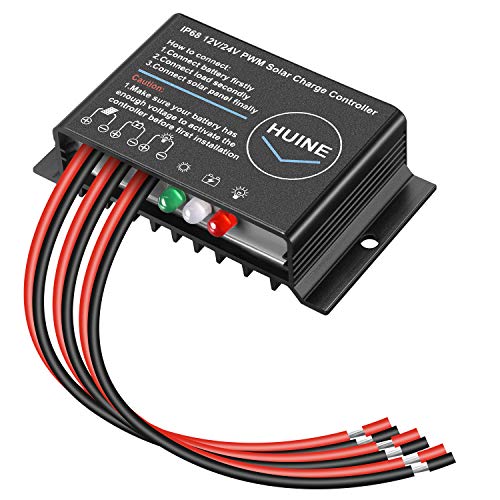
- IP68 waterproof construction for outdoor systems
- Automatically detects 12V or 24V batteries
- 20A rating with four-stage PWM charging
Best For: Outdoor caravans, boats, lighting, and monitoring systems
Simple 12V/24V Setup
SOLPERK 10A Waterproof PWM Controller

- IP67 waterproof housing for outdoor use
- Automatic 12V/24V battery-voltage detection
- Supports up to 150W at 12V or 300W at 24V
Best For: Compact RV, boat, and vehicle systems using AGM, gel, or flooded batteries
Winter Power Optimizer – Victron SmartSolar MPPT 100/50
For solar charge controllers for winter use, the Victron SmartSolar MPPT 100/50 is a strong choice when changing light and partial shade make efficient harvesting important. Its MPPT tracking, configurable charging, and Bluetooth monitoring help you manage a 12/24V system through seasonal conditions.
Best For: Larger 12V or 24V off-grid systems that need high charging capacity, monitoring, and load control.
Pros:
- 50A MPPT charging is designed to maximize available solar power, including in partial shade.
- VictronConnect provides real-time data, 30-day history, settings, firmware updates, and alarms.
- Supports synchronized operation with multiple SmartSolar MPPT controllers.
- Configurable intelligent load output can disconnect loads when battery voltage is too low.
Cons:
- It has no built-in display, so monitoring relies on connected devices or the app.
- Its 50A capacity may be more than needed for small winter solar setups.
This controller is particularly appealing when winter shade and limited daylight make every watt count. Confirm that its 100V solar-input rating, battery voltage, and 50A capacity match your system before installation.
Small-System Winter Reliable – Morningstar SunSaver 10A PWM
For solar charge controllers for winter use on smaller 12V systems, the Morningstar SunSaver 10A PWM emphasizes dependable regulation and battery care. Four-stage charging, temperature compensation, and factory presets simplify setup while helping manage seasonal charging conditions.
Best For: Smaller 12V battery systems where straightforward PWM charging, load control, and durable protections are priorities.
Pros:
- Four-stage PWM charging and temperature compensation support battery longevity.
- Factory presets and electronic protections make installation simpler and safer.
- Includes sealed or flooded battery options, dead-battery recovery, and load control.
- Built-in protection covers surges, overloads, short circuits, reverse polarity, and high temperature.
Cons:
- The 10A PWM design is intended for smaller systems rather than high-output arrays.
- It is specified for 12V batteries and does not offer the broader 12/24V flexibility of some alternatives.
The SunSaver is a practical winter option when system size is modest and reliability matters more than advanced app connectivity or MPPT performance. Its LED indicators provide basic status information without requiring a separate monitoring app.
Extreme-Climate Winter Choice – Renogy Rover 40A MPPT
For solar charge controllers for winter use in demanding climates, the Renogy Rover 40A combines MPPT charging with a stated operating range of -40°F to 149°F. Low-temperature protection, adjustable cutoff settings, and support for lead-acid or lithium batteries make it adaptable for off-grid installations.
Best For: 12V/24V off-grid systems exposed to cold weather and users who want an LCD, battery flexibility, and optional app connectivity.
Pros:
- MPPT technology is rated for 98% conversion and 99% tracking efficiency.
- Operates from -40°F to 149°F and includes low-temperature protection.
- Supports Gel, AGM, flooded, and lithium batteries with tailored charging stages.
- Includes an LCD, remote temperature sensor, and protections against common electrical faults.
Cons:
- Bluetooth app connectivity requires the separately sold BT-2 accessory.
- Its 40A capacity and larger enclosure may be unnecessary for compact systems.
The Rover 40A stands out for winter installations where temperature range and battery chemistry flexibility are central concerns. Check the array, battery, and wiring specifications carefully, and account for the separate accessory cost if app control is desired.
Compact Winter MPPT – Victron SmartSolar 75/15
For solar charge controllers for winter use in compact 12V or 24V systems, the Victron SmartSolar 75/15 uses MPPT tracking to capture available energy during variable light and partial shade. Bluetooth connectivity adds convenient configuration and performance monitoring.
Best For: Smaller off-grid systems that need compact MPPT performance, app-based monitoring, and intelligent load control.
Pros:
- MPPT tracking is designed to maximize output when panels are partially shaded.
- VictronConnect offers real-time data, 30-day history, configuration, updates, and alarms.
- Multiple units can synchronize their charging stages for system-wide optimization.
- Intelligent load output can disconnect loads when battery voltage falls too low.
Cons:
- The 15A rating limits it to smaller solar arrays and battery systems.
- Its 75V input rating may not suit higher-voltage panel configurations.
- The unit has only an LED or minimal display rather than a full onboard screen.
This is a useful compact choice when winter charging efficiency and remote visibility matter but system demand remains moderate. Verify the panel voltage, array current, and battery configuration before pairing it with your installation.
Best Temperature-Compensating PWM Pick – Renogy Wanderer Li 30A
For solar charge controllers for winter use, the Renogy Wanderer Li 30A is a practical 12V PWM option when battery chemistry and temperature compensation matter. It supports LiFePO4, AGM, gel, and flooded batteries, with an optional BT-1 module for app-based monitoring.
Best For: RV, boat, and off-grid 12V systems that need chemistry-specific charging and optional cold-weather monitoring.
Pros:
- Supports LiFePO4, AGM, gel, and flooded batteries.
- Optional temperature compensation from -4°F to 113°F with the BT-1 module.
- Four-stage charging includes bulk, boost, float, and automatic equalization.
- Includes reverse-polarity, overcharge, overload, and short-circuit protection.
Cons:
- PWM charging is less energy-efficient than MPPT.
- Temperature compensation and Bluetooth monitoring require the optional BT-1 module.
- Designed for 12V systems, with a 25V maximum PV input.
This is a well-rounded choice when winter charging needs to be matched to the battery and installation space is limited. Confirm the optional accessories and system voltage before buying.
Best All-Weather MPPT Option – SUNAPEX 12V 15A MPPT
The SUNAPEX 12V 15A is a strong candidate among solar charge controllers for winter use because its MPPT design is intended to capture more available energy in changing sunlight. Its IP68 housing, LCD monitoring, and reverse-current protection are useful for outdoor systems operating through wet, low-light conditions.
Best For: Small 12V solar systems using 20W to 200W panels in outdoor locations such as RVs, boats, cabins, and sheds.
Pros:
- MPPT charging is designed to reduce energy loss versus traditional PWM controllers.
- IP68 waterproof housing helps protect against rain, dust, and moisture.
- LCD shows battery voltage, charging current, battery level, and status.
- Supports LiFePO4, AGM, gel, flooded, and sealed lead-acid batteries.
Cons:
- Compatible only with 12V battery systems, not 24V or 36V.
- Limited to solar panels rated from 20W to 200W.
- Its integrated USB and Type-C ports are intended for small electronics rather than large loads.
Choose this model when maximizing panel output and protecting the controller from winter moisture are higher priorities than supporting larger battery banks. Verify the panel wattage and 12V system requirement first.
Best Heavy-Duty Lead-Acid Controller – Zuomeng 10A PWM
For demanding installations, the Zuomeng 10A is one of the more rugged solar charge controllers for winter use. It combines four-stage PWM charging, IP68 protection, a sealed metal housing, and temperature compensation across -40°F to 140°F for 12V lead-acid systems.
Best For: 12V sealed, flooded, or gel lead-acid batteries in industrial, remote, marine, RV, and off-grid environments.
Pros:
- Temperature compensation covers -40°F to 140°F.
- Sealed explosion-proof metal housing and IP68 construction suit harsh environments.
- Four-stage charging includes bulk, absorption, float, and equalization.
- Includes low-voltage disconnect, reverse-polarity, short-circuit, overcurrent, and surge protection.
Cons:
- Supports lead-acid batteries only; lithium compatibility is not listed.
- 10A capacity is intended for smaller 12V systems.
- Uses LED indicators rather than an LCD or app-based monitoring system.
This controller is best suited to buyers who prioritize enclosure protection and wide-range temperature compensation over advanced display features. Its lead-acid-only compatibility should be checked carefully before installation.
Efficient Winter Charging – SOLPERK MPPT 10A 12V Controller
For solar charge controllers for winter use, this compact MPPT model is a practical choice for 12V battery systems. Its stated efficiency advantage over PWM charging may help replenish compatible batteries faster, while IP67 waterproofing supports outdoor installations.
Best For: 12V RV, boat, vehicle, or backup-battery setups using AGM, lead-acid, gel, deep-cycle, sealed, flooded, or LiFePO4 batteries.
Pros:
- MPPT charging is advertised as up to 30% more efficient than PWM.
- IP67 waterproof housing suits outdoor use.
- Supports several 12V battery types, including LiFePO4.
- LED indicators and an SAE port simplify monitoring and installation.
Cons:
- Designed for 12V batteries rather than automatic 12V/24V operation.
- Limited to a 10A controller rating.
- Its compact LED indicators provide less information than a detailed display.
This controller stands out when faster MPPT charging and broad 12V battery compatibility matter more than higher system capacity. Verify your panel, battery, and current requirements before installation.
Rugged Dual-Voltage Value – 20A 12V/24V IP68 PWM Controller
Among solar charge controllers for winter use, this 20A PWM regulator offers a straightforward option for outdoor 12V or 24V systems. Its IP68 rating, automatic voltage sensing, and four-stage charging design make it suitable for exposed installations such as caravans, boats, lighting, and monitoring systems.
Best For: Outdoor 12V/24V solar systems where waterproof construction, automatic voltage detection, and a 24-hour working mode are priorities.
Pros:
- IP68 waterproof rating supports demanding outdoor placement.
- Automatically senses 12V or 24V battery systems.
- 20A capacity is higher than the two 10A options in this roundup.
- Includes short connection cables, LED status lights, mounting holes, and a heat sink.
Cons:
- Uses PWM charging rather than MPPT.
- The supplied notes do not identify specific battery chemistry compatibility.
- Its 24-hour working mode may not suit systems requiring scheduled load control.
This is a sensible pick for buyers who value rugged waterproofing and flexible 12V/24V operation. Choose it over a smaller controller when your system benefits from the 20A rating and continuous working mode.
Simple 12V/24V Setup – SOLPERK 10A Waterproof PWM Controller
This SOLPERK model is one of the more accessible solar charge controllers for winter use, combining automatic 12V/24V detection with an IP67 waterproof enclosure. It provides three-stage PWM charging, LED status monitoring, and plug-and-play SAE connectivity for smaller RV, boat, and vehicle systems.
Best For: Compact 12V or 24V installations using AGM, gel, or flooded deep-cycle batteries, with up to 150W at 12V or 300W at 24V.
Pros:
- IP67 waterproof design is intended for outdoor use.
- Automatically identifies 12V and 24V systems.
- Supports up to 150W at 12V or 300W at 24V with a 10A maximum current.
- Offers protection against under-voltage, over-voltage, overload, short circuit, and reverse connection.
Cons:
- Uses PWM charging rather than the more efficient MPPT design in the first product.
- Listed battery compatibility covers AGM, gel, and flooded batteries, not lithium.
- LED indicators show basic status rather than detailed charging data.
Its automatic voltage detection and simple SAE installation make this a convenient choice for modest systems. Match the controller to the panel wattage and battery chemistry, especially if winter performance is a priority.
How We Picked the Best Solar Charge Controllers for Winter Use
We focused on controllers that suit common winter applications such as RVs, boats, cabins, backup systems, and small off-grid arrays. The selection covers both PWM and MPPT designs, 12V and 24V systems, and several current ratings so you can compare compact battery maintainers with higher-output controllers.
Key considerations included supported battery voltage, charging capacity, battery-chemistry compatibility, protective features, weather resistance, display or monitoring options, and the practical installation needs of cold-season systems. Product claims should still be checked against the latest manufacturer specifications before purchase.
Quick Comparison
MPPT models generally offer better energy harvest than PWM controllers, especially when panel voltage is higher than battery voltage or sunlight is weak. PWM units can be a sensible lower-cost choice when the panel and battery are closely matched and the system is small.
- Higher-output MPPT: Victron Energy 50A and Renogy Rover 40A models suit larger 12V/24V arrays.
- Compact MPPT: Victron Energy 15A, SUNAPEX 15A, and SOLPERK 10A options fit smaller systems.
- Simple PWM: Morningstar, Renogy Wanderer Li, and the listed 10A/20A regulators are aimed at straightforward installations.
- Outdoor-focused designs: Waterproof or IP-rated models can be useful where condensation, spray, or exposed mounting is a concern.
Key Buying Factors for Solar Charge Controllers for Winter Use
Match Voltage and Charging Current
Confirm that the controller supports your battery bank’s nominal voltage, usually 12V or 24V. Its rated output should also exceed the maximum charging current your solar array can produce, with reasonable headroom. Never size only by panel wattage without checking the controller’s voltage and current limits.
Choose MPPT or PWM Deliberately
MPPT technology is often preferable for winter because it can make better use of low or variable solar input and allows more flexible panel-voltage matching. PWM can work well for small, budget-conscious systems with compatible panels, but it usually gives up some harvest compared with MPPT.
Check Battery Chemistry and Cold-Weather Charging
Lead-acid and lithium batteries do not use identical charging profiles. Look for selectable settings or a controller specifically designed for your chemistry. Lithium batteries also require careful attention to charging below freezing; a controller alone may not prevent damage unless the battery or system includes low-temperature protection.
Prioritize Protection and Monitoring
Useful safeguards include overcharge, reverse-polarity, short-circuit, over-temperature, and over-discharge protection. An LCD, app, or remote-monitoring feature can make winter troubleshooting easier, while an IP-rated enclosure is valuable for damp or exposed locations.
Who Should Buy Which Solar Charge Controllers for Winter Use?
Choose a higher-current MPPT controller for a larger cabin, RV, or backup array where maximizing limited winter sunlight matters. Select a compact MPPT model for a modest battery bank that still needs efficient charging. A PWM controller is appropriate for a simple 12V setup, matched panel, and cost-sensitive installation. For boats, caravans, and outdoor enclosures, prioritize waterproofing and robust protection—but still verify the stated rating, wiring requirements, and installation instructions before relying on it in severe weather.