Choosing among solar charge controllers can significantly affect charging efficiency, battery life, and system reliability. The right model depends on your battery chemistry, solar array voltage, current needs, and installation environment.
This roundup compares 10 popular PWM and MPPT options, from compact 12V controllers to high-capacity units designed for larger off-grid systems.
Best 10 Solar Charge Controllers Picks for 2026
Best Smart Monitoring
Victron SmartSolar MPPT 100V 50A

- MPPT tracking helps maximize solar output
- Bluetooth app provides monitoring and configuration
- Supports synchronized multi-controller charging
Best For: 12V/24V systems needing efficient charging and wireless monitoring
Best 12V PWM Value

- 30A PWM charging for 12V systems
- Supports lithium, AGM, gel, and flooded batteries
- Compact IP32 housing with built-in safeguards
Best For: 12V RV, boat, and off-grid installations
Best High-Voltage MPPT
Victron SmartSolar MPPT 150V 45A

- Works with 12V through 48V battery systems
- 150V PV input supports higher-voltage arrays
- App connectivity and MPPT tracking included
Best For: Flexible multi-voltage off-grid solar installations
Best Compact Small-System Controller
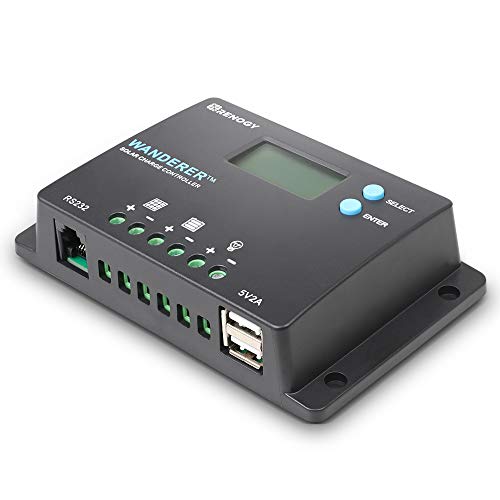
- Supports 12V and 24V battery systems
- LCD displays key system information
- Compact design with four-stage charging
Best For: Small RV, marine, and DIY off-grid systems
Best for Easy Setup

- 12/24V MPPT controller with 30A capacity
- Bluetooth app offers live data and history
- Supports synchronized charging and load disconnect
Best For: Moderate 12V/24V systems needing app-based monitoring
High-Capacity Value Option

- Auto-senses systems from 12V to 96V
- 120A capacity with claimed 98% MPPT efficiency
- LCD monitoring and multiple battery protections
Best For: Large or varied-voltage off-grid solar systems
Compact Setup Choice

- Compact 12/24V MPPT controller
- Bluetooth monitoring through VictronConnect
- 15A rating suits smaller solar systems
Best For: Space-constrained 12V/24V installations
Best All-Weather Pick
Renogy Rover 40A MPPT Controller

- Up to 98% conversion and 99% tracking efficiency
- Supports Gel, AGM, Flooded, and Lithium batteries
- 12V/24V auto-detection with extensive protections
Best For: Off-grid 12V/24V systems in demanding climates
Best Easy-Setup Value

- 12V/24V auto-recognition simplifies installation
- LCD provides real-time performance updates
- Includes dual USB ports and core safety protections
Best For: Simple home or commercial 12V/24V systems
Best for Larger Systems

- Supports 12V–48V battery systems
- 150V maximum solar input for series arrays
- LCD controls with optional smartphone monitoring
Best For: Larger DIY systems with higher-voltage panel arrays
Best Smart Monitoring – Victron SmartSolar MPPT 100V 50A
The Victron Energy SmartSolar MPPT 100/50 is one of the more capable solar charge controllers for 12V and 24V systems. Its MPPT tracking, Bluetooth connectivity, synchronized charging support, and configurable load output make it a strong choice when maximizing solar harvest and monitoring system performance matter.
Best For: RV, off-grid, and other 12V or 24V systems where app-based monitoring and efficient MPPT charging are priorities.
Pros:
- MPPT tracking is designed to maximize available solar power, including during partial shading.
- Bluetooth connectivity works with the VictronConnect app for real-time data, history, configuration, firmware updates, and alarms.
- Supports synchronized operation with multiple SmartSolar MPPT controllers.
- Configurable load disconnect helps protect batteries from excessive discharge.
Cons:
- Supports 12V and 24V systems rather than higher-voltage battery banks.
- No built-in display is included.
Choose this model if you want the efficiency advantages of MPPT charging plus detailed wireless system information. It is especially appealing for installations that may expand to multiple synchronized controllers.
Best 12V PWM Value – Renogy Wanderer Li 30A PWM
The Renogy Wanderer Li 30A is a practical PWM option among solar charge controllers for 12V RV, boat, and off-grid systems. It supports several battery chemistries, uses multi-stage charging, and includes protective features for straightforward installations where compact size and affordability are important.
Best For: 12V RV, marine, and small off-grid systems using LiFePO4, AGM, gel, or flooded batteries.
Pros:
- 30A PWM charging includes bulk, boost, float, and automatic equalization stages.
- Supports LiFePO4, AGM, gel, and flooded battery types with chemistry-specific charging.
- Built-in protection covers reverse polarity, overcharging, overload, and short circuits.
- Compact IP32-rated housing supports wall or DIN-rail mounting.
Cons:
- PWM charging is less efficient than MPPT technology in many solar configurations.
- Designed for 12V systems rather than 24V battery banks.
- Bluetooth monitoring requires the separately added BT-1 module.
This Wanderer model makes sense when a 12V system needs a 30A controller and broad battery compatibility without moving to an MPPT design. Consider the optional monitoring module if remote status information is important.
Best High-Voltage MPPT – Victron SmartSolar MPPT 150V 45A
The Victron SmartSolar MPPT 150/45 is a flexible choice among solar charge controllers for systems using 12V, 24V, 36V, or 48V batteries. Its 150V PV input rating, MPPT tracking, app connectivity, and synchronized charging capability suit installations that need more voltage flexibility and detailed control.
Best For: Multi-voltage off-grid systems that need MPPT efficiency, a higher PV input rating, and Victron app connectivity.
Pros:
- Supports 12V, 24V, 36V, and 48V battery systems.
- 150V PV input rating accommodates higher-voltage solar array designs.
- MPPT tracking is intended to maximize output, including in partial shade.
- VictronConnect provides real-time data, 30-day history, settings, firmware updates, and alarms.
Cons:
- No built-in display is provided.
- Its 45A rating may not suit systems requiring more charging current.
This is the more versatile Victron option for buyers planning around 36V or 48V battery banks, or for arrays with higher PV voltage. Its wireless app access adds useful oversight without requiring an integrated screen.
Best Compact Small-System Controller – Renogy Wanderer 10A PWM
The Renogy Wanderer 10A is a compact PWM choice among solar charge controllers for lower-power 12V or 24V systems. It combines four-stage charging, manual or automatic load control, battery-type compatibility, an LCD, and multiple protections in a small enclosure suited to RV and marine control panels.
Best For: Small RV, marine, and DIY off-grid systems with modest charging loads and a need for 12V/24V flexibility.
Pros:
- Supports both 12V and 24V battery systems.
- Four-stage charging works with AGM, gel, flooded, and manually selected lithium batteries.
- LCD shows voltage, current, and system status.
- Includes load-control modes, temperature compensation, and protection against common electrical faults.
Cons:
- The 10A capacity is intended for smaller solar setups.
- PWM charging may provide less harvest efficiency than MPPT controllers.
- Bluetooth monitoring requires the separate BT-1 module.
For a small installation, the Wanderer 10A offers useful visibility and control without taking much panel space. Verify the array’s charging current before buying, since its 10A rating limits the size of the system it can serve.
Best for Easy Setup – Victron SmartSolar 100V 30A
Victron Energy SmartSolar MPPT 100V 30 amp 12/24-Volt Solar Charge Controller (Bluetooth)
Check Price On AmazonFor shoppers comparing solar charge controllers, the Victron Energy SmartSolar MPPT 100V 30A combines fast maximum-power-point tracking with app-based system monitoring. Its 12/24-volt compatibility and configurable load output make it a practical choice for setups where performance data and battery protection matter.
Best For: 12V or 24V solar systems that benefit from Bluetooth monitoring, configurable settings, and synchronized charging.
Pros:
- MPPT tracking is designed to maximize available solar power, including in partial shade.
- VictronConnect provides real-time data, 30-day performance history, settings, firmware updates, and alarms.
- Multiple units can synchronize charging stages, while the intelligent load output can disconnect loads at low battery voltage.
Cons:
- It is limited to 12/24-volt systems rather than the wider voltage range offered by some controllers.
- System monitoring and configuration rely on the VictronConnect app rather than a built-in LCD display.
This is a well-rounded solar charge controller for users who want a reputable MPPT design and detailed remote visibility. Its 30-amp rating suits moderate systems, while the app and synchronization features leave room for more advanced installations.
High-Capacity Value Option – POWLAND 120A MPPT Controller
The POWLAND 120A is one of the more broadly compatible solar charge controllers in this roundup, automatically supporting systems from 12V through 96V. Its high charging capacity, LCD dashboard, and support for several battery chemistries make it worth considering for larger or expanding off-grid installations.
Best For: High-capacity RV, off-grid, and mobile power systems using LiFePO4, AGM, GEL, or flooded lead-acid batteries.
Pros:
- Automatically detects 12V, 24V, 36V, 48V, 60V, 72V, 84V, and 96V systems.
- 120A capacity and MPPT technology are designed for substantial solar charging demands.
- LCD display shows PV input, charging stage, warnings, and diagnostics.
- Includes reverse-polarity, overload, and open-circuit protection with three-stage charging.
Cons:
- The supplied notes do not specify physical dimensions, warranty coverage, or a Bluetooth/app feature.
- A 120A controller may be more capacity than smaller solar setups require.
Choose this model when broad voltage compatibility and a large charging rating are higher priorities than compact size or app connectivity. The built-in LCD and battery customization options also make on-device status checking straightforward.
Compact Setup Choice – Victron SmartSolar 75V 15A
For smaller 12/24-volt installations, the Victron Energy SmartSolar MPPT 75V 15A provides the core advantages of MPPT charging in a compact package. Bluetooth connectivity, load control, and synchronized charging support make it one of the more flexible solar charge controllers for modest systems.
Best For: Compact 12V or 24V solar setups where space, app monitoring, and controlled load disconnect are important.
Pros:
- Compact dimensions and 0.58 kg weight suit space-conscious installations.
- MPPT tracking is designed to improve power harvesting, including when panels are partially shaded.
- Bluetooth access through VictronConnect enables monitoring, configuration, firmware updates, and alarms.
- Supports synchronized charging and configurable low-voltage load disconnect.
Cons:
- The 15A rating is intended for smaller systems and may limit expansion.
- It supports 12/24V systems rather than the broader voltage range of the POWLAND controller.
- The supplied details describe only a minimal LED/display arrangement rather than a full onboard dashboard.
This controller is a sensible fit when you want Victron’s connected MPPT feature set without stepping up to a higher-current model. Check your array and battery requirements carefully, since its compact design comes with a modest 15A charging capacity.
Best All-Weather Pick – Renogy Rover 40A MPPT Controller
If you need dependable solar charge controllers for a 12V or 24V off-grid system, the Renogy Rover 40A stands out for its MPPT efficiency, broad battery compatibility, and weather-ready design. Its LCD provides on-device visibility, while optional Bluetooth connectivity adds app-based monitoring and control.
Best For: Off-grid systems using Gel, AGM, Flooded, or Lithium batteries in demanding climates.
Pros:
- MPPT technology delivers up to 98% conversion and 99% tracking efficiency.
- Supports automatic 12V/24V detection and multiple battery chemistries.
- Includes protection against reverse polarity, overcharge, overload, short circuits, and reverse current.
- Operates across a stated -40°F to 149°F range and includes a remote temperature sensor.
Cons:
- Bluetooth monitoring requires the separately sold BT-2 module.
- Limited to 12V and 24V battery systems.
The Rover 40A is a well-rounded choice when safety features, battery flexibility, and cold- or hot-weather operation matter more than higher-voltage system support. Its three-year warranty is an added advantage for long-term installations.
Best Easy-Setup Value – 100A MPPT LCD Controller
This 100A MPPT model is a practical option for shoppers seeking solar charge controllers with straightforward setup and clear system feedback. Its 12V/24V auto-recognition, LCD display, and adjustable settings are designed to simplify battery charging for home or commercial applications.
Best For: Users who want a simple 12V/24V controller with LCD monitoring, dual USB ports, and lithium-battery adjustment.
Pros:
- Automatically recognizes 12V or 24V systems when the battery is connected first.
- LCD displays real-time performance information and supports adjustable settings.
- Tracks charging current with up to 99% efficiency.
- Includes overcharge, short-circuit, and reverse-polarity protection, plus a 12-month warranty and lifetime technical support.
Cons:
- The supplied notes do not specify an operating-temperature range.
- Battery-chemistry support is described primarily around lithium adjustment rather than a broader list of chemistries.
Choose this controller if ease of installation and an accessible LCD interface are your priorities. Its stated 100A rating and USB ports may appeal to larger or convenience-focused setups, but confirm system compatibility and charging requirements before installation.
Best for Larger Systems – Renogy Rover Lite 60A MPPT
For larger solar installations, the Renogy Rover Lite 60A offers broader system compatibility than many basic solar charge controllers. It supports 12V, 24V, 36V, and 48V batteries and accepts up to 150V of solar input, making it suitable for higher-voltage panel arrangements with less wiring complexity.
Best For: Larger DIY solar systems using 12V–48V batteries and series-connected panels.
Pros:
- 150V maximum solar input can support up to six Renogy 200W monocrystalline panels in series.
- Works with 12V, 24V, 36V, and 48V battery systems.
- Designed for full-load operation from -31°F to 113°F, with lithium low-temperature protection and self-cooling.
- LCD controls, labeled ports, optional Bluetooth, and FCC, RoHS, and CE certifications support practical operation.
Cons:
- Bluetooth monitoring requires a separately purchased module.
- Notes specify compatibility only with BT-2 Bluetooth modules sold separately.
- Its higher-voltage capabilities may be unnecessary for small 12V installations.
The Rover Lite 60A is the strongest fit here for systems that need higher solar input and multi-voltage battery support. Its 150V limit can simplify larger panel arrays, while the two-year warranty provides additional purchase reassurance.
How We Picked These Solar Charge Controllers
We focused on controllers with useful combinations of charging capacity, supported battery voltages, solar-input limits, battery compatibility, and monitoring features. The selection includes simple PWM models for small systems and MPPT controllers for users who want better energy harvesting, broader configuration options, or support for larger arrays.
We also considered practical installation factors, including automatic voltage detection, display or Bluetooth monitoring, lithium-battery support, adjustable charging parameters, and suitability for common applications such as RVs, boats, cabins, and emergency backup systems.
Quick Comparison
| Best For | Recommended Type | What to Look For |
|---|---|---|
| Small 12V systems | 10A–30A PWM | Simple setup, basic protections, affordable pricing |
| Higher efficiency | 15A–60A MPPT | Solar-input headroom and adjustable battery profiles |
| Large off-grid arrays | 60A–120A MPPT | High current capacity, cooling, and suitable wiring |
| Remote monitoring | Bluetooth-enabled model | App access and clear charging data |
Key Buying Factors for Solar Charge Controllers
PWM Vs. MPPT
PWM controllers are usually the economical choice for smaller systems where panel and battery voltages closely match. MPPT controllers can extract more usable energy, particularly in colder conditions, with longer cable runs, or when the panel voltage is substantially higher than the battery voltage.
Current and Solar-Input Limits
Choose a controller whose rated output current exceeds the expected charging current. Confirm both the maximum PV voltage and maximum PV power; exceeding either limit can damage the controller. Leave reasonable headroom rather than sizing the unit exactly to the array.
Battery Compatibility
Check that the controller supports your battery chemistry, including flooded, sealed, gel, AGM, or lithium batteries. Lithium systems often require specific charging profiles and low-temperature protections, so compatibility should be verified before installation.
Monitoring and Protection
LCD screens and Bluetooth apps make it easier to check voltage, charging current, faults, and battery status. Also look for reverse-polarity, overcurrent, overcharging, overheating, and short-circuit protection.
Who Should Buy Which Solar Charge Controllers?
Choose a Renogy Wanderer PWM model for a straightforward, budget-conscious 12V setup such as a small panel, shed, boat, or basic lighting system. Select a compact Victron SmartSolar MPPT model when efficiency, app-based monitoring, or premium build quality matters more than the lowest price.
For medium-sized RV, cabin, and backup systems, the Renogy Rover 40A or 60A MPPT controllers offer more capacity and broader battery-voltage support. Larger arrays may call for a 100A or 120A controller, but these installations require appropriately sized cables, fusing, ventilation, and careful PV-voltage calculations. When in doubt, size the controller conservatively and confirm the manufacturer’s wiring and battery requirements before connecting the panels.